QUESTION IMAGE
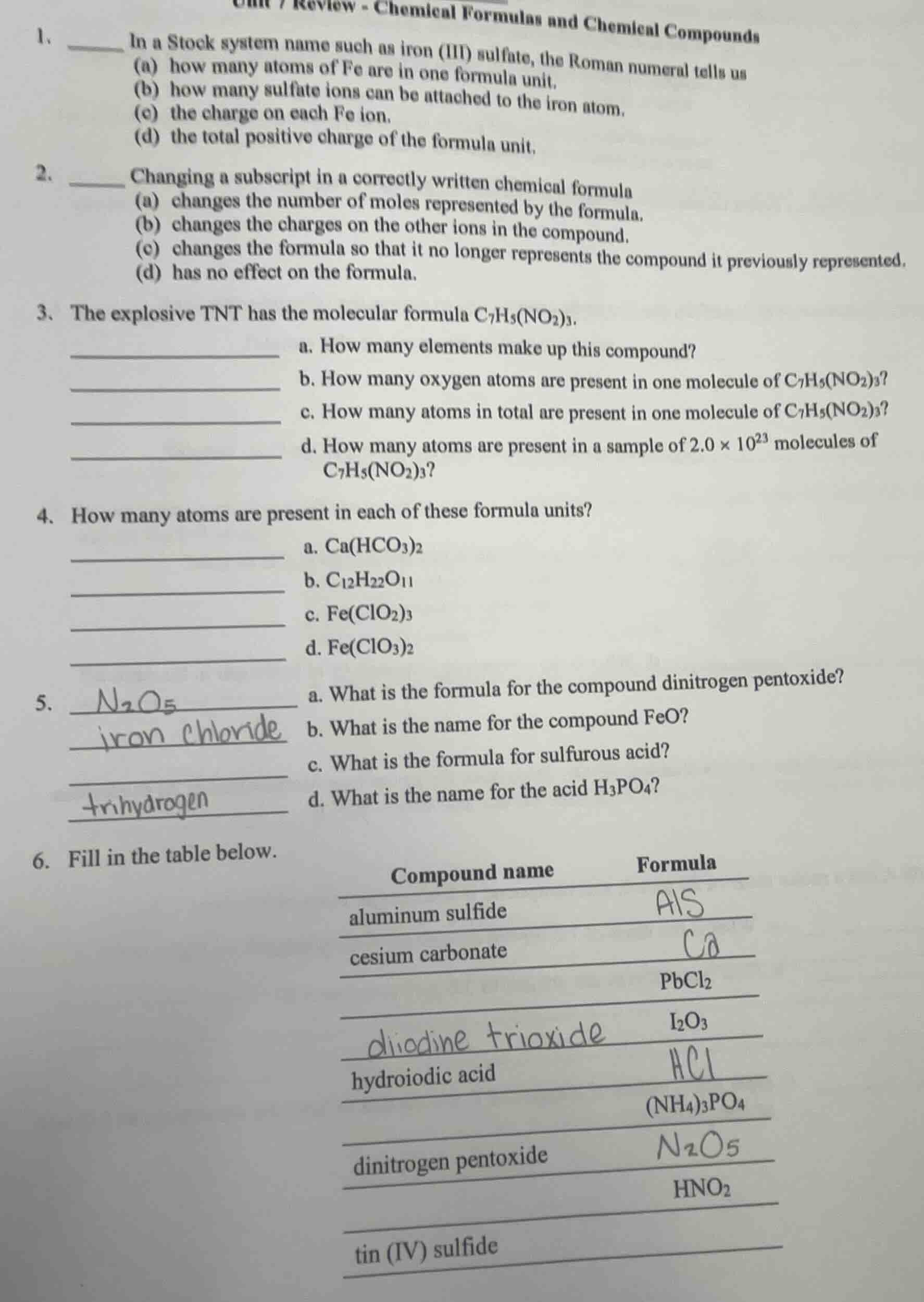
Question
unit 7 review - chemical formulas and chemical compounds
- ____ in a stock system name such as iron (iii) sulfate, the roman numeral tells us
(a) how many atoms of fe are in one formula unit.
(b) how many sulfate ions can be attached to the iron atom.
(c) the charge on each fe ion.
(d) the total positive charge of the formula unit.
- ____ changing a subscript in a correctly written chemical formula
(a) changes the number of moles represented by the formula.
(b) changes the charges on the other ions in the compound.
(c) changes the formula so that it no longer represents the compound it previously represented.
(d) has no effect on the formula.
- the explosive tnt has the molecular formula c₇h₅(no₂)₃.
______ a. how many elements make up this compound?
______ b. how many oxygen atoms are present in one molecule of c₇h₅(no₂)₃?
______ c. how many atoms in total are present in one molecule of c₇h₅(no₂)₃?
______ d. how many atoms are present in a sample of 2.0 × 10²³ molecules of c₇h₅(no₂)₃?
- how many atoms are present in each of these formula units?
______ a. ca(hco₃)₂
______ b. c₁₂h₂₂o₁₁
______ c. fe(clo₂)₃
______ d. fe(clo₃)₂
- ______ a. what is the formula for the compound dinitrogen pentoxide?
______ b. what is the name for the compound feo?
______ c. what is the formula for sulfurous acid?
______ d. what is the name for the acid h₃po₄?
- fill in the table below.
| compound name | formula |
|---|---|
| cesium carbonate | |
| pbcl₂ | |
| i₂o₃ | |
| hydroiodic acid | |
| (nh₄)₃po₄ | |
| dinitrogen pentoxide | |
| hno₂ | |
| tin (iv) sulfide |
Step1: Solve Q1 (Stock system)
The Roman numeral in Stock system denotes the charge of the cation.
Step2: Solve Q2 (Chemical formula subscripts)
Subscripts define the compound's identity; changing them makes it a different compound.
Step3: Solve Q3a (TNT elements)
Identify unique elements in $\text{C}_7\text{H}_5(\text{NO}_2)_3$: C, H, N, O.
Step4: Solve Q3b (TNT oxygen atoms)
Calculate O atoms: $3 \times 2 = 6$.
Step5: Solve Q3c (Total TNT atoms)
Sum all atoms: $7 + 5 + 3 + 6 = 21$.
Step6: Solve Q3d (Atoms in TNT sample)
Multiply per-molecule atoms by number of molecules: $21 \times 2.0 \times 10^{23} = 4.2 \times 10^{24}$.
Step7: Solve Q4a (Total atoms in $\text{Ca(HCO}_3\text{)}_2$)
Calculate: $1 + 2\times(1+1+3) = 11$.
Step8: Solve Q4b (Total atoms in $\text{C}_{12}\text{H}_{22}\text{O}_{11}$)
Calculate: $12 + 22 + 11 = 45$.
Step9: Solve Q4c (Total atoms in $\text{Fe(ClO}_2\text{)}_3$)
Calculate: $1 + 3\times(1+2) = 10$.
Step10: Solve Q4d (Total atoms in $\text{Fe(ClO}_3\text{)}_2$)
Calculate: $1 + 2\times(1+3) = 9$.
Step11: Solve Q5a (Dinitrogen pentoxide formula)
Use prefixes: 2 N, 5 O → $\text{N}_2\text{O}_5$.
Step12: Solve Q5b (Name for $\text{FeO}$)
Fe has +2 charge → iron(II) oxide.
Step13: Solve Q5c (Sulfurous acid formula)
Sulfurous acid uses sulfite ion: $\text{H}_2\text{SO}_3$.
Step14: Solve Q5d (Name for $\text{H}_3\text{PO}_4$)
This is phosphoric acid (ternary acid naming).
Step15: Fill Q6 table (Compound names/formulas)
Use ionic charge balancing and naming rules for each entry.

Snap & solve any problem in the app
Get step-by-step solutions on Sovi AI
Photo-based solutions with guided steps
Explore more problems and detailed explanations
- (c) the charge on each Fe ion.
- (c) changes the formula so that it no longer represents the compound it previously represented.
3.
a. 4
b. 6
c. 21
d. $4.2 \times 10^{24}$
4.
a. 11
b. 45
c. 10
d. 9
5.
a. $\text{N}_2\text{O}_5$
b. iron(II) oxide
c. $\text{H}_2\text{SO}_3$
d. phosphoric acid
6.
| Compound name | Formula |
|---|---|
| cesium carbonate | $\text{Cs}_2\text{CO}_3$ |
| lead(II) chloride | $\text{PbCl}_2$ |
| diiodine trioxide | $\text{I}_2\text{O}_3$ |
| hydroiodic acid | $\text{HI}$ |
| ammonium phosphate | $(\text{NH}_4)_3\text{PO}_4$ |
| dinitrogen pentoxide | $\text{N}_2\text{O}_5$ |
| nitrous acid | $\text{HNO}_2$ |
| tin(IV) sulfide | $\text{SnS}_2$ |