QUESTION IMAGE
Question
unit 5 review
score: 30.5/71 answered: 7/18
question 8
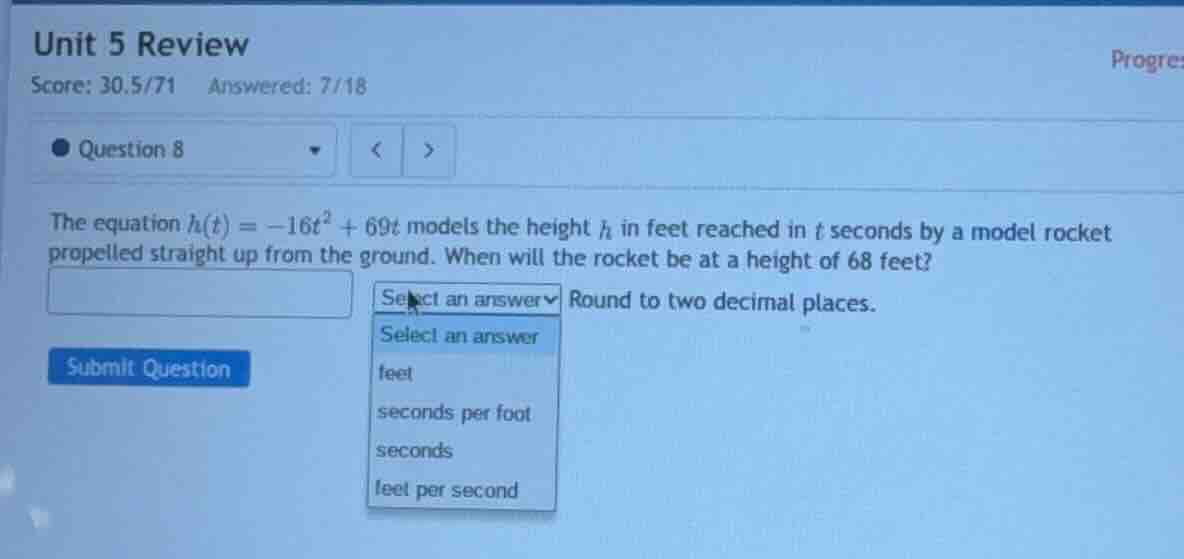
the equation ( h(t) = -16t^2 + 69t ) models the height ( h ) in feet reached in ( t ) seconds by a model rocket propelled straight up from the ground. when will the rocket be at a height of 68 feet?
round to two decimal places.
select an answer
feet
seconds per foot
seconds
feet per second
Step1: Set up the equation
We know that \( h(t) = 68 \), so substitute into the given equation:
\( 68=-16t^{2}+69t \)
Rearrange it to standard quadratic form \( ax^{2}+bx + c = 0 \):
\( 16t^{2}-69t + 68 = 0 \)
Here, \( a = 16 \), \( b=-69 \), \( c = 68 \)
Step2: Use the quadratic formula
The quadratic formula is \( t=\frac{-b\pm\sqrt{b^{2}-4ac}}{2a} \)
First, calculate the discriminant \( D=b^{2}-4ac \)
\( D=(-69)^{2}-4\times16\times68 \)
\( D = 4761-4352 \)
\( D = 409 \)
Then, find \( t \):
\( t=\frac{69\pm\sqrt{409}}{32} \)
Calculate the two solutions:
For the plus sign:
\( t_1=\frac{69 + \sqrt{409}}{32}\approx\frac{69+20.2237}{32}=\frac{89.2237}{32}\approx2.79 \)
For the minus sign:
\( t_2=\frac{69-\sqrt{409}}{32}\approx\frac{69 - 20.2237}{32}=\frac{48.7763}{32}\approx1.52 \)

Snap & solve any problem in the app
Get step-by-step solutions on Sovi AI
Photo-based solutions with guided steps
Explore more problems and detailed explanations
The rocket will be at a height of 68 feet at approximately \( t \approx 1.52 \) seconds and \( t \approx 2.79 \) seconds. (If we consider the context, both times are valid as the rocket goes up and then comes down. But if we need to present the answers as per the calculation, they are approximately 1.52 seconds and 2.79 seconds.)