QUESTION IMAGE
Question
5 unit test
- read each question carefully. write your response in the space provided for each part of each question. answers must be written out in paragraph form. outlines, bulleted lists, or diagrams alone are not acceptable and will not be scored.
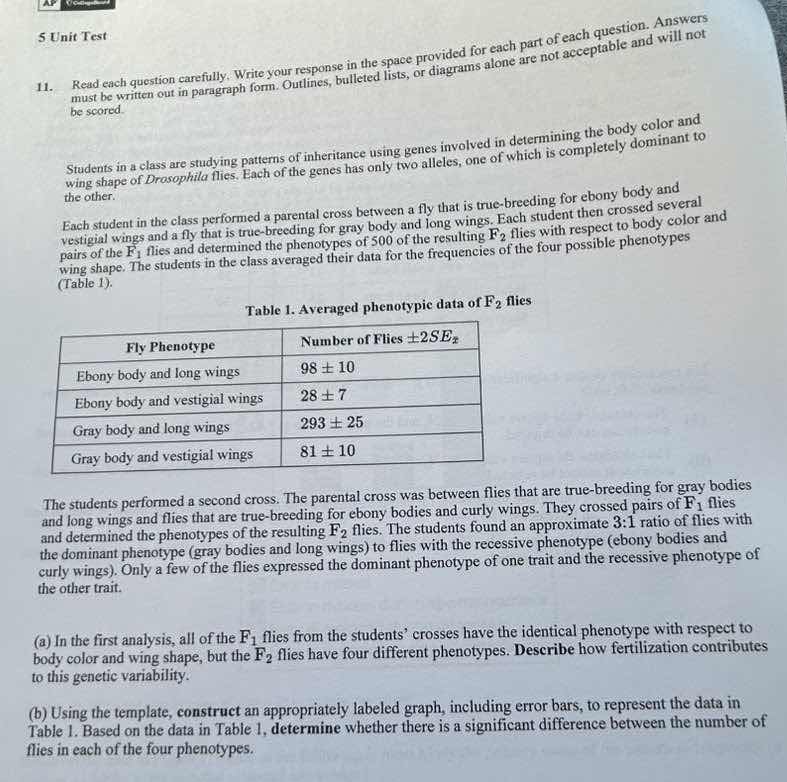
students in a class are studying patterns of inheritance using genes involved in determining the body color and wing shape of drosophila flies. each of the genes has only two alleles, one of which is completely dominant to the other.
each student in the class performed a parental cross between a fly that is true - breeding for ebony body and vestigial wings and a fly that is true - breeding for gray body and long wings. each student then crossed several pairs of f₁ flies and determined the phenotypes of 500 of the resulting f₂ flies with respect to body color and wing shape. the students in the class averaged their data for the frequencies of the four possible phenotypes (table 1).
table 1. averaged phenotypic data of f₂ flies
| fly phenotype | number of flies ± 2seₓ |
|---|---|
| ebony body and vestigial wings | 28 ± 7 |
| gray body and long wings | 293 ± 25 |
| gray body and vestigial wings | 81 ± 10 |
the students performed a second cross. the parental cross was between flies that are true - breeding for gray bodies and long wings and flies that are true - breeding for ebony bodies and curly wings. they crossed pairs of f₁ flies and determined the phenotypes of the resulting f₂ flies. the students found an approximate 3:1 ratio of flies with the dominant phenotype (gray bodies and long wings) to flies with the recessive phenotype (ebony bodies and curly wings). only a few of the flies expressed the dominant phenotype of one trait and the recessive phenotype of the other trait.
(a) in the first analysis, all of the f₁ flies from the students’ crosses have the identical phenotype with respect to body color and wing shape, but the f₂ flies have four different phenotypes. describe how fertilization contributes to this genetic variability.
(b) using the template, construct an appropriately labeled graph, including error bars, to represent the data in table 1. based on the data in table 1, determine whether there is a significant difference between the number of flies in each of the four phenotypes.
Part (a)
Fertilization contributes to genetic variability in two key ways. First, during meiosis, homologous chromosomes undergo independent assortment, meaning the alleles for body color and wing shape are randomly distributed into gametes. When gametes from F₁ parents (which are heterozygous for both traits) fuse during fertilization, the random combination of these genetically distinct gametes creates new combinations of alleles in the F₂ offspring. Second, random fertilization means any male gamete can fuse with any female gamete, leading to a wide range of genotypic (and thus phenotypic) combinations beyond the parental types, resulting in the four different phenotypes observed in the F₂ generation.
Step1: Identify graph parameters
Independent variable: Fly Phenotype (4 categories: Ebony body/long wings, Ebony body/vestigial wings, Gray body/long wings, Gray body/vestigial wings)
Dependent variable: Number of Flies (with ±2SEₑ error bars)
Step2: Calculate phenotype totals
- Ebony body, long wings: $98 \pm 10$
- Ebony body, vestigial wings: $28 \pm 7$
- Gray body, long wings: $293 \pm 25$
- Gray body, vestigial wings: $81 \pm 10$
Step3: Evaluate significant differences
Compare the range of each phenotype (mean ± 2SEₑ):
- Ebony long: $88$ to $108$
- Ebony vestigial: $21$ to $35$
- Gray long: $268$ to $318$
- Gray vestigial: $71$ to $91$
No overlapping ranges exist between any of the four phenotype groups.

Snap & solve any problem in the app
Get step-by-step solutions on Sovi AI
Photo-based solutions with guided steps
Explore more problems and detailed explanations
Fertilization introduces genetic variability for the F₂ phenotypes through two main mechanisms: 1) Random fusion of genetically diverse gametes: F₁ parents are heterozygous for both traits, so their gametes carry different allele combinations for body color and wing shape. The random union of these gametes during fertilization creates new genotypic and phenotypic combinations. 2) Independent assortment-driven gamete diversity: During meiosis in F₁ flies, alleles for the two traits assort independently into gametes, producing four unique gamete types. Fertilization combines these gametes randomly, resulting in the four distinct F₂ phenotypes by generating novel allele combinations not seen in the parental or F₁ generations.
---