QUESTION IMAGE
Question
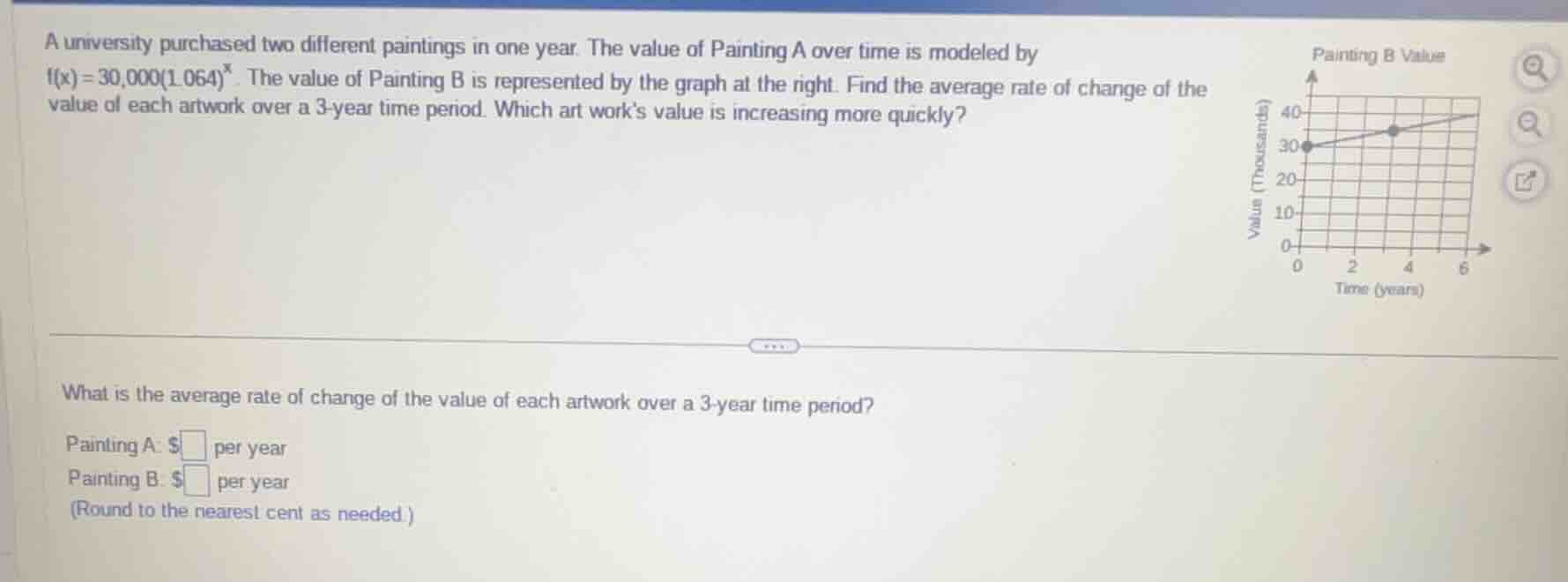
a university purchased two different paintings in one year. the value of painting a over time is modeled by $f(x)=30,000(1.064)^x$. the value of painting b is represented by the graph at the right. find the average rate of change of the value of each artwork over a 3-year time period. which art works value is increasing more quickly?
what is the average rate of change of the value of each artwork over a 3-year time period?
painting a: $\square$ per year
painting b: $\square$ per year
(round to the nearest cent as needed )
Step1: Define average rate of change formula
The average rate of change over $[a,b]$ is $\frac{f(b)-f(a)}{b-a}$.
Step2: Calculate Painting A's values
At $x=0$: $f(0)=30,000(1.064)^0 = 30,000$
At $x=3$: $f(3)=30,000(1.064)^3 \approx 30,000 \times 1.20275 = 36,082.50$
Step3: Compute Painting A's rate
$\frac{36,082.50 - 30,000}{3-0} = \frac{6,082.50}{3} = 2,027.50$
Step4: Extract Painting B's values
From the graph: At $x=0$, value = $30,000$; at $x=3$, value = $33,000$
Step5: Compute Painting B's rate
$\frac{33,000 - 30,000}{3-0} = \frac{3,000}{3} = 1,000$
Step6: Compare the two rates
$2,027.50 > 1,000$, so Painting A increases faster.

Snap & solve any problem in the app
Get step-by-step solutions on Sovi AI
Photo-based solutions with guided steps
Explore more problems and detailed explanations
Painting A: $\$2027.50$ per year
Painting B: $\$1000.00$ per year
Painting A's value is increasing more quickly.