QUESTION IMAGE
Question
until there can be as many as 10,000 times more electrons in the bottom of the cloud compared to the top.
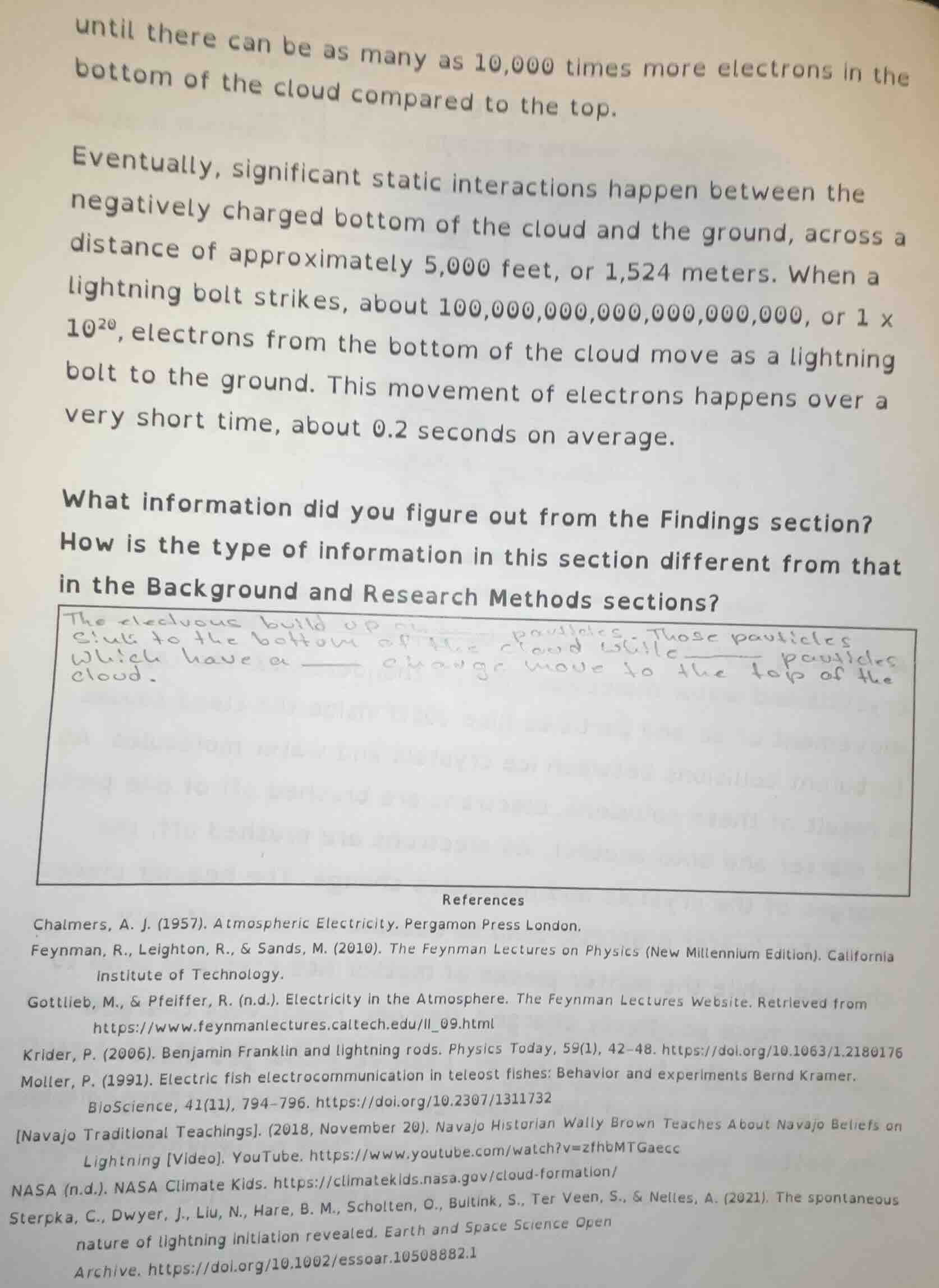
eventually, significant static interactions happen between the negatively charged bottom of the cloud and the ground, across a distance of approximately 5,000 feet, or 1,524 meters. when a lightning bolt strikes, about 100,000,000,000,000,000,000, or (1 \times 10^{20}), electrons from the bottom of the cloud move as a lightning bolt to the ground. this movement of electrons happens over a very short time, about 0.2 seconds on average.
what information did you figure out from the findings section? how is the type of information in this section different from that in the background and research methods sections?
the electrons build up on particles. those particles clutc to the bottom of the cloud while __ particles which have a __ charge move to the top of the cloud.
references
chalmers, a. j. (1957). atmospheric electricity. pergamon press london.
feynman, r., leighton, r., & sands, m. (2010). the feynman lectures on physics (new millennium edition). california institute of technology.
gottlieb, m., & pfeiffer, r. (n.d.). electricity in the atmosphere. the feynman lectures website. retrieved from https://www.feynmanlectures.caltech.edu/ii_09.html
krider, p. (2006). benjamin franklin and lightning rods. physics today, 59(1), 42–48. https://doi.org/10.1063/1.2180176
moller, p. (1991). electric fish electrocommunication in teleost fishes: behavior and experiments bernd kramer. bioscience, 41(11), 794–796. https://doi.org/10.2307/1311732
navajo traditional teachings. (2018, november 20). navajo historian wally brown teaches about navajo beliefs on lightning video. youtube. https://www.youtube.com/watch?v=zthbmtgaec
nasa (n.d.). nasa climate kids. https://climatekids.nasa.gov/cloud-formation/
sterpka, c., dwyer, j., liu, n., hare, b. m., scholten, o., bultink, s., ter veen, s., & nelles, a. (2021). the spontaneous nature of lightning initiation revealed. earth and space science open archive. https://doi.org/10.1002/essoar.10508882.1

Snap & solve any problem in the app
Get step-by-step solutions on Sovi AI
Photo-based solutions with guided steps
Explore more problems and detailed explanations
The Findings section provides quantitative data and specific observations about lightning, such as the number of electrons ($1 \times 10^{20}$), the distance of the strike (5,000 feet), and the duration (0.2 seconds).
The Findings section presents specific results and data from the study, whereas the Background provides general context/theory and Research Methods describe the procedures used to collect data.