QUESTION IMAGE
Question
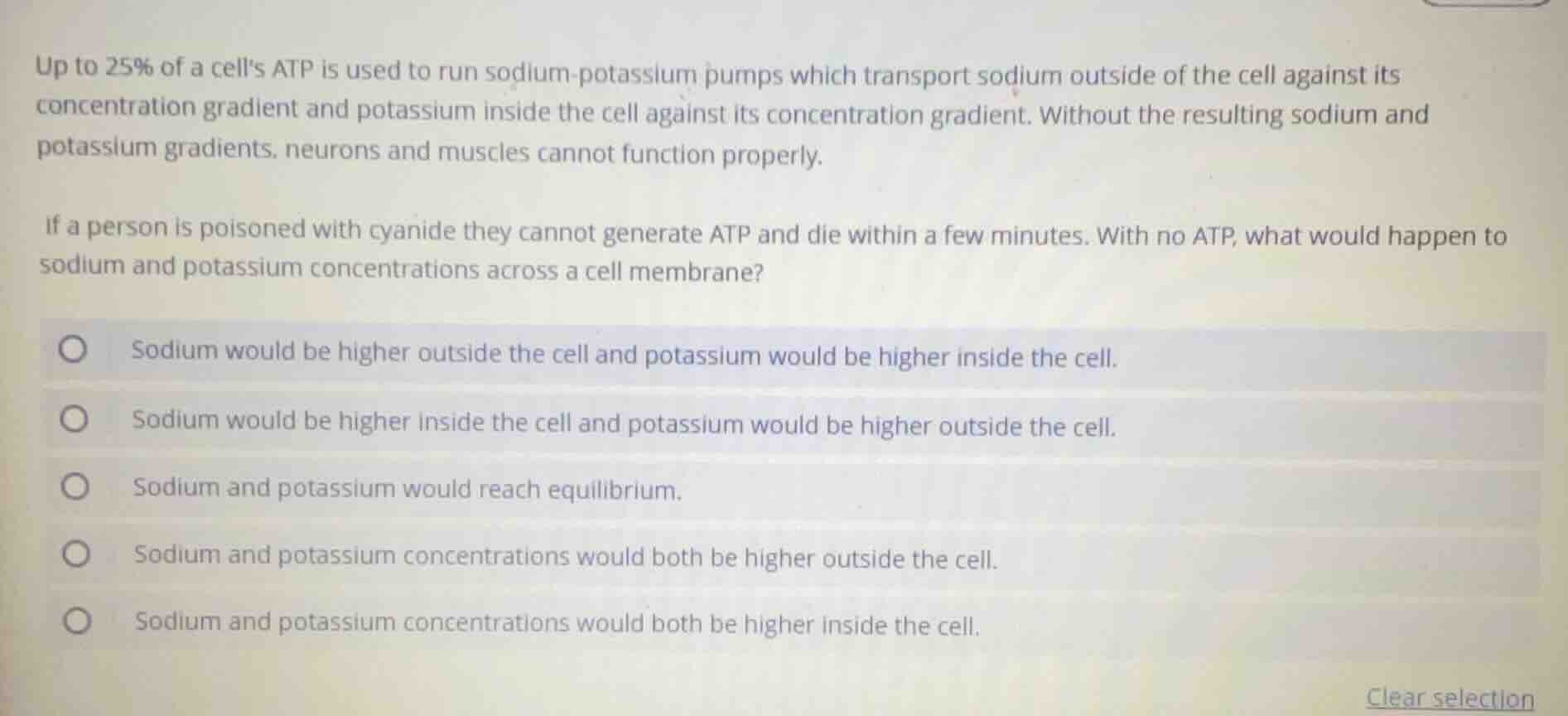
up to 25% of a cells atp is used to run sodium - potassium pumps which transport sodium outside of the cell against its concentration gradient and potassium inside the cell against its concentration gradient. without the resulting sodium and potassium gradients, neurons and muscles cannot function properly. if a person is poisoned with cyanide they cannot generate atp and die within a few minutes. with no atp, what would happen to sodium and potassium concentrations across a cell membrane?
- sodium would be higher outside the cell and potassium would be higher inside the cell.
- sodium would be higher inside the cell and potassium would be higher outside the cell.
- sodium and potassium would reach equilibrium.
- sodium and potassium concentrations would both be higher outside the cell.
- sodium and potassium concentrations would both be higher inside the cell.
The sodium - potassium pump requires ATP to transport sodium out of the cell and potassium into the cell against their concentration gradients. When there is no ATP (as in cyanide poisoning), the active transport of sodium and potassium stops. Passive transport (like diffusion) will then act to make the concentrations of sodium and potassium equalize across the cell membrane, as there is no energy - dependent process to maintain the concentration gradients.

Snap & solve any problem in the app
Get step-by-step solutions on Sovi AI
Photo-based solutions with guided steps
Explore more problems and detailed explanations
Sodium and potassium would reach equilibrium.