QUESTION IMAGE
Question
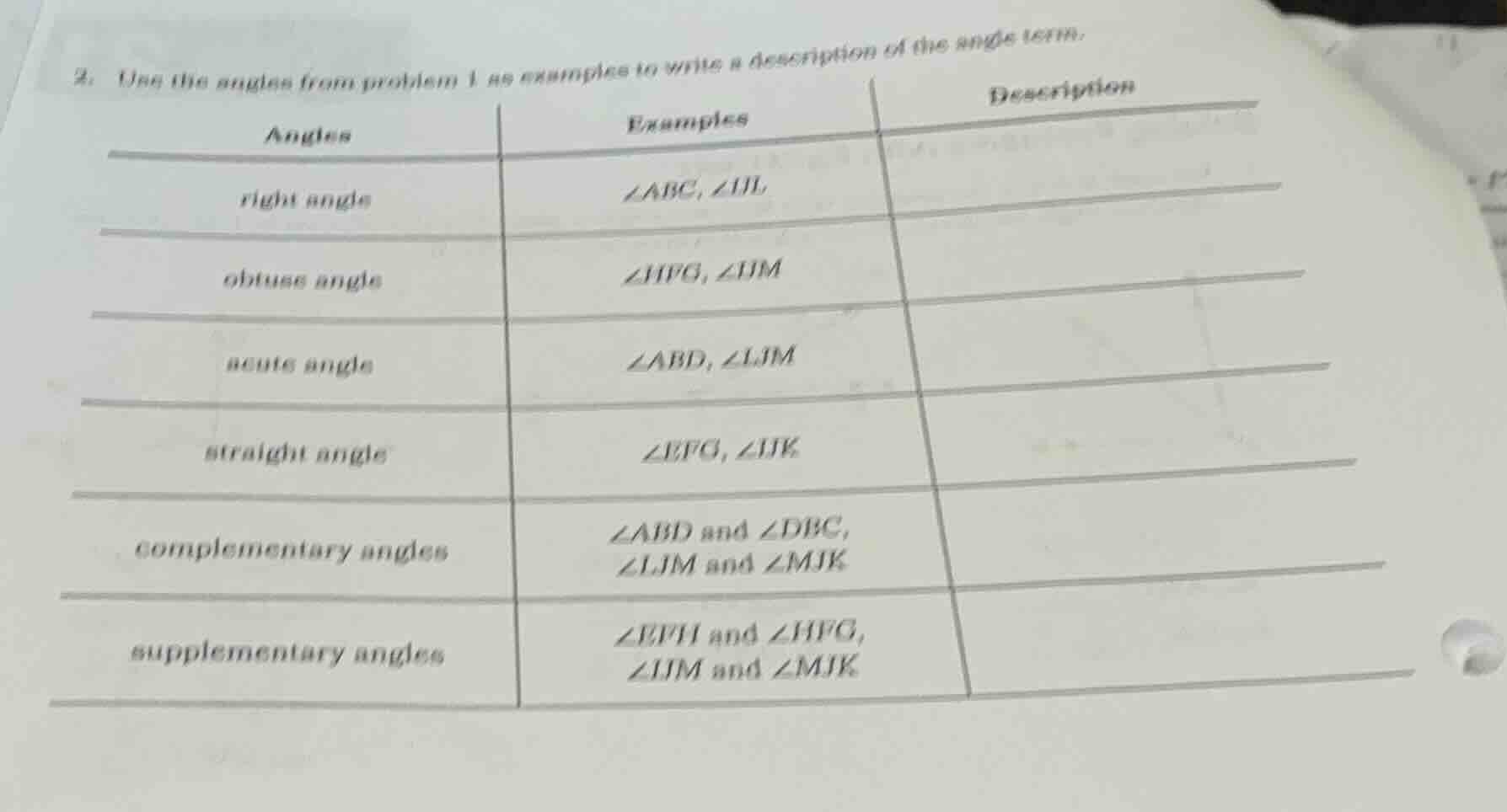
- use the angles from problem 1 as examples to write a description of the angle term.
angles | examples | description
--- | --- | ---
right angle | $\angle abc$, $\angle ijl$ |
obtuse angle | $\angle hfg$, $\angle ijm$ |
acute angle | $\angle abd$, $\angle ljm$ |
straight angle | $\angle efg$, $\angle ijk$ |
complementary angles | $\angle abd$ and $\angle dbc$, $\angle ljm$ and $\angle mjk$ |
supplementary angles | $\angle efh$ and $\angle hfg$, $\angle ijm$ and $\angle mjk$ |
Brief Explanations
Each description is based on the standard geometric definition of the angle type, aligned with the given examples.

Snap & solve any problem in the app
Get step-by-step solutions on Sovi AI
Photo-based solutions with guided steps
Explore more problems and detailed explanations
| Angles | Examples | Description |
|---|---|---|
| obtuse angle | $\angle HFG, \angle IJM$ | An angle greater than $90^\circ$ but less than $180^\circ$ |
| acute angle | $\angle ABD, \angle LJM$ | An angle less than $90^\circ$ |
| straight angle | $\angle EFG, \angle IJK$ | An angle equal to $180^\circ$, forming a straight line |
| complementary angles | $\angle ABD$ and $\angle DBC$, $\angle LJM$ and $\angle MJK$ | A pair of angles whose sum equals $90^\circ$ |
| supplementary angles | $\angle EFH$ and $\angle HFG$, $\angle IJM$ and $\angle MJK$ | A pair of angles whose sum equals $180^\circ$ |