QUESTION IMAGE
Question
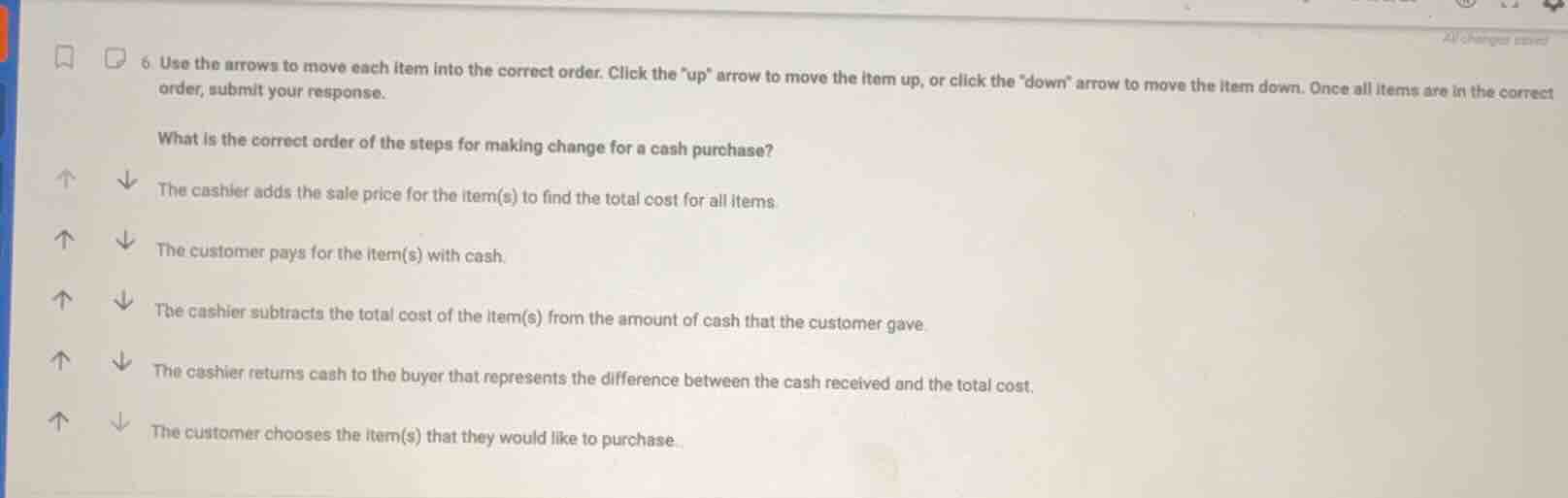
- use the arrows to move each item into the correct order. click the up arrow to move the item up, or click the down arrow to move the item down. once all items are in the correct order, submit your response.
what is the correct order of the steps for making change for a cash purchase?
the cashier adds the sale price for the item(s) to find the total cost for all items.
the customer pays for the item(s) with cash.
the cashier subtracts the total cost of the item(s) from the amount of cash that the customer gave
the cashier returns cash to the buyer that represents the difference between the cash received and the total cost.
the customer chooses the item(s) that they would like to purchase.
To determine the correct order of steps for making change for a cash purchase, we analyze the logical flow of the process:
- The customer chooses the item(s) that they would like to purchase: This is the first step, as the transaction begins with the customer selecting what they want to buy.
- The cashier adds the sale price for the item(s) to find the total cost for all items: After selection, the cashier calculates the total cost of the chosen items.
- The customer pays for the item(s) with cash: Once the total is known, the customer provides cash as payment.
- The cashier subtracts the total cost of the item(s) from the amount of cash that the customer gave: The cashier then calculates the change by subtracting the total cost from the cash received.
- The cashier returns cash to the buyer that represents the difference between the cash received and the total cost: Finally, the cashier gives the calculated change back to the customer.
The correct order (from top to bottom after arranging) is:
- The customer chooses the item(s) that they would like to purchase.
- The cashier adds the sale price for the item(s) to find the total cost for all items.
- The customer pays for the item(s) with cash.
- The cashier subtracts the total cost of the item(s) from the amount of cash that the customer gave.
- The cashier returns cash to the buyer that represents the difference between the cash received and the total cost.

Snap & solve any problem in the app
Get step-by-step solutions on Sovi AI
Photo-based solutions with guided steps
Explore more problems and detailed explanations
To determine the correct order of steps for making change for a cash purchase, we analyze the logical flow of the process:
- The customer chooses the item(s) that they would like to purchase: This is the first step, as the transaction begins with the customer selecting what they want to buy.
- The cashier adds the sale price for the item(s) to find the total cost for all items: After selection, the cashier calculates the total cost of the chosen items.
- The customer pays for the item(s) with cash: Once the total is known, the customer provides cash as payment.
- The cashier subtracts the total cost of the item(s) from the amount of cash that the customer gave: The cashier then calculates the change by subtracting the total cost from the cash received.
- The cashier returns cash to the buyer that represents the difference between the cash received and the total cost: Finally, the cashier gives the calculated change back to the customer.
The correct order (from top to bottom after arranging) is:
- The customer chooses the item(s) that they would like to purchase.
- The cashier adds the sale price for the item(s) to find the total cost for all items.
- The customer pays for the item(s) with cash.
- The cashier subtracts the total cost of the item(s) from the amount of cash that the customer gave.
- The cashier returns cash to the buyer that represents the difference between the cash received and the total cost.