QUESTION IMAGE
Question
use the chemical equation below to answer the next four questions.
nacl(s) + f₂(g) → naf(s) + cl₂(g)
- what are the coefficients, in order, when reaction 8-3 is balanced?
a. 2, 3, 6, 1
b. 1, 2, 1, 1
c. 2, 3, 1, 1
d. 2, 1, 2, 1
- what kind of reaction is shown in reaction 8-3?
a. redox, single replacement
b. precipitation, combustion
c. redox, decomposition
d. precipitation, double replacement
- in reaction 8-3, table salt (nacl) is used. if 2.00 moles of table salt is used, how many particles of table salt is that?
a. 6.02 x 10²³ particles
b. 3.01 x 10²³ particles
c. 1.20 x 10²⁴ particles
d. 3.62 x 10²⁴ particles
- what is true about reaction 8-3?
a. nacl and f₂ are reactants
b. naf and cl₂ are reactants
c. the (g) in the chemical equation stands for grams
d. nacl, f₂, naf, and cl₂ are all products of the reaction
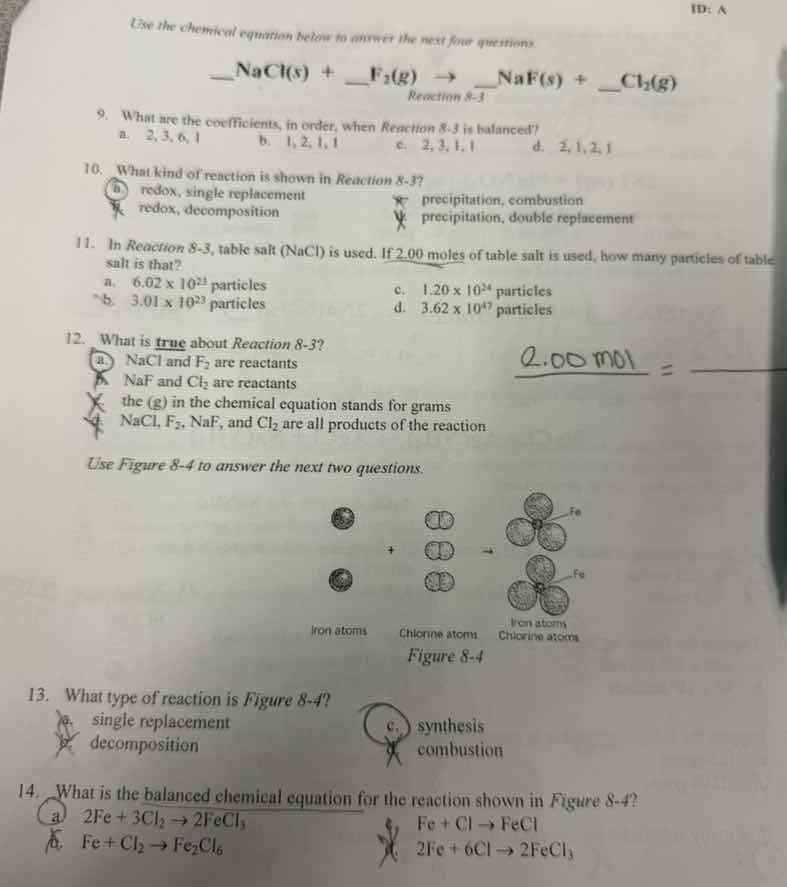
use figure 8-4 to answer the next two questions.
iron atoms, chlorine atoms, iron atoms and chlorine atoms diagram labeled figure 8-4
- what type of reaction is figure 8-4?
a. single replacement
b. decomposition
c. synthesis
d. combustion
- what is the balanced chemical equation for the reaction shown in figure 8-4?
a. 2fe + 3cl₂ → 2fecl₃
b. fe + cl₂ → fe₂cl₆
c. fe + cl → fecl
d. 2fe + 6cl → 2fecl₃
Question 9
Step1: Balance Na atoms
Add coefficient 2 to NaF: $\ce{NaCl(s) + F2(g) -> 2NaF(s) + Cl2(g)}$
Step2: Balance Cl atoms
Add coefficient 2 to NaCl: $\ce{2NaCl(s) + F2(g) -> 2NaF(s) + Cl2(g)}$
Step3: Verify all atoms
Na: 2=2; Cl:2=2; F:2=2. Equation balanced.
Fluorine replaces chlorine in NaCl, so it is a single replacement reaction. Oxidation states change (Cl: -1→0, F: 0→-1), so it is also redox.
Step1: Recall Avogadro's number
1 mole = $6.02 \times 10^{23}$ particles
Step2: Calculate total particles
Particles = $2.00\ \text{mol} \times 6.02 \times 10^{23}\ \text{particles/mol}$

Snap & solve any problem in the app
Get step-by-step solutions on Sovi AI
Photo-based solutions with guided steps
Explore more problems and detailed explanations
d. 2,1,2,1
---