QUESTION IMAGE
Question
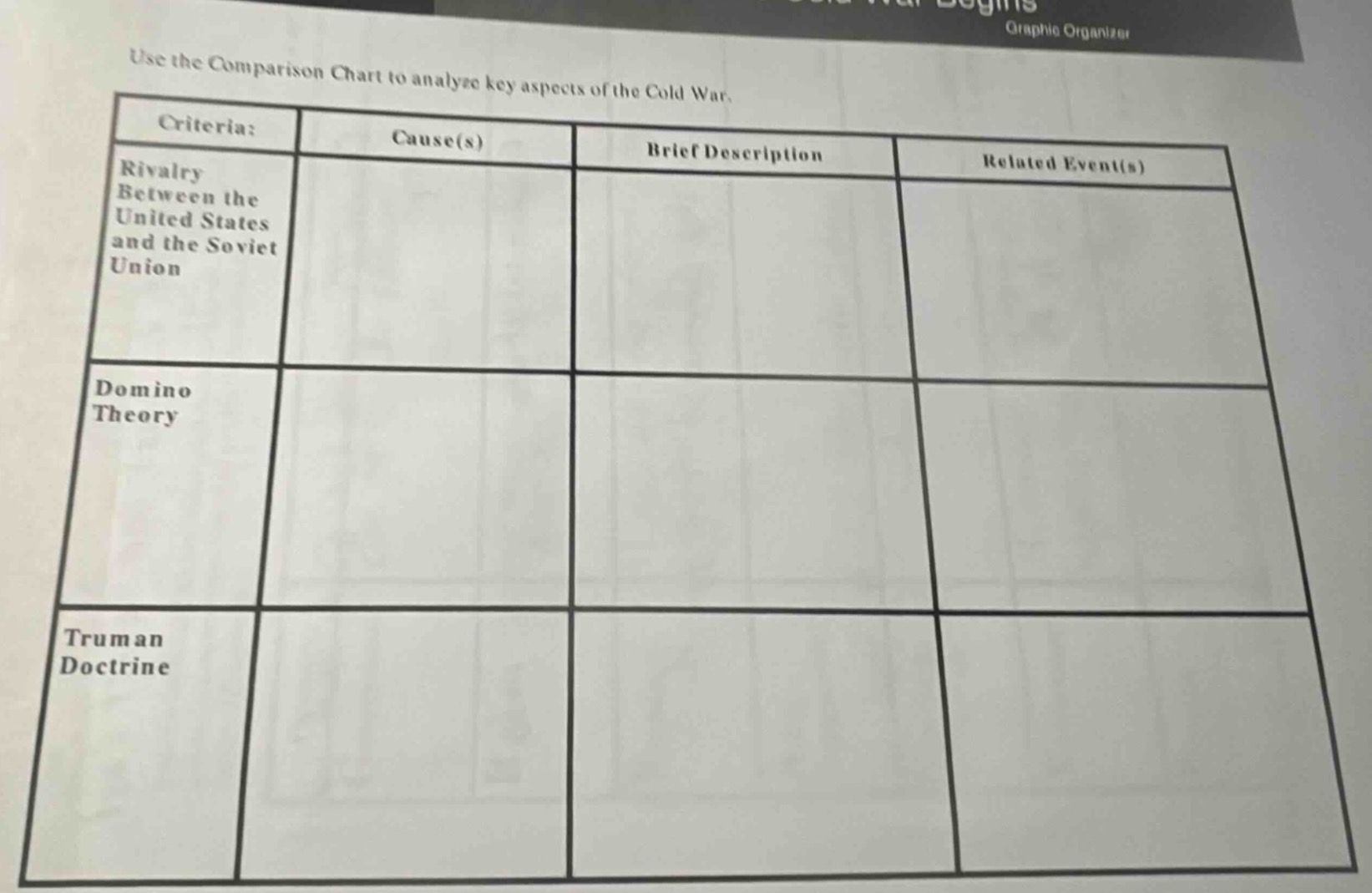
use the comparison chart to analyze key aspects of the cold war.
criteria: | cause(s) | brief description | related event(s)
rivalry between the united states and the soviet union | | |
domino theory | | |
truman doctrine | | |
Brief Explanations
- For the U.S.-Soviet rivalry: Rooted in clashing ideologies (capitalism vs. communism) and post-WWII power struggles for global influence. The rivalry was a state of political, military, and economic tension without direct armed conflict between the two superpowers.
- For the Domino Theory: A Cold War-era foreign policy concept driven by U.S. fear of communist expansion. It posited that if one country fell to communism, neighboring countries would follow in a chain reaction.
- For the Truman Doctrine: A response to growing communist influence in Greece and Turkey. It established U.S. policy to provide economic and military aid to nations threatened by communist takeovers, marking a formal start to U.S. containment policy.

Snap & solve any problem in the app
Get step-by-step solutions on Sovi AI
Photo-based solutions with guided steps
Explore more problems and detailed explanations
| Criteria: | Cause(s) | Brief Description | Related Event(s) |
|---|---|---|---|
| Domino Theory | U.S. fear of global communist expansion after WWII | The idea that if one country in a region fell to communism, adjacent countries would sequentially fall to communism, like a row of dominoes | U.S. involvement in the Vietnam War (1955-1975), U.S. intervention in the Korean War (1950-1953) |
| Truman Doctrine | Communist insurgencies in Greece and Soviet pressure on Turkey; U.S. desire to contain Soviet influence | U.S. foreign policy promising economic and military aid to democratic nations threatened by authoritarian forces (primarily communism) | U.S. aid to Greece and Turkey (1947), establishment of U.S. containment policy framework |