QUESTION IMAGE
Question
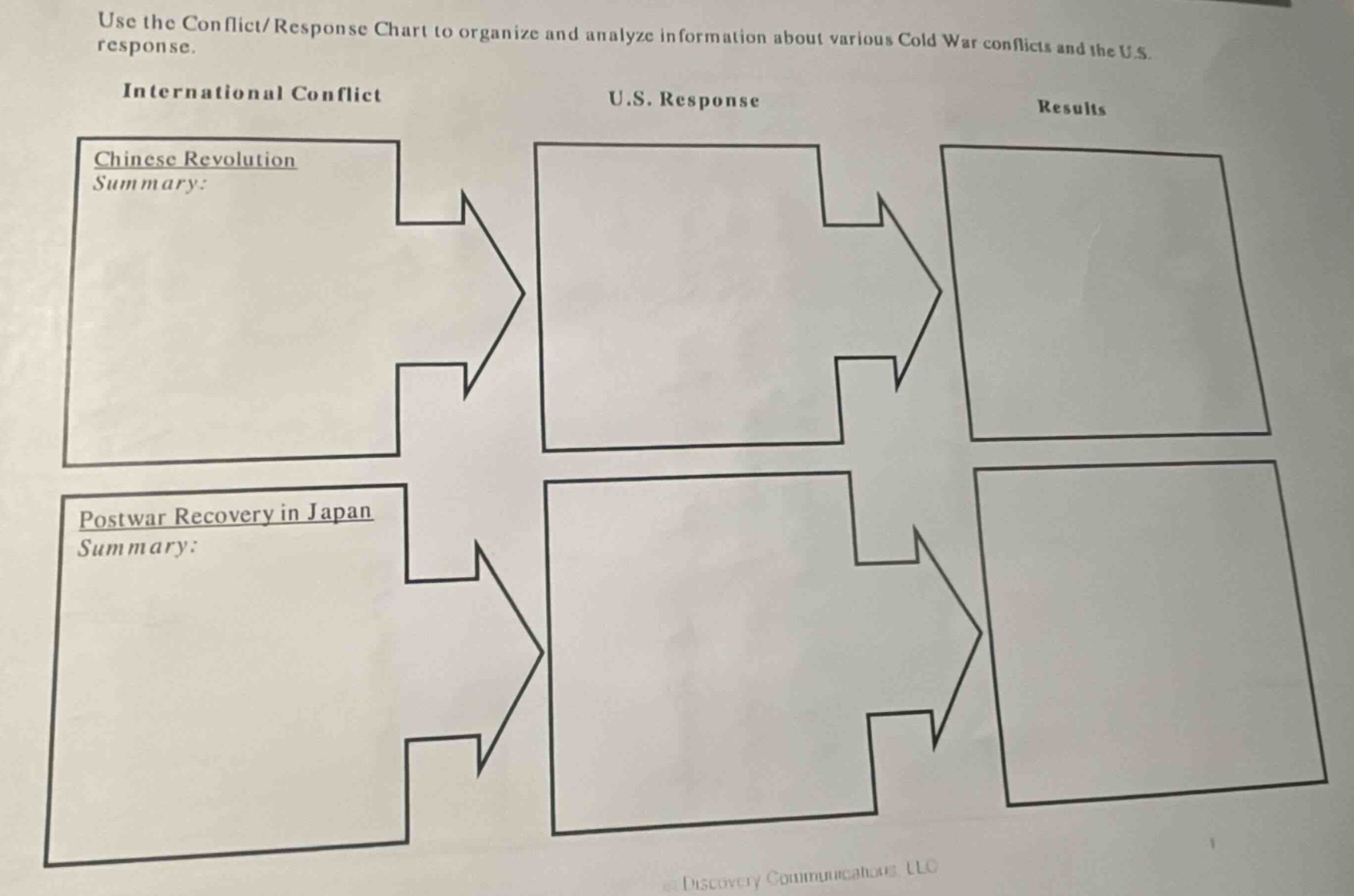
use the conflict/response chart to organize and analyze information about various cold war conflicts and the u.s. response.
international conflict\tu.s. response\tresults
chinese revolution
summary:
\t\t
postwar recovery in japan
summary:
\t\t
Brief Explanations
For the Chinese Revolution:
- International Conflict Summary: The Chinese Revolution (1945-1949) was a civil war between the U.S.-backed Nationalist Party (Kuomintang) and the Communist Party led by Mao Zedong, ending with a Communist victory and the establishment of the People's Republic of China.
- U.S. Response: The U.S. provided military aid and funding to the Nationalist government, refused to recognize the new Communist government, and later supported the Nationalist-held Taiwan as the legitimate Chinese government.
- Results: The People's Republic of China became a major Communist power in Asia, increasing Cold War tensions; the U.S. lost an ally in mainland China, and a long-standing rift developed between the U.S. and China until the 1970s.
For Postwar Recovery in Japan:
- International Conflict Summary: After Japan's 1945 surrender in WWII, the country was in ruins, facing political collapse, economic devastation, and the risk of instability that could create a power vacuum in Asia during the early Cold War.
- U.S. Response: The U.S. led an occupation (1945-1952) focused on democratizing Japan, drafting a new pacifist constitution, and providing economic aid to rebuild its infrastructure and economy through initiatives like the Dodge Plan.
- Results: Japan emerged as a stable, democratic, and economically prosperous U.S. ally in Asia, serving as a key bulwark against Communist expansion in the region and becoming a major global economic power.

Snap & solve any problem in the app
Get step-by-step solutions on Sovi AI
Photo-based solutions with guided steps
Explore more problems and detailed explanations
| International Conflict | U.S. Response | Results |
|---|---|---|
| Postwar Recovery in Japan<br>Summary: Post-WWII Japan was economically devastated, politically unstable, creating a Cold War power vacuum in Asia. | Led 1945-1952 occupation; implemented democratic reforms, drafted pacifist constitution; provided economic aid (e.g., Dodge Plan) for reconstruction. | Japan became a stable, democratic U.S. ally; grew into a global economic superpower; served as a key anti-Communist bulwark in Asia. |