QUESTION IMAGE
Question
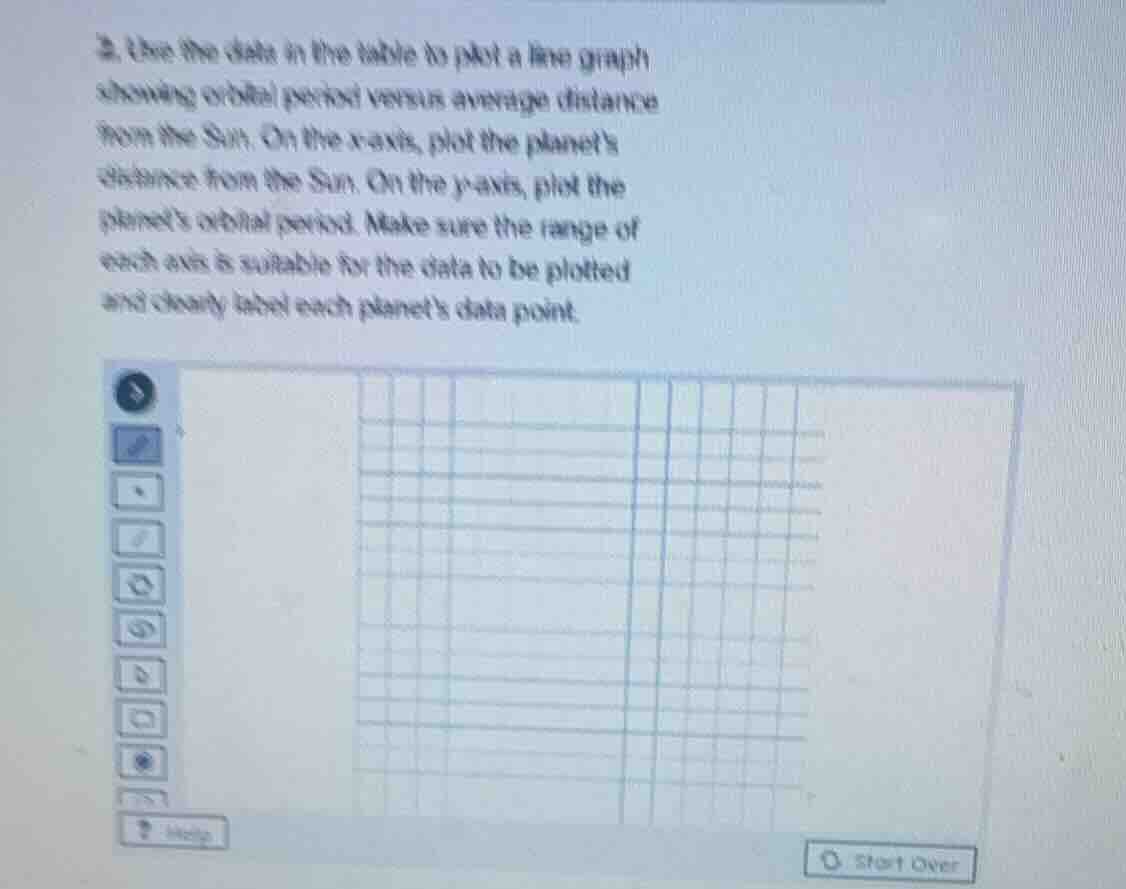
- use the data in the table to plot a line graph showing orbital period versus average distance from the sun. on the x - axis, plot the planets distance from the sun. on the y - axis, plot the planets orbital period. make sure the range of each axis is suitable for the data to be plotted and clearly label each planets data point.
To solve this problem of plotting a line graph for orbital period vs. average distance from the Sun, we follow these steps (assuming we have the table of data for planets' distance and orbital period, e.g., for our solar system planets like Mercury, Venus, Earth, Mars, Jupiter, etc.):
Step 1: Gather Data
First, we need the data for each planet's average distance from the Sun (let's say in astronomical units, AU) and its orbital period (in years or days, depending on the planet). For example:
- Mercury: Distance ≈ 0.39 AU, Orbital Period ≈ 0.24 years
- Venus: Distance ≈ 0.72 AU, Orbital Period ≈ 0.62 years
- Earth: Distance = 1 AU, Orbital Period = 1 year
- Mars: Distance ≈ 1.52 AU, Orbital Period ≈ 1.88 years
- Jupiter: Distance ≈ 5.20 AU, Orbital Period ≈ 11.86 years
- Saturn: Distance ≈ 9.54 AU, Orbital Period ≈ 29.46 years
- Uranus: Distance ≈ 19.22 AU, Orbital Period ≈ 84.01 years
- Neptune: Distance ≈ 30.06 AU, Orbital Period ≈ 164.8 years
Step 2: Set Up the Graph Axes
- X - axis (Distance from the Sun): Determine the range. The maximum distance for Neptune is ~30 AU, so we can set the x - axis from 0 to 35 AU (or a suitable range that covers all planet distances). Label the x - axis as "Average Distance from the Sun (in AU)".
- Y - axis (Orbital Period): The maximum orbital period for Neptune is ~165 years, so we can set the y - axis from 0 to 170 years (or adjust based on the data). Label the y - axis as "Orbital Period (in years)".
Step 3: Plot the Data Points
For each planet, find the corresponding x (distance) and y (orbital period) values on the graph. For example:
- For Mercury: Find x = 0.39 on the x - axis and y = 0.24 on the y - axis. Mark a point there and label it "Mercury".
- For Earth: Find x = 1 and y = 1. Mark the point and label it "Earth".
- Continue this process for all the planets in the data set.
Step 4: Draw the Line Graph
After plotting all the data points, connect them in the order of increasing distance from the Sun (since we are showing the relationship between distance and orbital period, a line graph will show the trend).
Step 5: Label the Graph
- Title the graph: "Orbital Period vs. Average Distance from the Sun for Solar System Planets"
- Ensure the x - axis and y - axis are clearly labeled with their units.
- Each data point is labeled with the planet's name.
Since the problem asks to plot the graph, the final answer is the completed line graph with correctly plotted data points, labeled axes, and labeled data points as per the steps above. If we were to describe the graph's appearance, we would see a curve (since the relationship between orbital period \( T \) and distance \( r \) follows Kepler's third law \( T^{2}\propto r^{3} \)) where as the distance from the Sun increases, the orbital period increases in a non - linear fashion.
(Note: If the data is in different units, like distance in kilometers and orbital period in days, we adjust the axes range accordingly. For example, for inner planets with orbital periods in days, the y - axis range would be from 0 to, say, 600 days, and x - axis from 0 to \( 2\times10^{8} \) km (for Mars' distance ~228 million km).)

Snap & solve any problem in the app
Get step-by-step solutions on Sovi AI
Photo-based solutions with guided steps
Explore more problems and detailed explanations
To solve this problem of plotting a line graph for orbital period vs. average distance from the Sun, we follow these steps (assuming we have the table of data for planets' distance and orbital period, e.g., for our solar system planets like Mercury, Venus, Earth, Mars, Jupiter, etc.):
Step 1: Gather Data
First, we need the data for each planet's average distance from the Sun (let's say in astronomical units, AU) and its orbital period (in years or days, depending on the planet). For example:
- Mercury: Distance ≈ 0.39 AU, Orbital Period ≈ 0.24 years
- Venus: Distance ≈ 0.72 AU, Orbital Period ≈ 0.62 years
- Earth: Distance = 1 AU, Orbital Period = 1 year
- Mars: Distance ≈ 1.52 AU, Orbital Period ≈ 1.88 years
- Jupiter: Distance ≈ 5.20 AU, Orbital Period ≈ 11.86 years
- Saturn: Distance ≈ 9.54 AU, Orbital Period ≈ 29.46 years
- Uranus: Distance ≈ 19.22 AU, Orbital Period ≈ 84.01 years
- Neptune: Distance ≈ 30.06 AU, Orbital Period ≈ 164.8 years
Step 2: Set Up the Graph Axes
- X - axis (Distance from the Sun): Determine the range. The maximum distance for Neptune is ~30 AU, so we can set the x - axis from 0 to 35 AU (or a suitable range that covers all planet distances). Label the x - axis as "Average Distance from the Sun (in AU)".
- Y - axis (Orbital Period): The maximum orbital period for Neptune is ~165 years, so we can set the y - axis from 0 to 170 years (or adjust based on the data). Label the y - axis as "Orbital Period (in years)".
Step 3: Plot the Data Points
For each planet, find the corresponding x (distance) and y (orbital period) values on the graph. For example:
- For Mercury: Find x = 0.39 on the x - axis and y = 0.24 on the y - axis. Mark a point there and label it "Mercury".
- For Earth: Find x = 1 and y = 1. Mark the point and label it "Earth".
- Continue this process for all the planets in the data set.
Step 4: Draw the Line Graph
After plotting all the data points, connect them in the order of increasing distance from the Sun (since we are showing the relationship between distance and orbital period, a line graph will show the trend).
Step 5: Label the Graph
- Title the graph: "Orbital Period vs. Average Distance from the Sun for Solar System Planets"
- Ensure the x - axis and y - axis are clearly labeled with their units.
- Each data point is labeled with the planet's name.
Since the problem asks to plot the graph, the final answer is the completed line graph with correctly plotted data points, labeled axes, and labeled data points as per the steps above. If we were to describe the graph's appearance, we would see a curve (since the relationship between orbital period \( T \) and distance \( r \) follows Kepler's third law \( T^{2}\propto r^{3} \)) where as the distance from the Sun increases, the orbital period increases in a non - linear fashion.
(Note: If the data is in different units, like distance in kilometers and orbital period in days, we adjust the axes range accordingly. For example, for inner planets with orbital periods in days, the y - axis range would be from 0 to, say, 600 days, and x - axis from 0 to \( 2\times10^{8} \) km (for Mars' distance ~228 million km).)