QUESTION IMAGE
Question
use the drawing tool to form the correct answers on the provided graph.
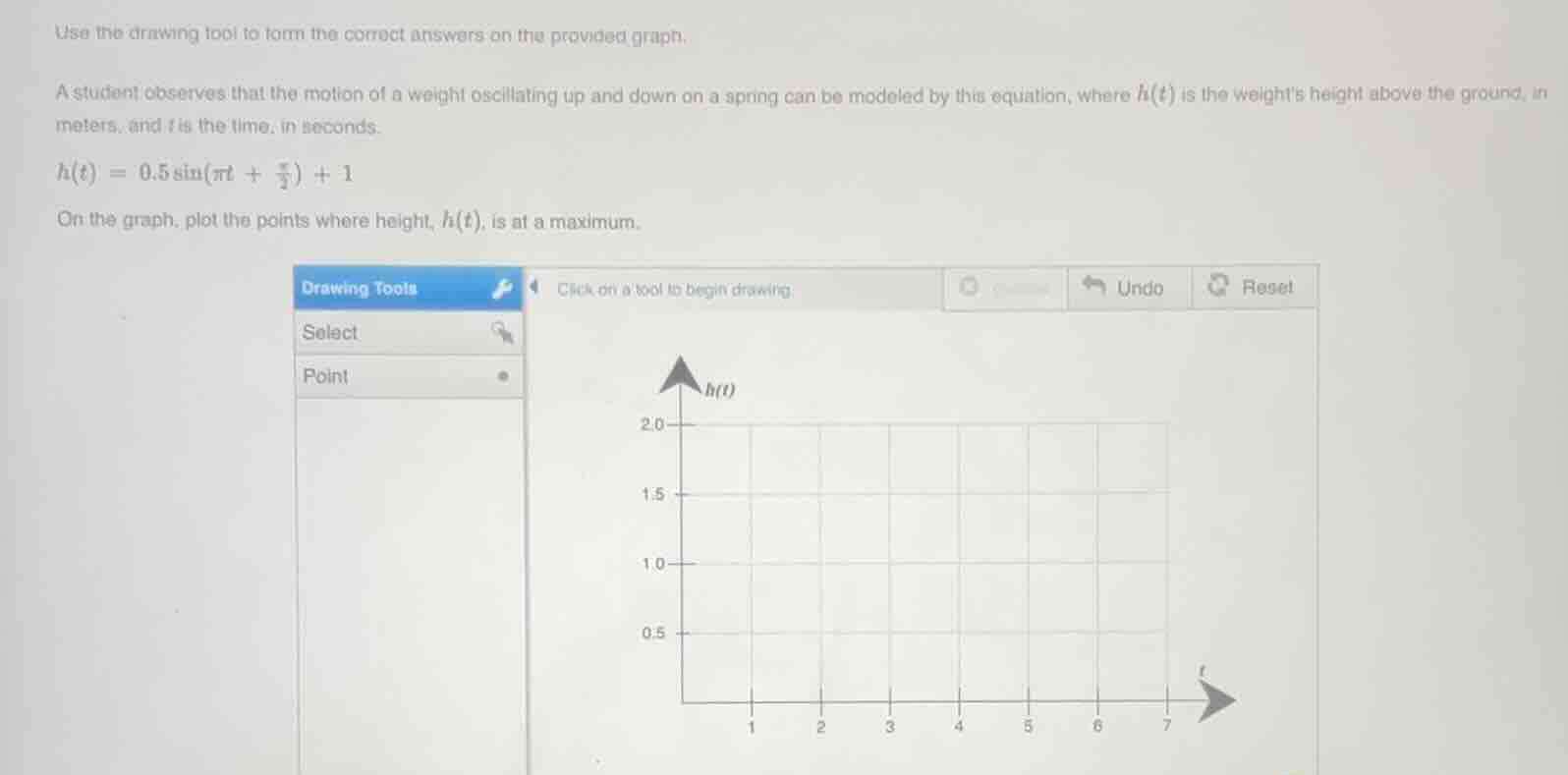
a student observes that the motion of a weight oscillating up and down on a spring can be modeled by this equation, where ( h(t) ) is the weight’s height above the ground, in meters, and ( t ) is the time, in seconds.
( h(t) = 0.5sin(pi t + \frac{pi}{2}) + 1 )
on the graph, plot the points where height, ( h(t) ), is at a maximum.
Step1: Recall sine function maximum
The maximum value of \( \sin(\theta) \) is \( 1 \), which occurs when \( \theta = \frac{\pi}{2} + 2k\pi \), \( k \in \mathbb{Z} \).
Step2: Set up the equation for \( \theta \)
For \( h(t) = 0.5\sin(\pi t + \frac{\pi}{2}) + 1 \), let \( \theta=\pi t + \frac{\pi}{2} \). We set \( \theta=\frac{\pi}{2}+2k\pi \):
\[
\pi t + \frac{\pi}{2}=\frac{\pi}{2}+2k\pi
\]
Step3: Solve for \( t \)
Subtract \( \frac{\pi}{2} \) from both sides: \( \pi t = 2k\pi \). Divide by \( \pi \): \( t = 2k \), where \( k \) is an integer.
Step4: Find valid \( t \) values (from graph)
The graph's \( t \)-axis ranges (visibly) from \( t = 1 \) to \( t = 7 \). Let's find \( t \) values:
- For \( k = 1 \): \( t = 2(1) = 2 \)
- For \( k = 2 \): \( t = 2(2) = 4 \)
- For \( k = 3 \): \( t = 2(3) = 6 \)
Step5: Find maximum height
Substitute \( \sin(\theta)=1 \) into \( h(t) \): \( h(t)=0.5(1)+1 = 1.5 \). So maximum height is \( 1.5 \) at \( t = 2, 4, 6 \).

Snap & solve any problem in the app
Get step-by-step solutions on Sovi AI
Photo-based solutions with guided steps
Explore more problems and detailed explanations
The points where height is maximum are \( (2, 1.5) \), \( (4, 1.5) \), and \( (6, 1.5) \). To plot, use the drawing tool to mark these points on the graph (e.g., at \( t = 2, 4, 6 \) with \( h(t) = 1.5 \)).