QUESTION IMAGE
Question
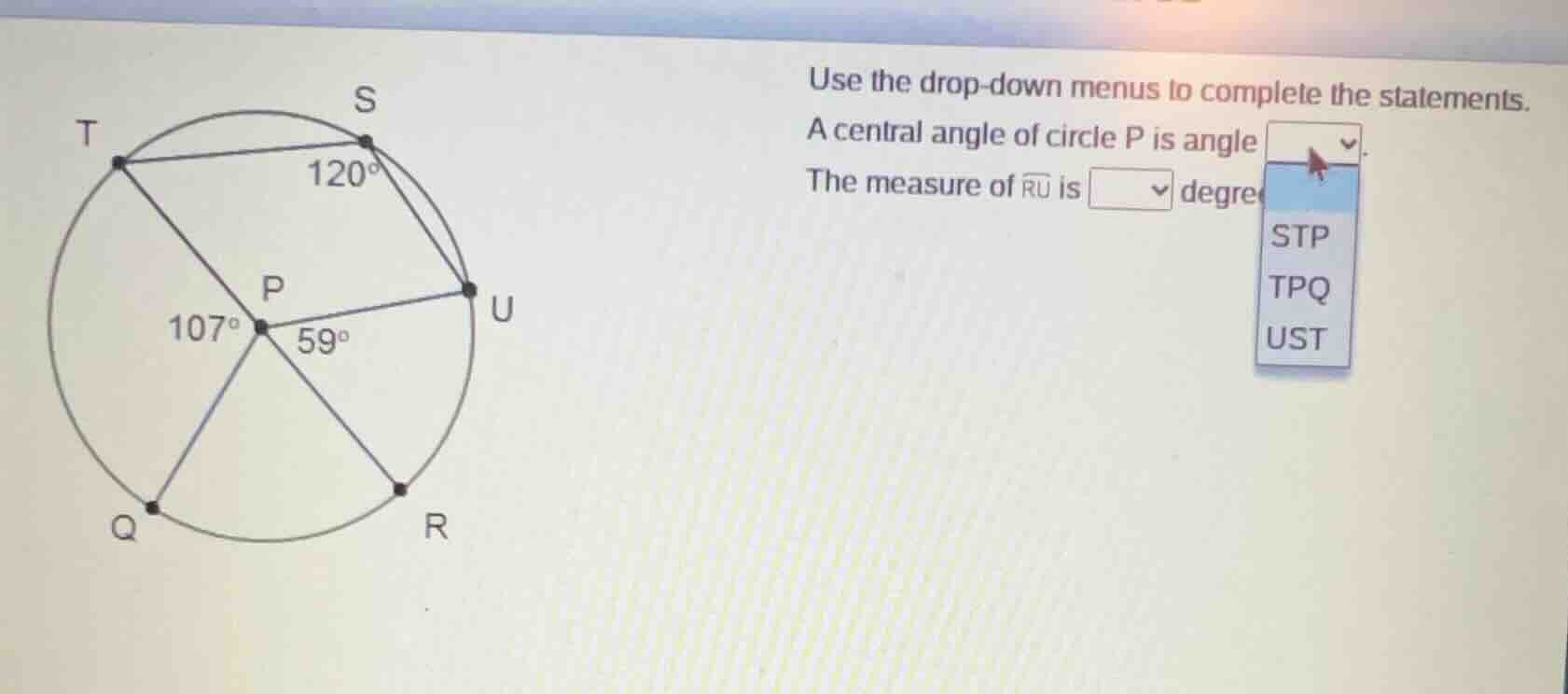
use the drop-down menus to complete the statements. a central angle of circle p is angle. the measure of \\(\widehat{ru}\\) is degree. (options for the first drop - down: stp, tpq, ust; there is a circle with center p, points t, s, u, r, q on the circle, angle between pt and pq is 107°, angle between pu and pr is 59°, angle between ts and su is 120°)
First Part: Identifying the Central Angle
A central angle of a circle has its vertex at the center of the circle (point \( P \)) and its sides as radii of the circle. Let's analyze the options:
- Angle \( STP \): Its vertex is at \( T \), not the center \( P \), so it's not a central angle.
- Angle \( TPQ \): Its vertex is at \( P \) (the center), and its sides are \( PT \) and \( PQ \) (radii of the circle). So this is a central angle.
- Angle \( UST \): Its vertex is at \( S \), not the center \( P \), so it's not a central angle.
Second Part: Finding the Measure of \( \widehat{RU} \)
The total measure of a circle is \( 360^\circ \). We know the measures of some central angles: \( \angle TPS = 120^\circ \), \( \angle TPQ = 107^\circ \), and \( \angle UPR = 59^\circ \)? Wait, no, let's list all central angles around point \( P \). The sum of all central angles in a circle is \( 360^\circ \).
Wait, actually, the central angle for arc \( RU \) is \( \angle RPU \), but let's check the given angles. Wait, the central angles we have are:
- \( \angle TPS = 120^\circ \)
- \( \angle TPQ = 107^\circ \)
- \( \angle UPR \)? Wait, no, let's calculate the remaining angle. Wait, the sum of all central angles is \( 360^\circ \). So:
\( \angle TPS + \angle TPQ + \angle QPR + \angle RPU = 360^\circ \)? Wait, no, looking at the diagram, the angles at \( P \) are \( \angle TPS = 120^\circ \), \( \angle TPQ = 107^\circ \), \( \angle UPR = 59^\circ \)? Wait, no, the angle between \( PU \) and \( PR \) is what we need? Wait, no, the measure of an arc is equal to the measure of its central angle.
Wait, let's re - examine. The central angles around \( P \) should add up to \( 360^\circ \). So:
\( \angle TPS = 120^\circ \), \( \angle TPQ = 107^\circ \), \( \angle UPR = 59^\circ \)? Wait, no, let's calculate the measure of \( \angle RPU \). Wait, the sum of all central angles:
\( 120^\circ+ 107^\circ+ 59^\circ+\text{measure of } \angle RPU= 360^\circ \)
First, sum the known angles: \( 120 + 107+59=286^\circ \)
Then, \( \angle RPU=360 - 286 = 74^\circ \)? Wait, no, that can't be. Wait, maybe I made a mistake. Wait, the arc \( RU \)'s central angle is \( \angle RPU \), but wait, the angle given as \( 59^\circ \) is \( \angle UPR \)? Wait, no, the problem is that the measure of arc \( RU \) is equal to the measure of its central angle. Wait, maybe the diagram has \( \angle UPR = 59^\circ \)? No, wait, let's think again.
Wait, the total of all central angles is \( 360^\circ \). We have:
- \( \angle TPS = 120^\circ \)
- \( \angle TPQ = 107^\circ \)
- The angle between \( PQ \) and \( PR \): let's call it \( \angle QPR \)
- The angle between \( PR \) and \( PU \): \( \angle RPU \)
Wait, but the angle between \( PU \) and \( PT \)? No, maybe the angle for arc \( RU \) is equal to the central angle \( \angle RPU \). Wait, the sum of all central angles:
\( 120^\circ+ 107^\circ+ \angle QPR + \angle RPU=360^\circ \). But we know that \( \angle UPR \) (wait, maybe the angle between \( PU \) and \( PR \) is \( 59^\circ \)? Wait, no, the given angle is \( 59^\circ \) between \( PU \) and \( PR \)? Wait, the diagram shows \( \angle UPR = 59^\circ \)? Wait, no, the angle labeled \( 59^\circ \) is between \( PU \) and \( PR \). Wait, then the measure of arc \( RU \) is equal to the measure of its central angle \( \angle RPU \), which is \( 59^\circ \)? Wait, no, that can't be. Wait, maybe I messed up. Wait, the sum of all central angles:
Wait, \( 120 + 107+59 + x=360 \), where \( x \) is the remaining angle. \( 120 + 107=227 \), \( 227+59 = 2…

Snap & solve any problem in the app
Get step-by-step solutions on Sovi AI
Photo-based solutions with guided steps
Explore more problems and detailed explanations
First Part: Identifying the Central Angle
A central angle of a circle has its vertex at the center of the circle (point \( P \)) and its sides as radii of the circle. Let's analyze the options:
- Angle \( STP \): Its vertex is at \( T \), not the center \( P \), so it's not a central angle.
- Angle \( TPQ \): Its vertex is at \( P \) (the center), and its sides are \( PT \) and \( PQ \) (radii of the circle). So this is a central angle.
- Angle \( UST \): Its vertex is at \( S \), not the center \( P \), so it's not a central angle.
Second Part: Finding the Measure of \( \widehat{RU} \)
The total measure of a circle is \( 360^\circ \). We know the measures of some central angles: \( \angle TPS = 120^\circ \), \( \angle TPQ = 107^\circ \), and \( \angle UPR = 59^\circ \)? Wait, no, let's list all central angles around point \( P \). The sum of all central angles in a circle is \( 360^\circ \).
Wait, actually, the central angle for arc \( RU \) is \( \angle RPU \), but let's check the given angles. Wait, the central angles we have are:
- \( \angle TPS = 120^\circ \)
- \( \angle TPQ = 107^\circ \)
- \( \angle UPR \)? Wait, no, let's calculate the remaining angle. Wait, the sum of all central angles is \( 360^\circ \). So:
\( \angle TPS + \angle TPQ + \angle QPR + \angle RPU = 360^\circ \)? Wait, no, looking at the diagram, the angles at \( P \) are \( \angle TPS = 120^\circ \), \( \angle TPQ = 107^\circ \), \( \angle UPR = 59^\circ \)? Wait, no, the angle between \( PU \) and \( PR \) is what we need? Wait, no, the measure of an arc is equal to the measure of its central angle.
Wait, let's re - examine. The central angles around \( P \) should add up to \( 360^\circ \). So:
\( \angle TPS = 120^\circ \), \( \angle TPQ = 107^\circ \), \( \angle UPR = 59^\circ \)? Wait, no, let's calculate the measure of \( \angle RPU \). Wait, the sum of all central angles:
\( 120^\circ+ 107^\circ+ 59^\circ+\text{measure of } \angle RPU= 360^\circ \)
First, sum the known angles: \( 120 + 107+59=286^\circ \)
Then, \( \angle RPU=360 - 286 = 74^\circ \)? Wait, no, that can't be. Wait, maybe I made a mistake. Wait, the arc \( RU \)'s central angle is \( \angle RPU \), but wait, the angle given as \( 59^\circ \) is \( \angle UPR \)? Wait, no, the problem is that the measure of arc \( RU \) is equal to the measure of its central angle. Wait, maybe the diagram has \( \angle UPR = 59^\circ \)? No, wait, let's think again.
Wait, the total of all central angles is \( 360^\circ \). We have:
- \( \angle TPS = 120^\circ \)
- \( \angle TPQ = 107^\circ \)
- The angle between \( PQ \) and \( PR \): let's call it \( \angle QPR \)
- The angle between \( PR \) and \( PU \): \( \angle RPU \)
Wait, but the angle between \( PU \) and \( PT \)? No, maybe the angle for arc \( RU \) is equal to the central angle \( \angle RPU \). Wait, the sum of all central angles:
\( 120^\circ+ 107^\circ+ \angle QPR + \angle RPU=360^\circ \). But we know that \( \angle UPR \) (wait, maybe the angle between \( PU \) and \( PR \) is \( 59^\circ \)? Wait, no, the given angle is \( 59^\circ \) between \( PU \) and \( PR \)? Wait, the diagram shows \( \angle UPR = 59^\circ \)? Wait, no, the angle labeled \( 59^\circ \) is between \( PU \) and \( PR \). Wait, then the measure of arc \( RU \) is equal to the measure of its central angle \( \angle RPU \), which is \( 59^\circ \)? Wait, no, that can't be. Wait, maybe I messed up. Wait, the sum of all central angles:
Wait, \( 120 + 107+59 + x=360 \), where \( x \) is the remaining angle. \( 120 + 107=227 \), \( 227+59 = 286 \), \( 360 - 286=74 \). Wait, that's not right. Wait, maybe the angle for arc \( RU \) is \( 59^\circ \)? Wait, no, the central angle for arc \( RU \) is \( \angle RPU \), and if the diagram shows \( \angle UPR = 59^\circ \), then the measure of arc \( RU \) is \( 59^\circ \)? Wait, maybe I made a mistake in the first part.
Wait, going back to the first question: a central angle of circle \( P \) is angle \( TPQ \) (since its vertex is at \( P \), the center, and sides are radii).
For the second part, the measure of arc \( RU \) is equal to the measure of its central angle, which is \( 59^\circ \)? Wait, no, wait the sum of all central angles:
Wait, the central angles are:
- \( \angle TPS = 120^\circ \)
- \( \angle TPQ = 107^\circ \)
- \( \angle QPR \): let's calculate it. Wait, \( 360-(120 + 107+59)=360 - 286 = 74 \). Wait, no, maybe the angle between \( PU \) and \( PR \) is \( 59^\circ \), so arc \( RU \) has measure \( 59^\circ \).
Wait, maybe the second part is \( 59 \) degrees.
Final Answers
- The central angle is \( TPQ \).
- The measure of \( \widehat{RU} \) is \( 59 \) degrees.
So, for the first drop - down, the answer is \( TPQ \), and for the second drop - down, the answer is \( 59 \).