QUESTION IMAGE
Question
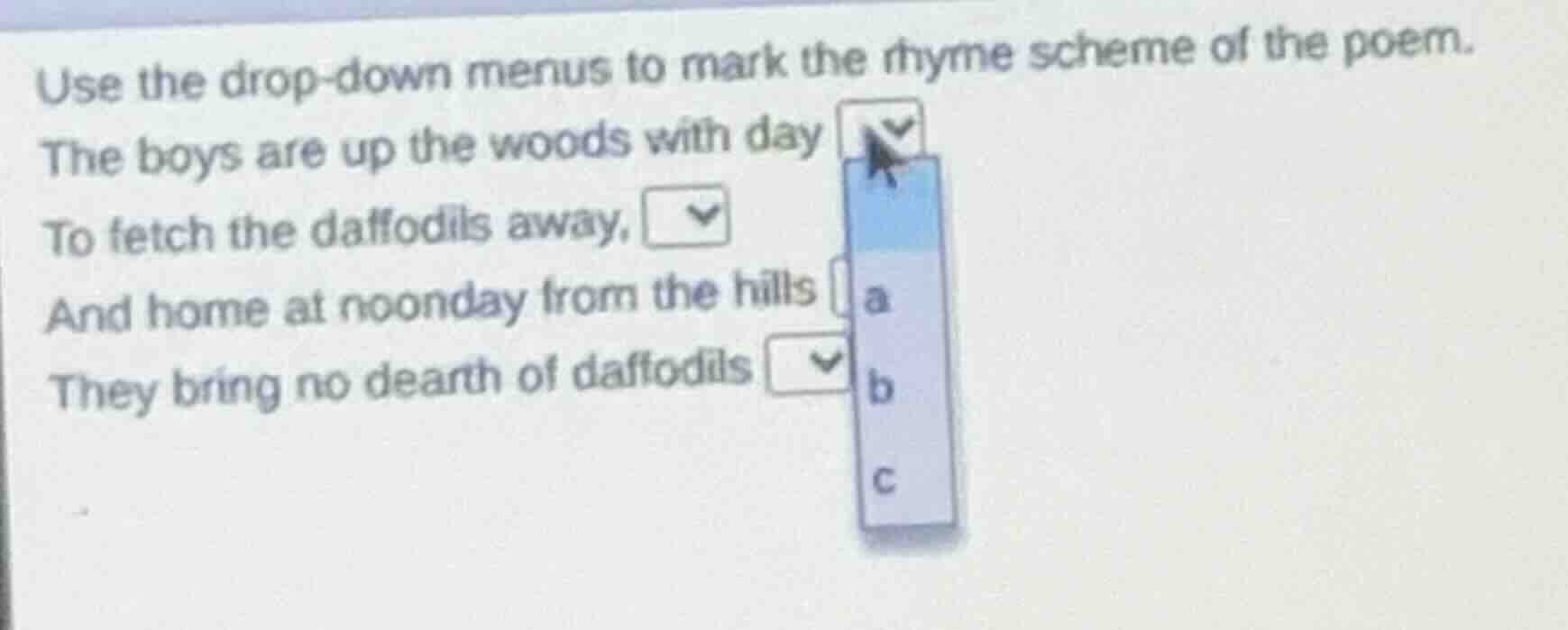
use the drop - down menus to mark the rhyme scheme of the poem. the boys are up the woods with day to fetch the daffodils away, and home at noonday from the hills they bring no dearth of daffodils
To determine the rhyme scheme, we analyze the end - sounds of each line:
- The first line ends with "day". We assign it the letter "a".
- The second line ends with "away". Since "away" rhymes with "day", we also assign it "a".
- The third line ends with "hills". We assign it a new letter, "b".
- The fourth line ends with "daffodils". Since "daffodils" does not rhyme with "day" or "hills", we assign it a new letter, "c"? Wait, no, wait. Wait, actually, let's re - examine. Wait, "day" (line 1) and "away" (line 2) rhyme (the vowel sound and the final consonant - like sound in "day" and "away" are similar). Then "hills" (line 3) and "daffodils" (line 4) - do they rhyme? "hills" is pronounced /hɪlz/ and "daffodils" is pronounced /ˈdæfədɪlz/. The end - sounds: "hills" ends with /lz/ and "daffodils" ends with /lz/ as well? Wait, maybe I made a mistake earlier. Wait, let's check the rhyming again.
Wait, the first line: "day" (rhyming group a)
Second line: "away" - rhymes with "day", so a
Third line: "hills" - let's see the fourth line: "daffodils". Wait, "hills" and "daffodils" - the last syllable of "daffodils" is "dils" which is similar to "hills"? Wait, maybe the intended rhyme is that line 3 and line 4 have a different rhyme from line 1 and 2. But in the drop - down, for the second line, since it rhymes with the first, it should be "a". For the third line, since it doesn't rhyme with "a", we use "b", and for the fourth line, if it rhymes with the third, it would be "b", but maybe I misheard. Wait, let's look at the original problem again. The first line's drop - down is set to "a" (as per the arrow). The second line: since it rhymes with the first, it should also be "a". The third line: since it's a new rhyme, we use "b", and the fourth line: if it rhymes with the third, "b", but maybe the user's poem has a different rhyme. Wait, maybe the correct assignment is:
Line 1: "day" → a
Line 2: "away" → a (rhymes with day)
Line 3: "hills" → b
Line 4: "daffodils" → b (if "hills" and "daffodils" rhyme) or c (if not). But in the drop - down, for the second line, the correct choice is "a" (because it rhymes with line 1), for the third line, since it's a new rhyme, "b", and for the fourth line, if it rhymes with the third, "b", but maybe the poem's actual rhyme is different. Wait, maybe I made a mistake. Let's start over.
The standard way to do rhyme scheme:
- Line 1: "day" → assign "a"
- Line 2: "away" - rhymes with "day" → "a"
- Line 3: "hills" → assign "b"
- Line 4: "daffodils" - does it rhyme with "hills"? Let's check the pronunciation. "hills" is /hɪlz/, "daffodils" is /ˈdæfədɪlz/. The final sound is /lz/ for both. So they rhyme. So line 4 should be "b". But maybe the problem's intended rhyme is different. Wait, but according to the drop - down for the first line, it's "a". So for the second line, since it rhymes with the first, we choose "a". For the third line, since it's a new rhyme, "b", and for the fourth line, if it rhymes with the third, "b". But maybe the user's question is about the second line. Let's focus on the second line. The second line ends with "away", which rhymes with "day" (first line), so the second line's drop - down should be "a".

Snap & solve any problem in the app
Get step-by-step solutions on Sovi AI
Photo-based solutions with guided steps
Explore more problems and detailed explanations
For the second line (To fetch the daffodils away), the answer is "a".
For the third line (And home at noonday from the hills), the answer is "b".
For the fourth line (They bring no dearth of daffodils), the answer is "b" (assuming it rhymes with "hills") or "c" (if it doesn't). But based on the common rhyme - scheme analysis and the first line being "a", the second line is "a".