QUESTION IMAGE
Question
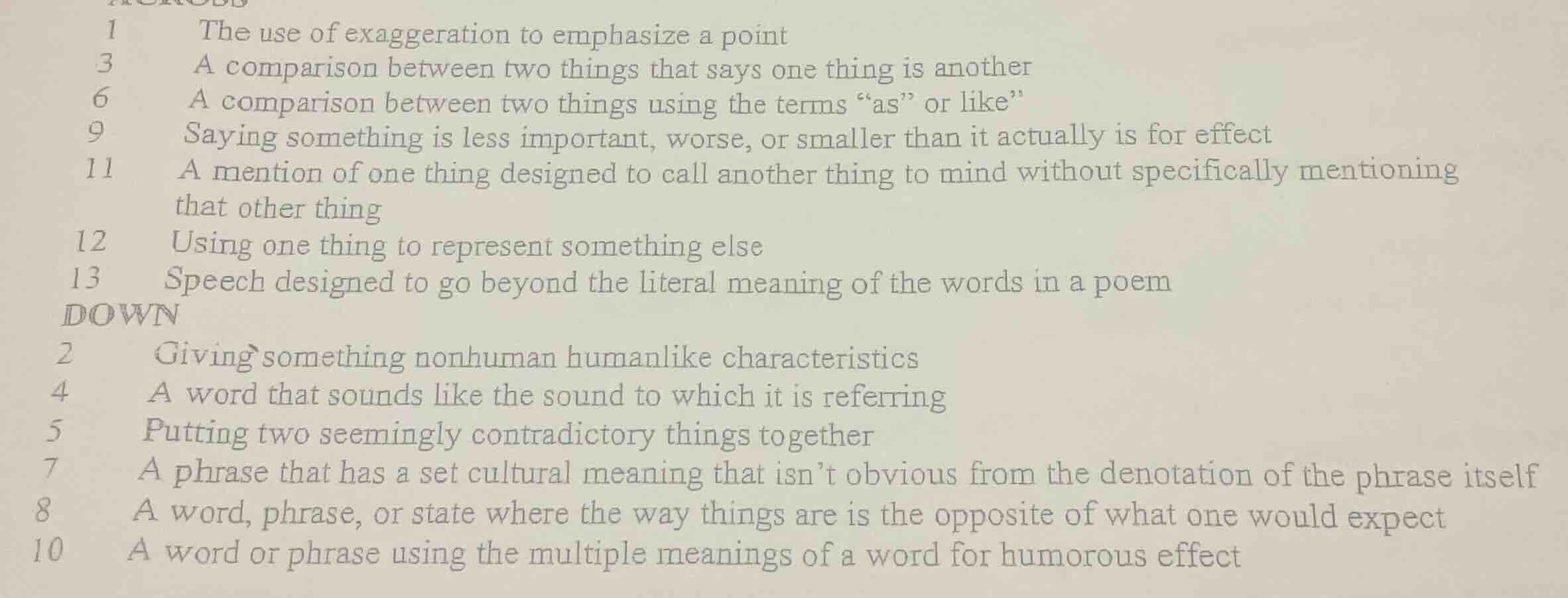
1 the use of exaggeration to emphasize a point
3 a comparison between two things that says one thing is another
6 a comparison between two things using the terms “as” or like”
9 saying something is less important, worse, or smaller than it actually is for effect
11 a mention of one thing designed to call another thing to mind without specifically mentioning that other thing
12 using one thing to represent something else
13 speech designed to go beyond the literal meaning of the words in a poem
down
2 giving something nonhuman humanlike characteristics
4 a word that sounds like the sound to which it is referring
5 putting two seemingly contradictory things together
7 a phrase that has a set cultural meaning that isn’t obvious from the denotation of the phrase itself
8 a word, phrase, or state where the way things are is the opposite of what one would expect
10 a word or phrase using the multiple meanings of a word for humorous effect
This appears to be a crossword puzzle about literary devices. Let's identify each clue with the corresponding literary device:
Across:
- Hyperbole: The use of exaggeration to emphasize a point.
- Metaphor: A comparison between two things that says one thing is another.
- Simile: A comparison between two things using the terms "as" or "like".
- Understatement: Saying something is less important, worse, or smaller than it actually is for effect.
- Allusion: A mention of one thing designed to call another thing to mind without specifically mentioning that other thing.
- Symbolism: Using one thing to represent something else.
- Figurative Language: Speech designed to go beyond the literal meaning of the words in a poem (this is a broader term, but fits as the overarching concept for these devices).
Down:
- Personification: Giving something nonhuman humanlike characteristics.
- Onomatopoeia: A word that sounds like the sound to which it is referring.
- Oxymoron: Putting two seemingly contradictory things together.
- Idiom: A phrase that has a set cultural meaning that isn’t obvious from the denotation of the phrase itself.
- Irony: A word, phrase, or state where the way things are is the opposite of what one would expect.
- Pun: A word or phrase using the multiple meanings of a word for humorous effect.
If you need to fill the crossword grid, here are the answers by number:
- Across:
- HYPERBOLE
- METAPHOR
- SIMILE
- UNDERSTATEMENT
- ALLUSION
- SYMBOLISM
- FIGURATIVE LANGUAGE
- Down:
- PERSONIFICATION
- ONOMATOPOEIA
- OXYMORON
- IDIOM
- IRONY
- PUN
(Note: Some clues might have slightly shorter answers depending on grid length, but these are the standard literary device terms for each definition.)

Snap & solve any problem in the app
Get step-by-step solutions on Sovi AI
Photo-based solutions with guided steps
Explore more problems and detailed explanations
This appears to be a crossword puzzle about literary devices. Let's identify each clue with the corresponding literary device:
Across:
- Hyperbole: The use of exaggeration to emphasize a point.
- Metaphor: A comparison between two things that says one thing is another.
- Simile: A comparison between two things using the terms "as" or "like".
- Understatement: Saying something is less important, worse, or smaller than it actually is for effect.
- Allusion: A mention of one thing designed to call another thing to mind without specifically mentioning that other thing.
- Symbolism: Using one thing to represent something else.
- Figurative Language: Speech designed to go beyond the literal meaning of the words in a poem (this is a broader term, but fits as the overarching concept for these devices).
Down:
- Personification: Giving something nonhuman humanlike characteristics.
- Onomatopoeia: A word that sounds like the sound to which it is referring.
- Oxymoron: Putting two seemingly contradictory things together.
- Idiom: A phrase that has a set cultural meaning that isn’t obvious from the denotation of the phrase itself.
- Irony: A word, phrase, or state where the way things are is the opposite of what one would expect.
- Pun: A word or phrase using the multiple meanings of a word for humorous effect.
If you need to fill the crossword grid, here are the answers by number:
- Across:
- HYPERBOLE
- METAPHOR
- SIMILE
- UNDERSTATEMENT
- ALLUSION
- SYMBOLISM
- FIGURATIVE LANGUAGE
- Down:
- PERSONIFICATION
- ONOMATOPOEIA
- OXYMORON
- IDIOM
- IRONY
- PUN
(Note: Some clues might have slightly shorter answers depending on grid length, but these are the standard literary device terms for each definition.)