QUESTION IMAGE
Question
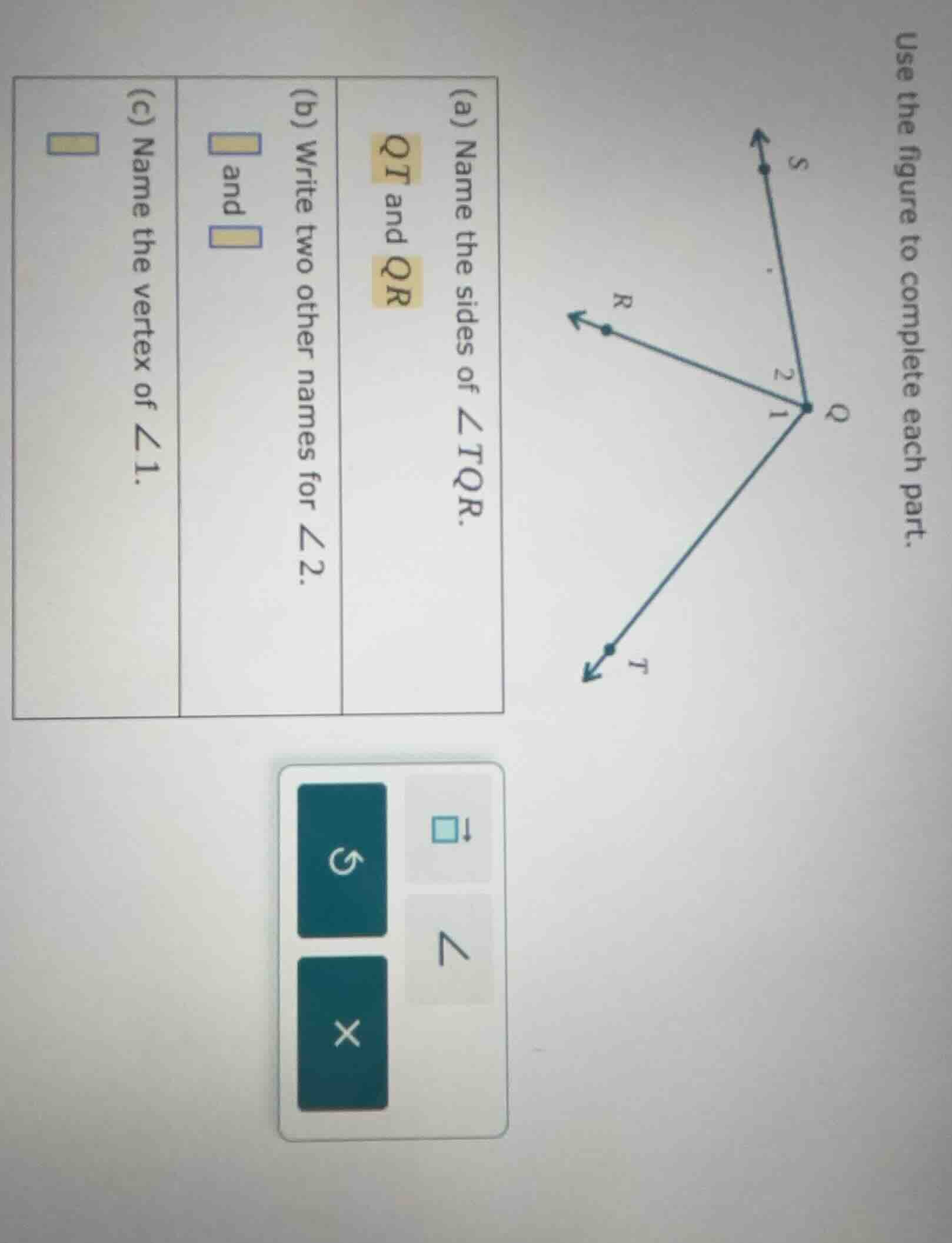
use the figure to complete each part.
(a) name the sides of ∠tqr.
qt and qr
(b) write two other names for ∠2.
and
(c) name the vertex of ∠1.
Part (a)
Step1: Recall angle side definition
An angle is formed by two rays (sides) with a common endpoint (vertex). For $\angle TQR$, the vertex is $Q$, and the two sides are the rays starting at $Q$ and passing through $T$ and $R$ respectively.
So the sides are $QT$ (or $\overrightarrow{QT}$) and $QR$ (or $\overrightarrow{QR}$), which matches the given answer.
Part (b)
Step1: Recall angle naming rules
An angle can be named by the vertex and two points (one on each side), with the vertex in the middle, or by the vertex alone if there's no ambiguity, or by a number. For $\angle 2$, the vertex is $Q$, and the sides are $QS$ and $QR$.
So two other names for $\angle 2$ can be $\angle SQR$ (using points $S$, $Q$, $R$ with $Q$ as vertex) and $\angle RQS$ (reversing the order of the side - points, still with $Q$ as vertex). Also, it can be named as $\angle Q$ (if there's no other angle at $Q$ that would cause ambiguity, but more precisely using the side - points is better). So two possible names are $\angle SQR$ and $\angle RQS$ (or $\angle Q$ and one of the others, but the first two are more accurate with the figure).
Part (c)
Step1: Recall vertex definition
The vertex of an angle is the common endpoint of the two rays (sides) forming the angle. For $\angle 1$, the two sides are $QT$ and $QR$ (from the figure, looking at $\angle 1$ at point $Q$ between $QT$ and $QR$). So the common endpoint (vertex) is $Q$.

Snap & solve any problem in the app
Get step-by-step solutions on Sovi AI
Photo-based solutions with guided steps
Explore more problems and detailed explanations
s:
(a) The sides of $\angle TQR$ are $QT$ and $QR$.
(b) Two other names for $\angle 2$ are $\boldsymbol{\angle SQR}$ and $\boldsymbol{\angle RQS}$ (or $\angle Q$ and $\angle SQR$ etc., but $\angle SQR$ and $\angle RQS$ are standard using the side - points).
(c) The vertex of $\angle 1$ is $\boldsymbol{Q}$.