QUESTION IMAGE
Question
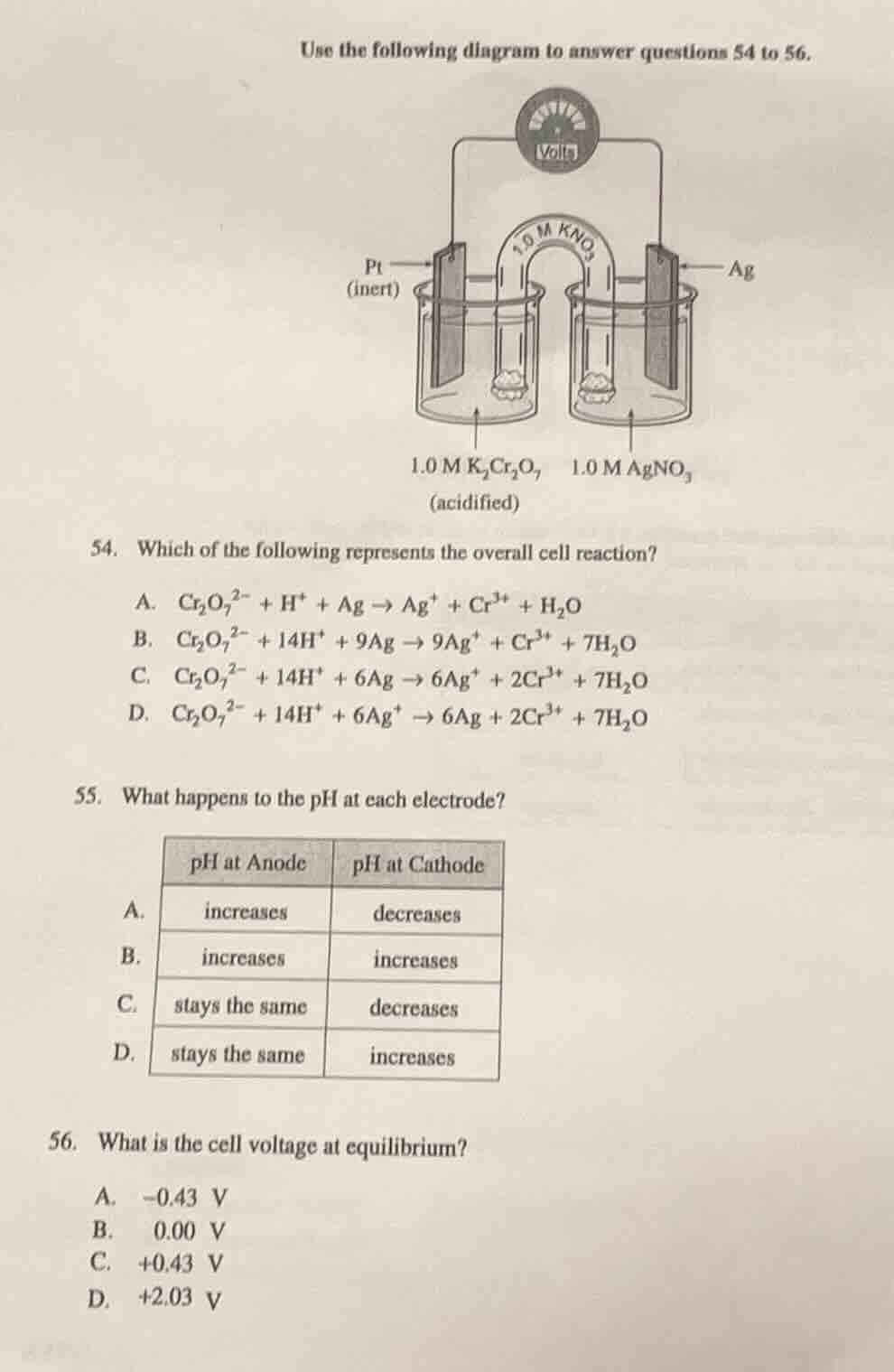
use the following diagram to answer questions 54 to 56.
- which of the following represents the overall cell reaction?
a. $ce{cr_{2}o^{2-}_{7} + h^{+} + ag -> ag^{+} + cr^{3+} + h_{2}o}$
b. $ce{cr_{2}o^{2-}_{7} + 14h^{+} + 9ag -> 9ag^{+} + cr^{3+} + 7h_{2}o}$
c. $ce{cr_{2}o^{2-}_{7} + 14h^{+} + 6ag -> 6ag^{+} + 2cr^{3+} + 7h_{2}o}$
d. $ce{cr_{2}o^{2-}_{7} + 14h^{+} + 6ag^{+} -> 6ag + 2cr^{3+} + 7h_{2}o}$
- what happens to the ph at each electrode?
| ph at anode | ph at cathode | |
|---|---|---|
| b. | increases | increases |
| c. | stays the same | decreases |
| d. | stays the same | increases |
- what is the cell voltage at equilibrium?
a. $-0.43$ v
b. $0.00$ v
c. $+0.43$ v
d. $+2.03$ v
Question 54
Step1: Identify half - reactions
- Reduction (Cathode, Pt side): In the acidic solution, \(Cr_2O_7^{2 -}\) is reduced. The reduction half - reaction of \(Cr_2O_7^{2-}\) in acidic medium is \(Cr_2O_7^{2-}+14H^{+}+6e^-
ightarrow2Cr^{3 +}+7H_2O\) (Cr goes from +6 in \(Cr_2O_7^{2-}\) to +3 in \(Cr^{3+}\), gain of 6 electrons for 2 Cr atoms, total gain of 6 \(e^-\)).
- Oxidation (Anode, Ag side): Ag is oxidized. The oxidation half - reaction is \(Ag
ightarrow Ag^{+}+e^-\) (Ag goes from 0 to +1, loss of 1 electron per Ag atom).
Step2: Balance electrons and add half - reactions
To balance the electrons, we multiply the oxidation half - reaction by 6 (since the reduction half - reaction gains 6 electrons). So the oxidation half - reaction becomes \(6Ag
ightarrow6Ag^{+}+6e^-\).
Now, add the two half - reactions:
Reduction: \(Cr_2O_7^{2-}+14H^{+}+6e^-
ightarrow2Cr^{3 +}+7H_2O\)
Oxidation: \(6Ag
ightarrow6Ag^{+}+6e^-\)
Overall reaction: \(Cr_2O_7^{2-}+14H^{+}+6Ag
ightarrow6Ag^{+}+2Cr^{3 +}+7H_2O\)
Step1: Analyze anode (Ag electrode)
At the anode, the oxidation reaction is \(Ag
ightarrow Ag^{+}+e^-\). The reaction at the anode does not involve \(H^+\) or \(OH^-\) directly. The solution in the anode compartment is \(1.0\ M\ AgNO_3\), and the reaction here is just the oxidation of Ag. So the concentration of \(H^+\) (from the salt bridge, but the anode reaction itself doesn't consume or produce \(H^+\)) remains the same. So the pH at the anode stays the same.
Step2: Analyze cathode (Pt electrode)
At the cathode, the reduction reaction is \(Cr_2O_7^{2-}+14H^{+}+6e^-
ightarrow2Cr^{3 +}+7H_2O\). In this reaction, \(H^+\) ions are consumed. As \(H^+\) concentration decreases, \(pH=-\log[H^+]\) increases (since lower \(H^+\) concentration means higher pH).
Step1: Recall cell voltage at equilibrium
For a cell, at equilibrium, the Gibbs free energy change \(\Delta G = 0\). The relationship between cell voltage (\(E_{cell}\)) and Gibbs free energy (\(\Delta G\)) is given by \(\Delta G=-nFE_{cell}\). When \(\Delta G = 0\) (at equilibrium), \(E_{cell}=0\ V\). This is because at equilibrium, there is no net flow of electrons, and the cell potential (voltage) is zero.

Snap & solve any problem in the app
Get step-by-step solutions on Sovi AI
Photo-based solutions with guided steps
Explore more problems and detailed explanations
C. \(\ce{Cr_{2}O^{2-}_{7} + 14H^{+} + 6Ag
ightarrow 6Ag^{+} + 2Cr^{3+} + 7H_{2}O}\)