QUESTION IMAGE
Question
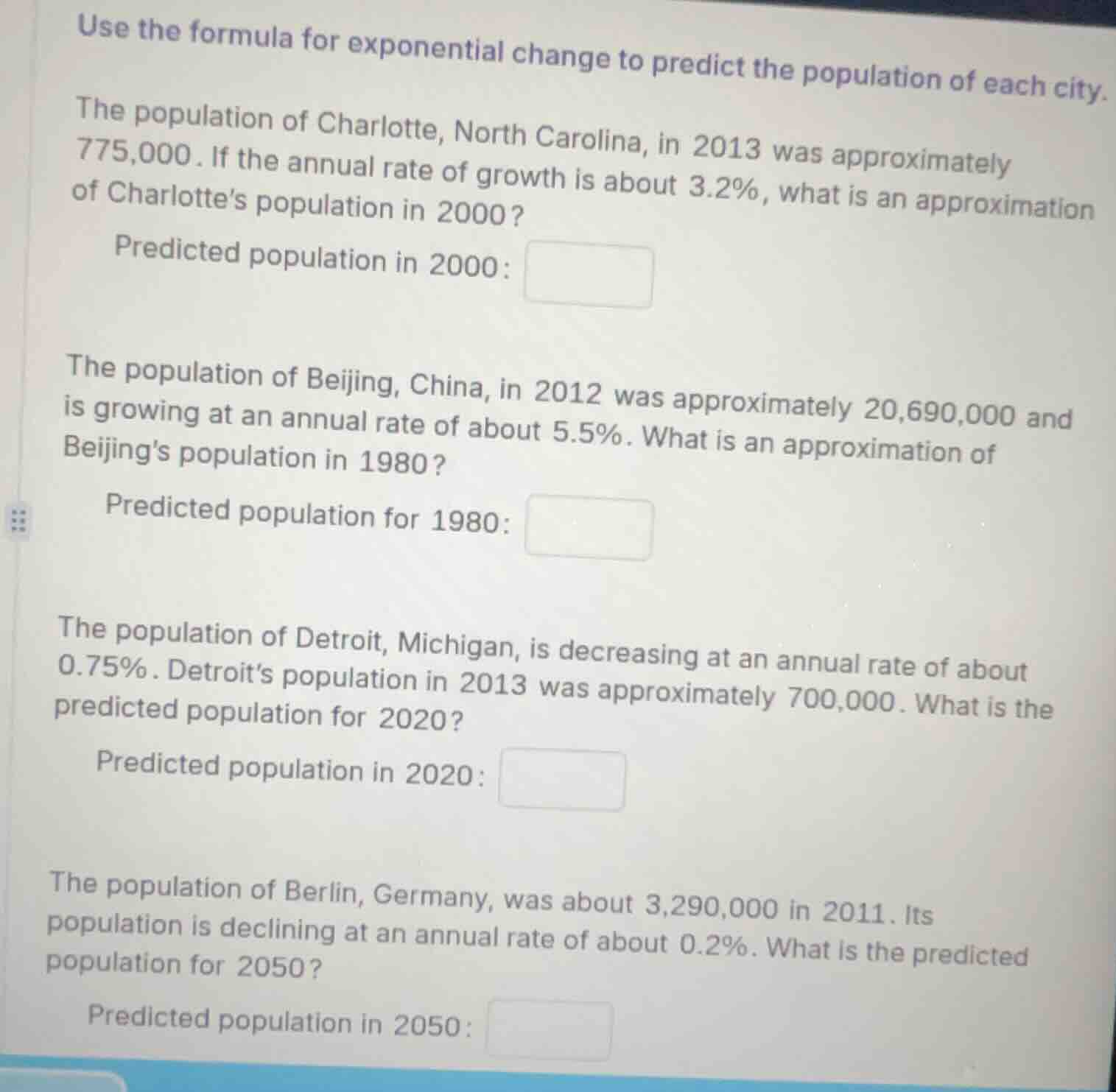
use the formula for exponential change to predict the population of each city.
the population of charlotte, north carolina, in 2013 was approximately 775,000. if the annual rate of growth is about 3.2%, what is an approximation of charlotte’s population in 2000?
predicted population in 2000:
the population of beijing, china, in 2012 was approximately 20,690,000 and is growing at an annual rate of about 5.5%. what is an approximation of beijing’s population in 1980?
predicted population for 1980:
the population of detroit, michigan, is decreasing at an annual rate of about 0.75%. detroit’s population in 2013 was approximately 700,000. what is the predicted population for 2020?
predicted population in 2020:
the population of berlin, germany, was about 3,290,000 in 2011. its population is declining at an annual rate of about 0.2%. what is the predicted population for 2050?
predicted population in 2050:
1. Charlotte, North Carolina (2000 population)
The formula for exponential change (population growth/decay) is \( P(t) = P_0(1 + r)^t \), where \( P(t) \) is the population at time \( t \), \( P_0 \) is the initial population, \( r \) is the annual growth rate (as a decimal), and \( t \) is the number of years. Here, we know \( P(t) \) (2013 population), \( r \), and we need to find \( P_0 \) (2000 population). The time difference \( t = 2013 - 2000 = 13 \) years, \( P(t) = 775000 \), \( r = 0.032 \). Rearranging the formula to solve for \( P_0 \): \( P_0=\frac{P(t)}{(1 + r)^t} \)
Step1: Identify values
\( P(t) = 775000 \), \( r = 0.032 \), \( t = 13 \)
Step2: Calculate \( (1 + r)^t \)
\( (1 + 0.032)^{13}=1.032^{13}\approx1.5007 \) (using a calculator to compute the power)
Step3: Solve for \( P_0 \)
\( P_0=\frac{775000}{1.5007}\approx516400 \) (rounded to a reasonable whole number)
Using the same exponential formula \( P(t) = P_0(1 + r)^t \). We know \( P(t) \) (2012 population), \( r \), and need \( P_0 \) (1980 population). Time difference \( t = 2012 - 1980 = 32 \) years, \( P(t) = 20690000 \), \( r = 0.055 \). Rearranged formula: \( P_0=\frac{P(t)}{(1 + r)^t} \)
Step1: Identify values
\( P(t) = 20690000 \), \( r = 0.055 \), \( t = 32 \)
Step2: Calculate \( (1 + r)^t \)
\( (1 + 0.055)^{32}=1.055^{32}\approx5.516 \) (using a calculator for the power)
Step3: Solve for \( P_0 \)
\( P_0=\frac{20690000}{5.516}\approx3751000 \) (rounded to a reasonable whole number)
For population decay, the formula is \( P(t) = P_0(1 - r)^t \) (since it's a decrease, \( r \) is the decay rate). We know \( P_0 \) (2013 population), \( r \), and need \( P(t) \) (2020 population). Time difference \( t = 2020 - 2013 = 7 \) years, \( P_0 = 700000 \), \( r = 0.0075 \)
Step1: Identify values
\( P_0 = 700000 \), \( r = 0.0075 \), \( t = 7 \)
Step2: Calculate \( (1 - r)^t \)
\( (1 - 0.0075)^{7}=0.9925^{7}\approx0.948 \) (using a calculator for the power)
Step3: Solve for \( P(t) \)
\( P(t)=700000\times0.948 = 663600 \) (rounded to a whole number)

Snap & solve any problem in the app
Get step-by-step solutions on Sovi AI
Photo-based solutions with guided steps
Explore more problems and detailed explanations
Approximately 516400