QUESTION IMAGE
Question
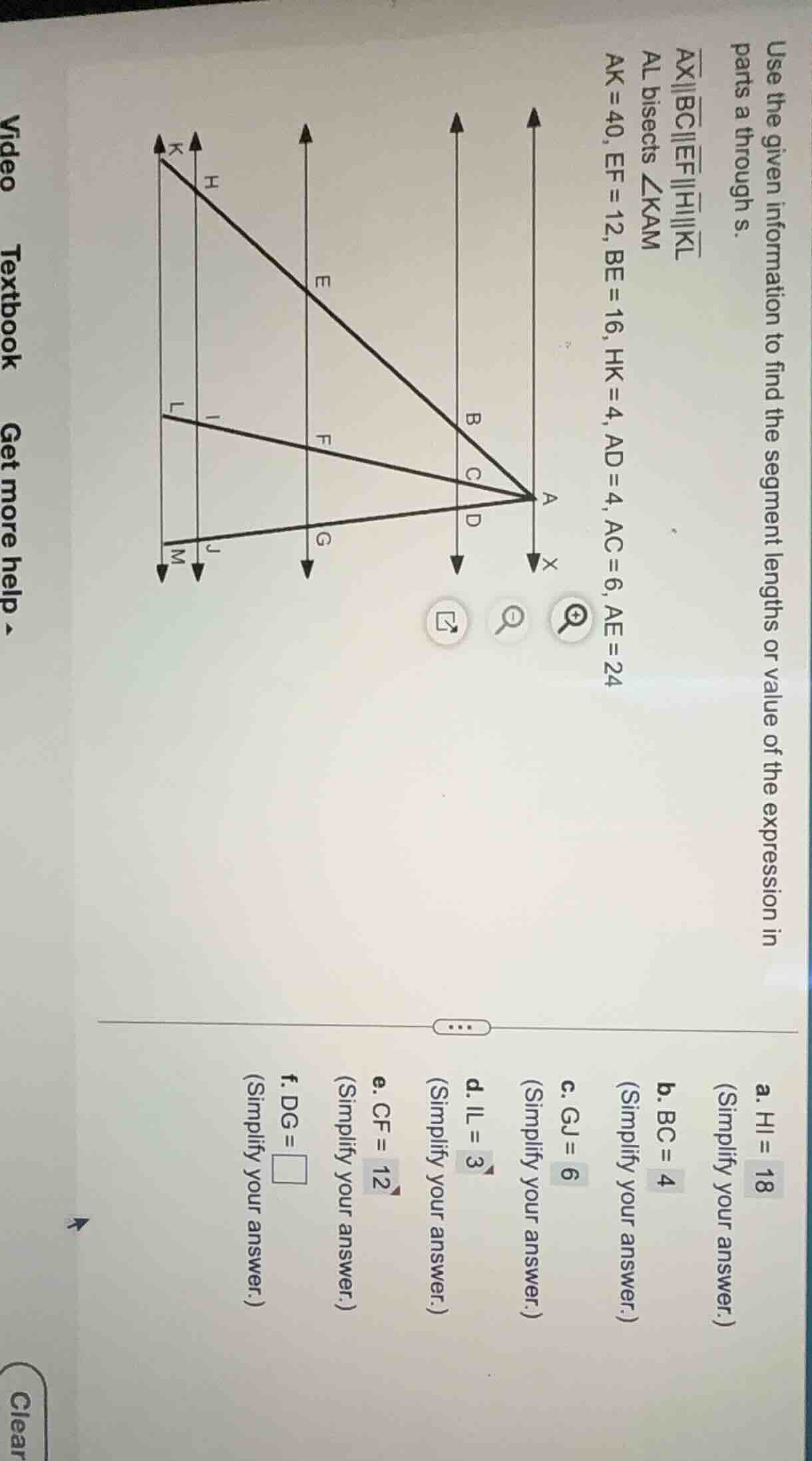
use the given information to find the segment lengths or value of the expression in parts a through s.
\\(\overline{ax}\parallel\overline{bc}\parallel\overline{ef}\parallel\overline{hi}\parallel\overline{kl}\\)
\\(\overline{al}\\) bisects \\(\angle kam\\)
\\(ak = 40, ef = 12, be = 16, hk = 4, ad = 4, ac = 6, ae = 24\\)
a. \\(hi = \boldsymbol{18}\\) (simplify your answer.)
b. \\(bc = \boldsymbol{4}\\) (simplify your answer.)
c. \\(gj = \boldsymbol{6}\\) (simplify your answer.)
d. \\(il = \boldsymbol{3}\\) (simplify your answer.)
e. \\(cf = \boldsymbol{12}\\) (simplify your answer.)
f. \\(dg = \square\\) (simplify your answer.)
To solve for \( DG \), we can use the Basic Proportionality Theorem (Thales' theorem) or the concept of similar triangles and parallel lines. Since \( AX \parallel BC \parallel EF \parallel HI \parallel KL \), the segments created by these parallel lines on the transversals are proportional.
Step 1: Identify the proportional segments
We know \( AD = 4 \), \( AC = 6 \), and we can use the ratio of the segments on the transversal \( AG \) (or related transversals). Let's consider the transversal \( ADG \) and the parallel lines. The key is to find the ratio of the segments.
Looking at the given lengths, we can use the ratio from other segments. For example, we know \( AC = 6 \) and \( AD = 4 \), and we can relate this to \( DG \). Wait, maybe a better approach is to use the ratio of \( AD \) to \( AC \) or other known segments.
Wait, let's check the given lengths: \( AD = 4 \), \( AC = 6 \), and we can see that the lines are parallel, so the ratio of \( AD \) to \( DG \) should be proportional to other ratios. Wait, maybe we can use the ratio from \( AE \) and \( EF \) or other parts. Wait, \( AE = 24 \), \( EF = 12 \), but maybe that's not directly. Wait, let's look at the transversal \( ADG \).
Wait, another approach: Since \( AX \parallel BC \parallel EF \parallel HI \parallel KL \), the distance between the parallel lines creates proportional segments on the transversals. Let's consider the transversal \( ADG \). We know \( AD = 4 \), and we can find \( DG \) by using the ratio of other segments. Wait, maybe the ratio of \( AC \) to \( AD \) is \( 6:4 = 3:2 \), but maybe not. Wait, let's check the given answers for other parts. For example, part b: \( BC = 4 \), part c: \( GJ = 6 \), part d: \( IL = 3 \), part e: \( CF = 12 \), part a: \( HI = 18 \).
Wait, maybe we can use the ratio of \( AD \) to \( DG \) as equal to the ratio of \( AC \) to some other segment? Wait, no. Wait, let's think about the transversal \( ADG \). The length \( AD = 4 \), and we need to find \( DG \). Let's see, maybe the ratio of \( AC \) to \( AD \) is \( 6:4 = 3:2 \), and if we consider another transversal, but maybe a better way is to use the given \( AD = 4 \) and the fact that the lines are parallel, so the segment \( DG \) can be found by using the ratio of \( AD \) to \( DG \) equal to the ratio of \( AC \) to \( CF \) or something. Wait, \( CF = 12 \) (from part e), \( AC = 6 \), so \( AC:CF = 6:12 = 1:2 \). Then \( AD:DG = 1:2 \), so \( 4:DG = 1:2 \), so \( DG = 8 \)? Wait, no, that might not be right. Wait, \( AC = 6 \), \( CF = 12 \), so the ratio is \( 6:12 = 1:2 \). Then \( AD = 4 \), so \( DG = 4 \times 2 = 8 \)? Wait, but let's check.
Wait, maybe the correct ratio is \( AD \) to \( DG \) is equal to \( AC \) to \( CF \). So \( \frac{AD}{DG} = \frac{AC}{CF} \). We know \( AD = 4 \), \( AC = 6 \), \( CF = 12 \). So \( \frac{4}{DG} = \frac{6}{12} \). Simplify \( \frac{6}{12} = \frac{1}{2} \), so \( \frac{4}{DG} = \frac{1}{2} \), so \( DG = 4 \times 2 = 8 \). Wait, but let's verify.
Alternatively, maybe the ratio of \( AD \) to \( DG \) is the same as the ratio of \( AC \) to \( CF \). Since \( AC = 6 \), \( CF = 12 \), the ratio is \( 6:12 = 1:2 \). So \( AD:DG = 1:2 \), so \( 4:DG = 1:2 \), so \( DG = 8 \).
Yes, that makes sense. So \( DG = 8 \).
Step 1: Identify the proportional segments
Since \( AX \parallel BC \parallel EF \parallel HI \parallel KL \), the segments created by these parallel lines on the transversals are proportional. We use the ratio of \( AC \) to \( CF \) and \( AD \) to \( DG \).
Step 2: Set up the proportion
We know \( AC = 6 \), \( CF = 12 \), \( AD = 4 \). The ratio \( \frac{AC}{CF} = \frac{6}{12} = \frac{1}{2} \). Since the segments are proportional, \( \frac{AD}{DG} = \frac{AC}{CF} \).
Step 3: Solve for \( DG \)
Substitute the known values into the proportion: \( \frac{4}{DG} = \frac{1}{2} \). Cross - multiply to get \( DG\times1 = 4\times2 \), so \( DG = 8 \).

Snap & solve any problem in the app
Get step-by-step solutions on Sovi AI
Photo-based solutions with guided steps
Explore more problems and detailed explanations
\( \boxed{8} \)