QUESTION IMAGE
Question
use the given information to prove that $\triangle adb \cong \triangle cdb$.
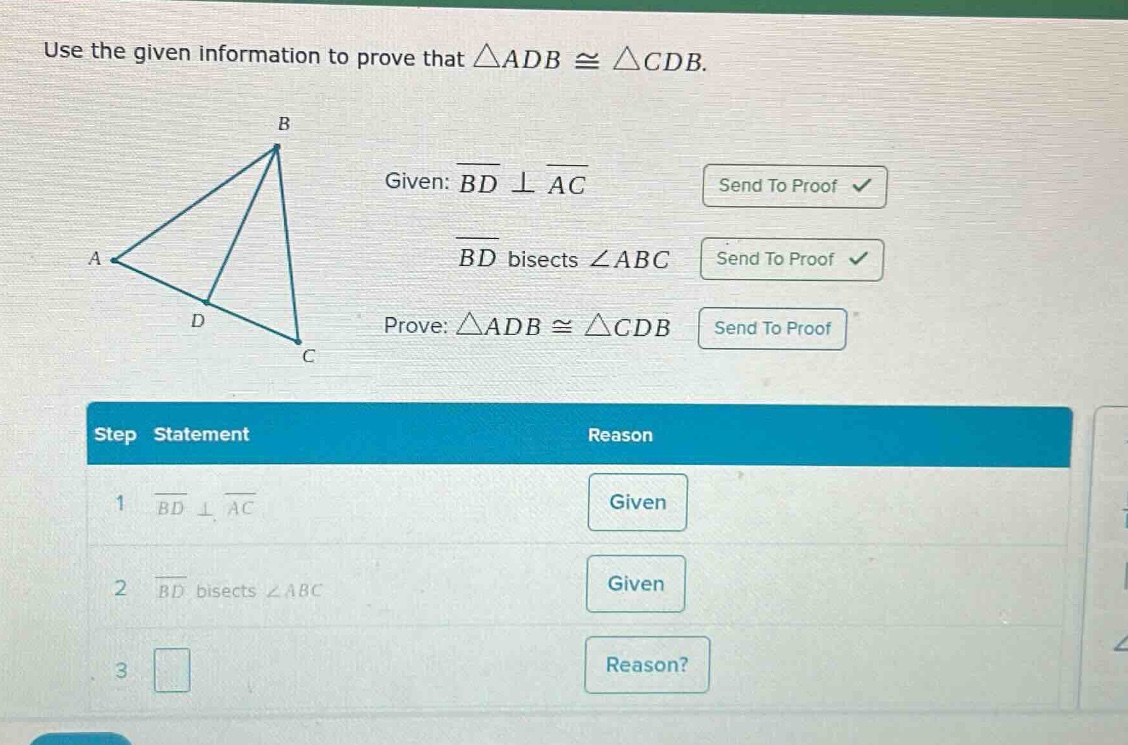
given: $\overline{bd} \perp \overline{ac}$; $\overline{bd}$ bisects $\angle abc$; prove: $\triangle adb \cong \triangle cdb$
(there is a triangle diagram with points a, b, c and d on ac)
Step1: Identify right angles
Since $\overline{BD} \perp \overline{AC}$, $\angle ADB = \angle CDB = 90^\circ$.
Step2: Identify equal angles from bisector
Since $\overline{BD}$ bisects $\angle ABC$, $\angle ABD = \angle CBD$.
Step3: Identify common side
$\overline{BD}$ is common to both $\triangle ADB$ and $\triangle CDB$, so $\overline{BD} \cong \overline{BD}$.
Step4: Apply ASA congruence
In $\triangle ADB$ and $\triangle CDB$:
- $\angle ADB = \angle CDB$ (right angles)
- $\overline{BD} = \overline{BD}$ (common side)
- $\angle ABD = \angle CBD$ (angle bisector)
By the Angle - Side - Angle (ASA) Congruence Postulate, $\triangle ADB \cong \triangle CDB$.

Snap & solve any problem in the app
Get step-by-step solutions on Sovi AI
Photo-based solutions with guided steps
Explore more problems and detailed explanations
To prove $\triangle ADB \cong \triangle CDB$:
- From $\overline{BD} \perp \overline{AC}$, we have $\angle ADB=\angle CDB = 90^{\circ}$ (definition of perpendicular lines).
- From $\overline{BD}$ bisecting $\angle ABC$, we have $\angle ABD=\angle CBD$ (definition of angle bisector).
- $\overline{BD}$ is a common side, so $\overline{BD}\cong\overline{BD}$ (reflexive property of congruence).
- By the ASA (Angle - Side - Angle) Congruence Postulate, since two angles and the included side of $\triangle ADB$ are congruent to two angles and the included side of $\triangle CDB$, we conclude $\triangle ADB \cong \triangle CDB$.