QUESTION IMAGE
Question
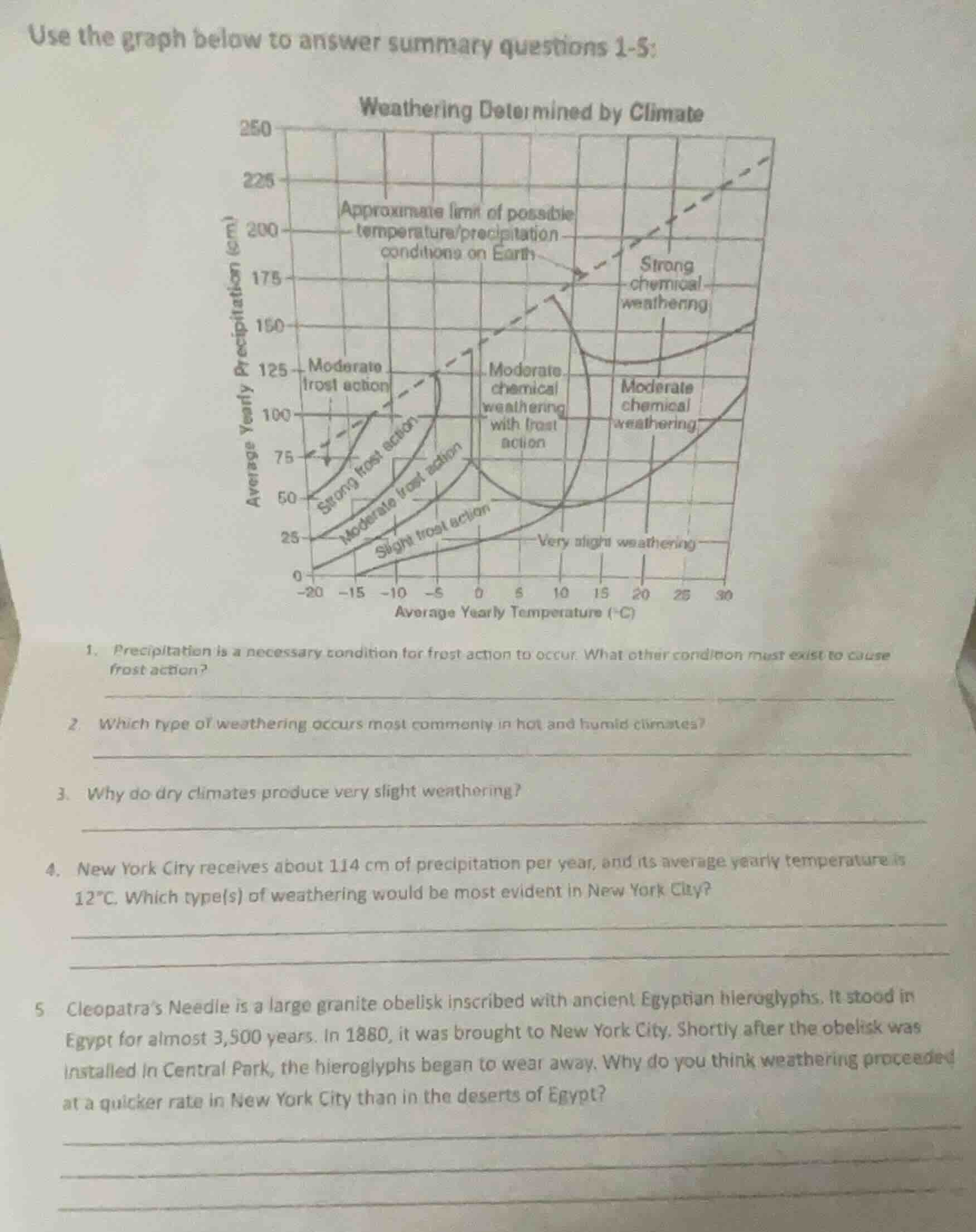
use the graph below to answer summary questions 1-5:weathering determined by climate1. precipitation is a necessary condition for frost action to occur. what other condition must exist to cause frost action?2. which type of weathering occurs most commonly in hot and humid climates?3. why do dry climates produce very slight weathering?4. new york city receives about 114 cm of precipitation per year, and its average yearly temperature is 12°c. which type(s) of weathering would be most evident in new york city?5. cleopatras needle is a large granite obelisk inscribed with ancient egyptian hieroglyphs. it stood in egypt for almost 3,500 years. in 1880, it was brought to new york city. shortly after the obelisk was installed in central park, the hieroglyphs began to wear away. why do you think weathering proceeded at a quicker rate in new york city than in the deserts of egypt?
- Frost action requires temperatures low enough for water to freeze, so average yearly temperatures must be at or below 0°C (freezing point of water) to allow repeated freezing/thawing cycles.
- Hot and humid climates have high temperature and high precipitation, which falls in the "Strong chemical weathering" zone on the graph, as these conditions accelerate chemical reactions that break down rock.
- Dry climates have very low precipitation. Both chemical weathering (which needs water as a reactant) and significant frost action (which needs precipitation to supply water that can freeze) are limited, leaving only very slight weathering.
- Locate 12°C (temperature) and 114 cm (precipitation) on the graph; this point falls within the "Moderate chemical weathering with frost action" zone.
- Egypt's deserts have a dry, hot climate with very low precipitation, leading to only very slight weathering. New York City has moderate precipitation and temperatures that allow both moderate chemical weathering and frost action, which together break down the granite obelisk much faster than the arid Egyptian climate.

Snap & solve any problem in the app
Get step-by-step solutions on Sovi AI
Photo-based solutions with guided steps
Explore more problems and detailed explanations
- Average yearly temperature at or below 0°C (freezing conditions for water to freeze and thaw repeatedly).
- Strong chemical weathering
- Dry climates have very little precipitation, which is required for significant chemical weathering and frost action, so only minimal weathering occurs.
- Moderate chemical weathering with frost action
- Egypt's desert climate has extremely low precipitation, causing only very slight weathering. New York City has moderate precipitation and temperatures that support both moderate chemical weathering and frost action, which together break down the obelisk at a faster rate.