QUESTION IMAGE
Question
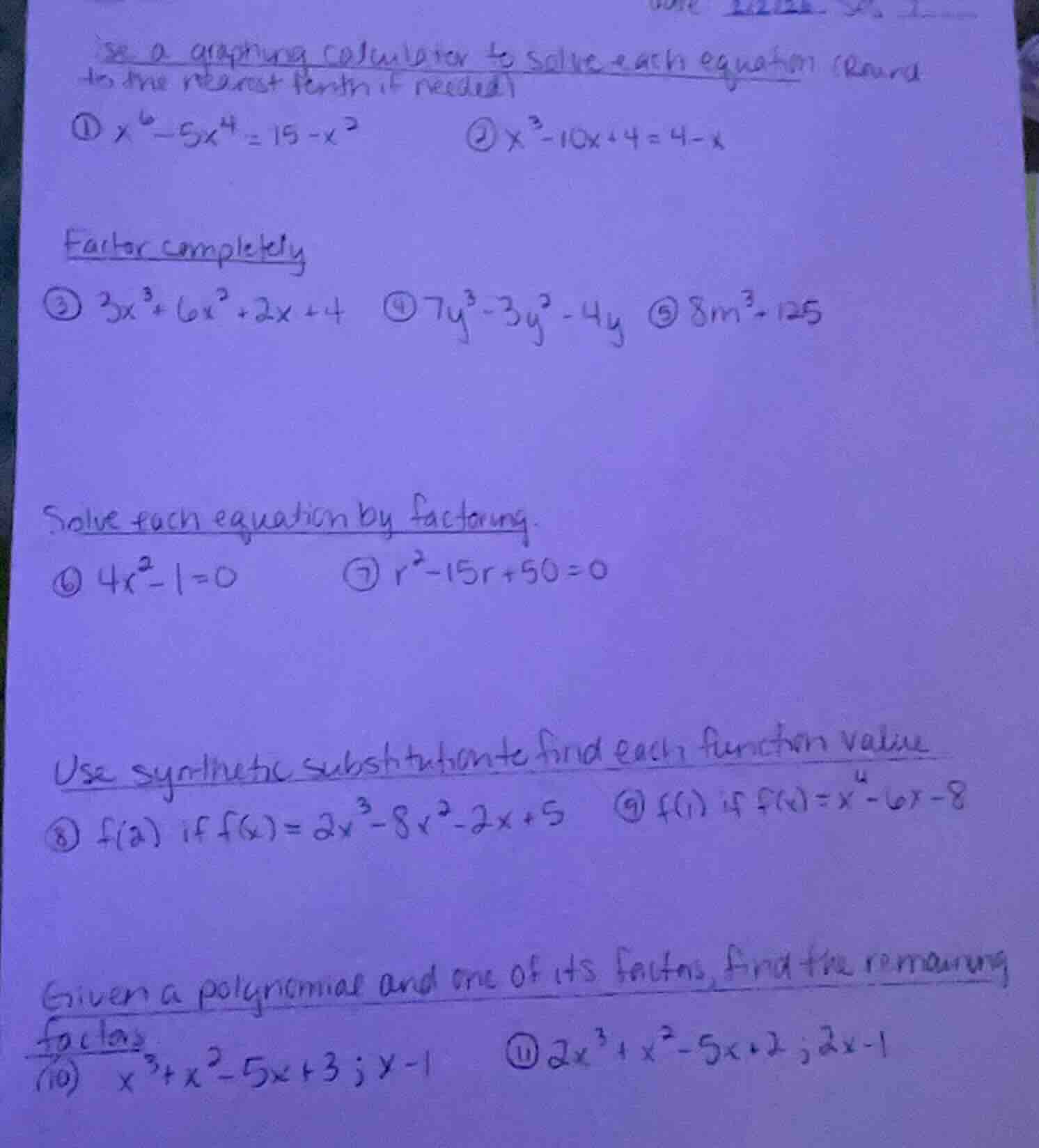
use a graphing calculator to solve each equation (round to the nearest tenth if needed)
① $x^6 - 5x^4 = 15 - x^2$ ② $x^3 - 10x + 4 = 4 - x$
factor completely
③ $3x^3 + 6x^2 + 2x + 4$ ④ $7y^3 - 3y^2 - 4y$ ⑤ $8m^3 + 125$
solve each equation by factoring.
⑥ $4x^2 - 1 = 0$ ⑦ $r^2 - 15r + 50 = 0$
use synthetic substitution to find each function value
⑧ $f(2)$ if $f(x) = 2x^3 - 8x^2 - 2x + 5$ ⑨ $f(1)$ if $f(x) = x^4 - 6x - 8$
given a polynomial and one of its factors, find the remaining factors
(10) $x^3 + x^2 - 5x + 3$ ; $x - 1$ ⑪ $2x^3 + x^2 - 5x + 2$ ; $2x - 1$
Problem 1: \( x^6 - 5x^4 = 15 - x^2 \)
Step 1: Rearrange the equation
Move all terms to one side: \( x^6 - 5x^4 + x^2 - 15 = 0 \)
Step 2: Use a graphing calculator
Graph the function \( y = x^6 - 5x^4 + x^2 - 15 \) and find the x - intercepts (roots). By graphing, we can observe the approximate roots. Let's assume we use a graphing utility. The real roots (approximate, to the nearest tenth) can be found. After graphing, we find that the real roots are approximately \( x\approx\pm2.2 \) (since the function is even, symmetric about the y - axis).
Step 1: Rearrange the equation
Subtract \( 4 - x \) from both sides: \( x^3 - 10x + 4-(4 - x)=0\)
Simplify: \( x^3 - 9x=0\)
Step 2: Factor the equation
Factor out \( x \): \( x(x^2 - 9)=0\)
Then, using the difference of squares \( a^2 - b^2=(a + b)(a - b) \), we get \( x(x + 3)(x - 3)=0\)
Step 3: Solve for x
Set each factor equal to zero:
\( x = 0\) or \( x+3 = 0\) (so \( x=-3\)) or \( x - 3 = 0\) (so \( x = 3\))
Step 1: Group the terms
Group the first two terms and the last two terms: \( (3x^3+6x^2)+(2x + 4) \)
Step 2: Factor out the GCF from each group
Factor out \( 3x^2 \) from the first group: \( 3x^2(x + 2) \)
Factor out \( 2 \) from the second group: \( 2(x + 2) \)
Step 3: Factor out the common binomial factor
Now we have \( (x + 2)(3x^2+2) \)

Snap & solve any problem in the app
Get step-by-step solutions on Sovi AI
Photo-based solutions with guided steps
Explore more problems and detailed explanations
The solutions (to the nearest tenth) are \( x\approx - 2.2, x\approx2.2 \) (and there may be non - real complex roots as well)