QUESTION IMAGE
Question
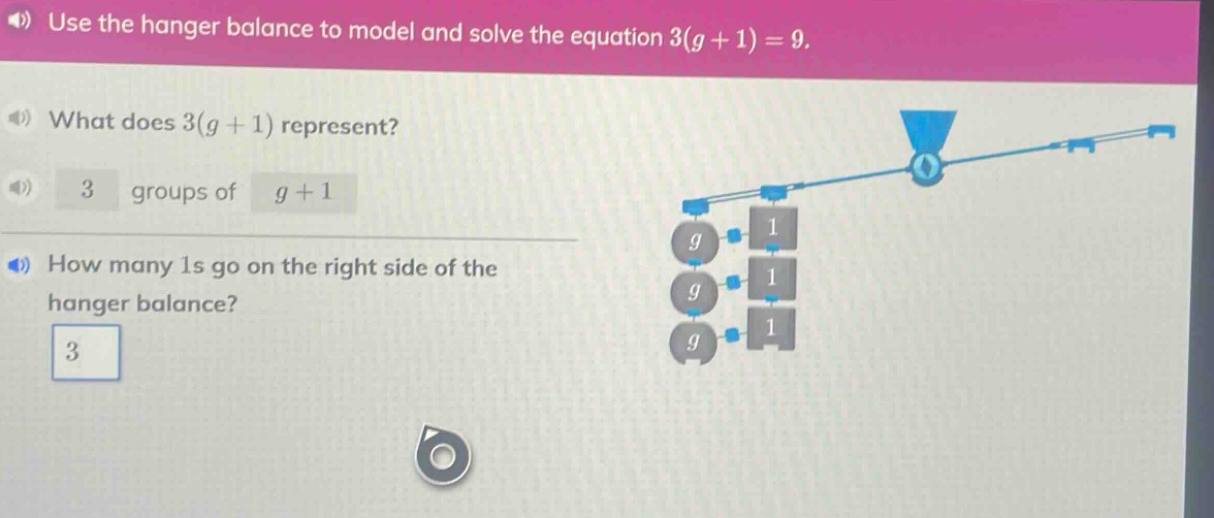
use the hanger balance to model and solve the equation 3(g + 1) = 9. what does 3(g + 1) represent? 3 groups of g + 1 how many 1s go on the right side of the hanger balance? 3
Step1: Analyze the equation structure
The equation is \(3(g + 1)=9\). First, we can simplify the left - hand side by using the distributive property \(a(b + c)=ab+ac\). Here, \(a = 3\), \(b = g\) and \(c = 1\), so \(3(g + 1)=3\times g+3\times1 = 3g + 3\).
Step2: Solve for g
We have the equation \(3g+3 = 9\). Subtract 3 from both sides of the equation: \(3g+3 - 3=9 - 3\), which simplifies to \(3g=6\). Then divide both sides by 3: \(\frac{3g}{3}=\frac{6}{3}\), so \(g = 2\). But if we think in terms of the hanger balance, the left - hand side has 3 groups of \((g + 1)\), which means 3 \(g\)s and 3 \(1\)s. The right - hand side has a total value of 9. Since the left - hand side is \(3g + 3\), and we know that the total on the right is 9. If we consider the hanger balance, the left has 3 \(1\)s (from the \(3\times1\) part of \(3(g + 1)=3g+3\)) and 3 \(g\)s. The right side should balance the left side. Since the left side has 3 \(1\)s (because \(3\times1 = 3\)) and 3 \(g\)s, and the total value of the left side is 9, when we solve the equation, we can also think of it as: each group \((g + 1)\) has a \(g\) and a \(1\), and there are 3 groups. So the number of \(1\)s on the left (from the \(3\times1\)) is 3, and the right side should have a total value equal to the left side. But the question is about the number of \(1\)s on the right side. From the equation \(3(g + 1)=9\), and \(3(g + 1)=3g + 3\), the non - \(g\) part (the constant term) on the left is 3 (from 3 times 1). So the number of \(1\)s on the right side should be equal to the number of \(1\)s on the left side from the \(3\times1\) part, which is 3. Also, if we solve the equation \(3(g + 1)=9\), divide both sides by 3: \(g + 1=\frac{9}{3}=3\), then \(g=3 - 1 = 2\). But in terms of the hanger balance, the left has 3 groups of \((g + 1)\), so 3 \(1\)s and 3 \(g\)s. The right side has a total value of 9. If we think of the right side as composed of some number of \(1\)s and maybe some \(g\)s, but since we are looking for the number of \(1\)s, from the expansion \(3(g + 1)=3g+3\), the coefficient of the constant term (the number of \(1\)s) is 3.

Snap & solve any problem in the app
Get step-by-step solutions on Sovi AI
Photo-based solutions with guided steps
Explore more problems and detailed explanations
The number of 1s on the right side of the hanger balance is 3.