QUESTION IMAGE
Question
use your knowledge of valence electrons and bond formation to complete the following description. (2 points)
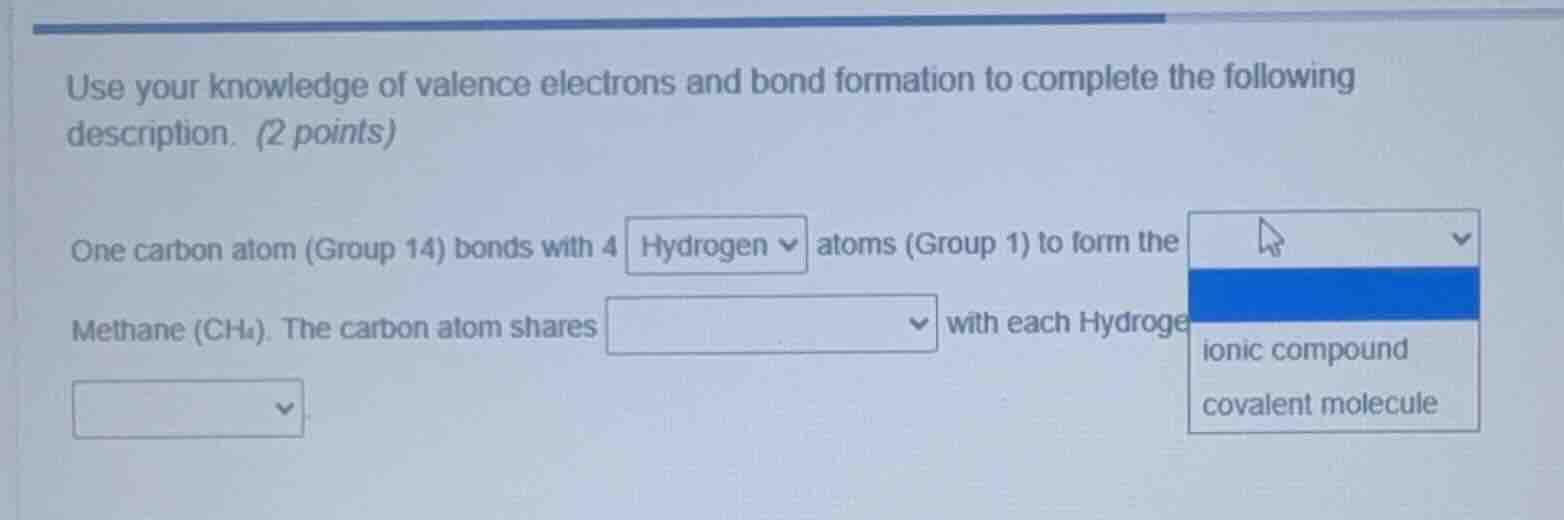
one carbon atom (group 14) bonds with 4 hydrogen atoms (group 1) to form the
methane (ch₄). the carbon atom shares with each hydroge
ionic compound
covalent molecule
- For the first blank (the type of compound): Methane (\(CH_4\)) is formed by covalent bonds (sharing electrons) between carbon and hydrogen, so it's a covalent molecule, not an ionic compound (which involves electron transfer).
- For the second blank (what carbon shares with each H): Carbon has 4 valence electrons, and each H has 1. In \(CH_4\), carbon shares 1 pair of electrons (or 2 electrons, but in terms of the bond, a single bond involves sharing 1 pair, so "1 pair of electrons" or "2 electrons" – but more precisely, in a single covalent bond, each atom contributes one electron, so carbon shares 1 electron with each hydrogen atom to form a single bond, and since there are 4 H, it shares 1 electron with each (total 4 electrons shared, 1 per H). Wait, more accurately, carbon has 4 valence electrons, and each H needs 1 to complete its shell. So carbon forms 4 single bonds, each bond is a shared pair (2 electrons), but from carbon's side, it contributes 1 electron per bond. So the carbon atom shares 1 electron (or 1 pair, but in terms of the bond, each bond is a shared pair, so for each H, carbon shares 1 pair? No, each single bond is one shared pair (2 electrons), with one electron from C and one from H. So carbon shares 1 electron with each H (since each H contributes 1, so together they form a pair). So the second blank: "1 electron" (or "a pair of electrons" but more precisely, in the context of valence electrons and bond formation, for each H, carbon shares 1 electron (to form a single covalent bond).
- Wait, the first dropdown (the compound type) should be "covalent molecule" because \(CH_4\) is a covalent compound (molecule) formed by sharing electrons. The second dropdown (what carbon shares with each H): in a single covalent bond, two atoms share a pair of electrons (one from each). So carbon shares 1 electron (its own) with each H (which shares 1 of its own), forming a pair. So the carbon atom shares "1 electron" (or "a pair of electrons" – but since each H is in group 1, has 1 valence electron, and carbon in group 14 has 4. So to form \(CH_4\), carbon forms 4 single bonds, each with a H. So for each H, carbon shares 1 electron (contributing 1 to the bond pair). So the second blank: "1 electron" (or "a pair of electrons" but the wording here – maybe the options are like "1 electron", "2 electrons", etc. Alternatively, since carbon has 4 valence electrons and bonds with 4 H, each bond is a single bond, so carbon shares 1 pair of electrons with each H? No, a single bond is one pair (2 electrons), so each bond has 2 electrons, one from C and one from H. So from C's perspective, it shares 1 electron per H. So the answers:
First dropdown (compound type): covalent molecule
Second dropdown (what C shares with each H): 1 electron (or "a pair of electrons" but more accurately, in the bond, each atom contributes one electron, so C shares 1 electron with each H to form a single bond.

Snap & solve any problem in the app
Get step-by-step solutions on Sovi AI
Photo-based solutions with guided steps
Explore more problems and detailed explanations
- The first dropdown (compound type): covalent molecule
- The second dropdown (what carbon shares with each H): 1 electron (or "a pair of electrons" – but based on valence electron sharing, each single bond involves sharing a pair, with one electron from each atom, so carbon shares 1 electron with each H)
(Note: The exact wording may depend on the options, but the key is:
- Compound type: covalent molecule (since \(CH_4\) is covalent, formed by sharing electrons, not transferring)
- What carbon shares: 1 electron (or a pair, but in terms of the bond, each bond is a shared pair, so carbon contributes 1 electron per H to form the pair))