QUESTION IMAGE
Question
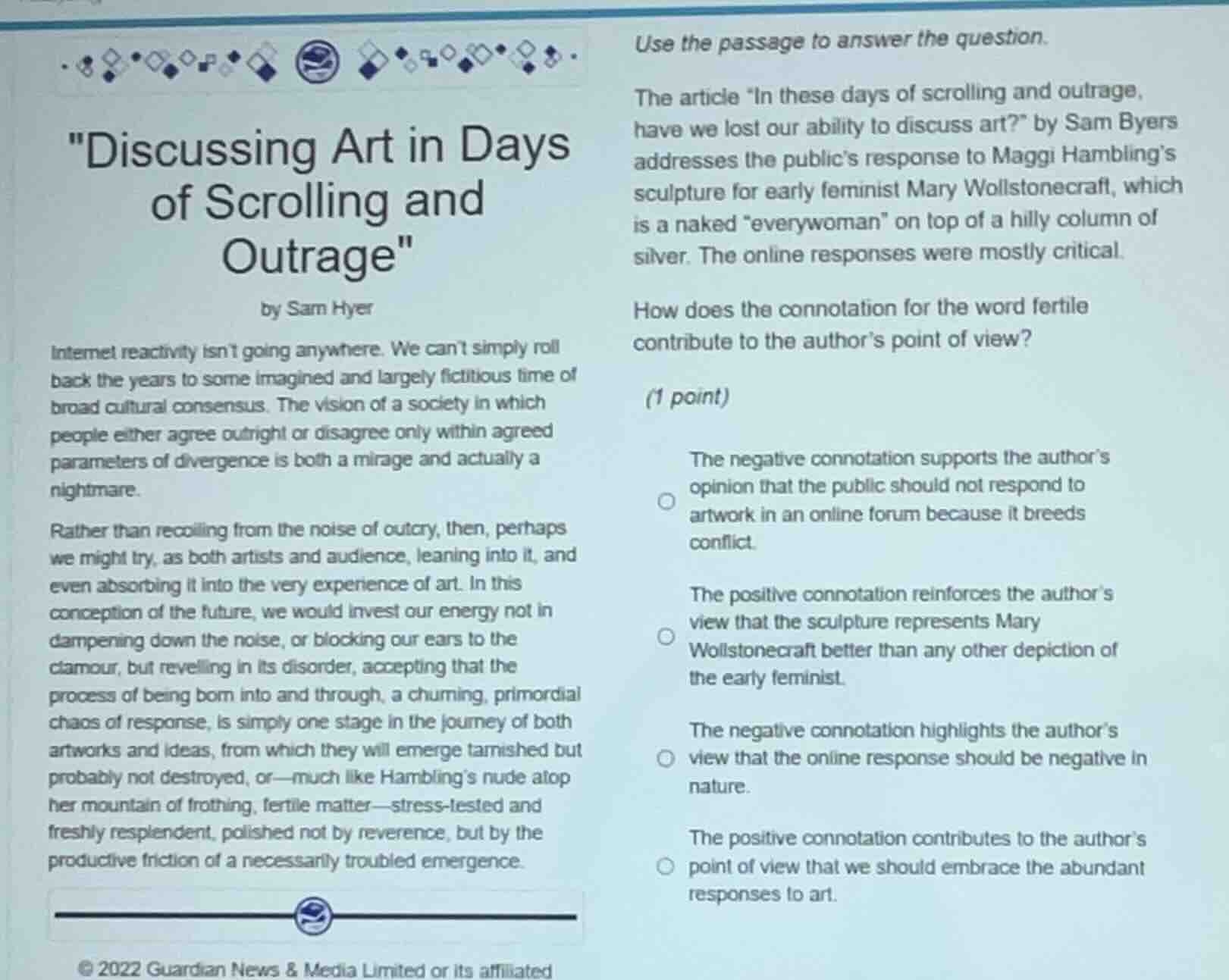
use the passage to answer the question.
the article “in these days of scrolling and outrage, have we lost our ability to discuss art?” by sam byers addresses the public’s response to maggi hambling’s sculpture for early feminist mary wollstonecraft, which is a naked “everywoman” on top of a hilly column of silver. the online responses were mostly critical.
how does the connotation for the word fertile contribute to the author’s point of view?
(1 point)
the negative connotation supports the author’s opinion that the public should not respond to artwork in an online forum because it breeds conflict.
the positive connotation reinforces the author’s view that the sculpture represents mary wollstonecraft better than any other depiction of the early feminist.
the negative connotation highlights the author’s view that the online response should be negative in nature.
the positive connotation contributes to the author’s point of view that we should embrace the abundant responses to art.
- Analyze the word "fertile" in the passage: The author uses "fertile matter" to describe the context of the artwork's response. "Fertile" has a positive connotation related to productivity, growth, or abundance.
- Evaluate each option:
- Option 1: The author does not say the public should not respond online; instead, they suggest embracing responses. Eliminate.
- Option 2: The passage does not compare the sculpture to other depictions of Mary Wollstonecraft. Eliminate.
- Option 3: The author does not think the online response should be negative by nature. Eliminate.
- Option 4: The positive connotation of "fertile" (relating to productivity, abundance) matches the author's view that we should embrace the abundant (productive) responses to art, as they see the "friction" of responses as part of the art's journey. This aligns with the text's message of leaning into the noise of outcry and accepting the chaotic responses as part of the art experience.

Snap & solve any problem in the app
Get step-by-step solutions on Sovi AI
Photo-based solutions with guided steps
Explore more problems and detailed explanations
The positive connotation contributes to the author’s point of view that we should embrace the abundant responses to art.