QUESTION IMAGE
Question
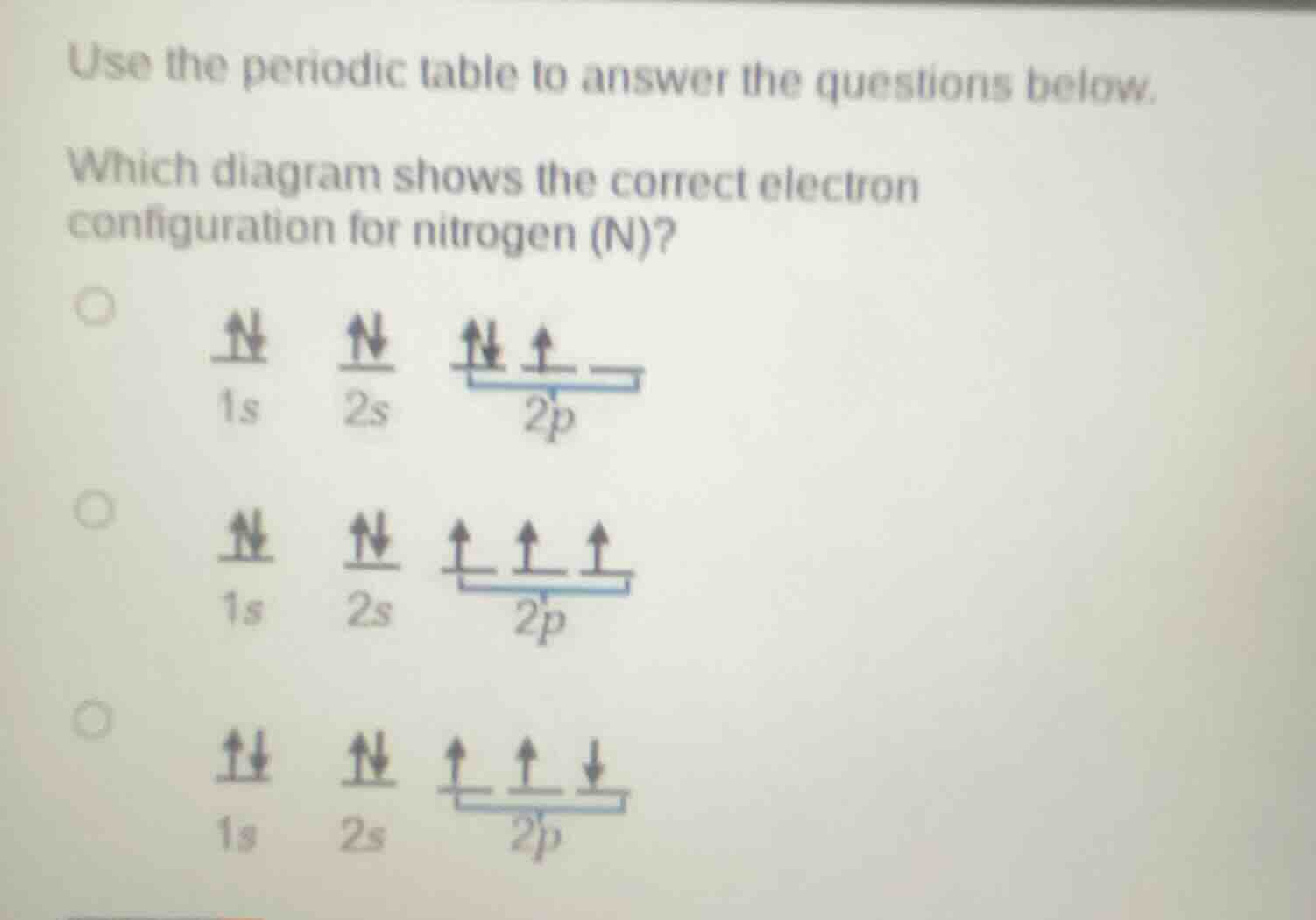
use the periodic table to answer the questions below. which diagram shows the correct electron configuration for nitrogen (n)? three multiple - choice options with electron configuration diagrams for 1s, 2s, 2p orbitals are provided
Brief Explanations
- First, recall the electron configuration of nitrogen (N). Nitrogen has an atomic number of 7, so its electron configuration is \(1s^2 2s^2 2p^3\).
- For the \(1s\) and \(2s\) orbitals, they are filled with two electrons each (paired, with opposite spins, represented as \(\uparrow\downarrow\)).
- For the \(2p\) orbitals, according to Hund's rule, electrons fill degenerate (same - energy) orbitals singly first, with parallel spins, before pairing up. Since there are 3 electrons in the \(2p\) sub - shell, each of the three \(2p\) orbitals will have one electron with parallel spins (all \(\uparrow\) or all \(\downarrow\), but typically drawn as \(\uparrow\) in such diagrams).
- Looking at the options:
- The first option has a paired electron and an unpaired electron in the \(2p\) sub - shell, which does not follow Hund's rule as it pairs electrons before filling all degenerate orbitals singly.
- The second option has the \(1s\) and \(2s\) orbitals filled with paired electrons (\(\uparrow\downarrow\)) and the three \(2p\) orbitals each with one unpaired electron (all \(\uparrow\)), which follows the electron configuration rules (Aufbau principle, Pauli exclusion principle, and Hund's rule).
- The third option has a mix of spin directions in the \(2p\) sub - shell, which does not follow Hund's rule (electrons in degenerate orbitals should have parallel spins when singly occupied).

Snap & solve any problem in the app
Get step-by-step solutions on Sovi AI
Photo-based solutions with guided steps
Explore more problems and detailed explanations
The second option (the one with \(1s\) and \(2s\) orbitals filled with \(\uparrow\downarrow\) and \(2p\) orbitals with three \(\uparrow\) electrons)