QUESTION IMAGE
Question
3
use a periodic table of the elements to answer these questions.
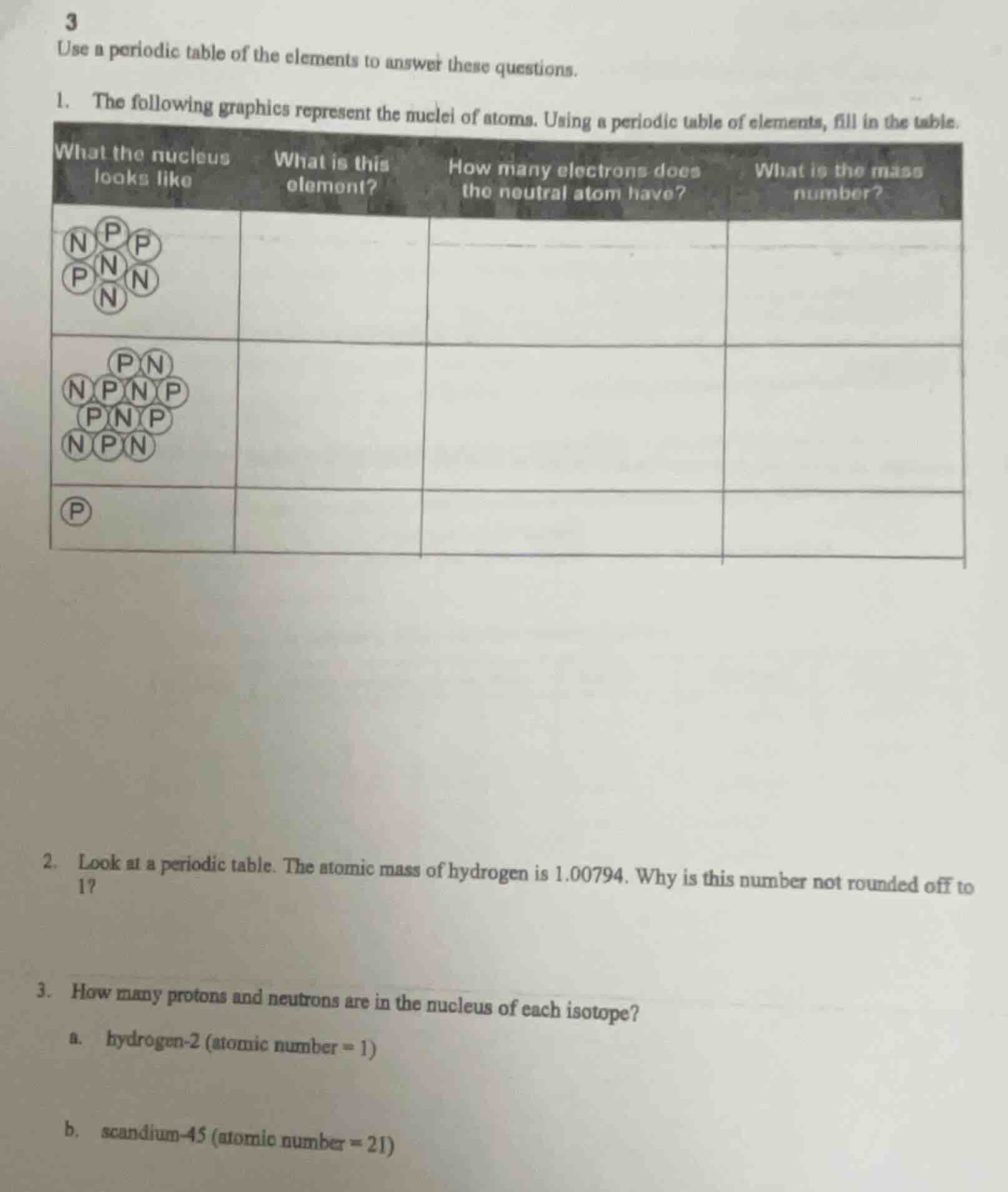
- the following graphics represent the nuclei of atoms. using a periodic table of elements, fill in the table.
| what the nucleus looks like | what is this element? | how many electrons does the neutral atom have? | what is the mass number? |
|---|---|---|---|
| (graphics of nucleus with p and n) | |||
| (graphics of nucleus with p) |
- look at a periodic table. the atomic mass of hydrogen is 1.00794. why is this number not rounded off to 1?
- how many protons and neutrons are in the nucleus of each isotope?
a. hydrogen-2 (atomic number = 1)
b. scandium-45 (atomic number = 21)
---
Part 1 Table:
Row 1:
Step1: Count protons (P)
Count = 3
Step2: Identify element (atomic number = proton count)
Atomic number 3 = Lithium (Li)
Step3: Neutral atom electrons = proton count
Electrons = 3
Step4: Mass number = protons + neutrons (N)
Mass number = $3 + 4 = 7$
Row 2:
Step1: Count protons (P)
Count = 11
Step2: Identify element (atomic number = proton count)
Atomic number 11 = Sodium (Na)
Step3: Neutral atom electrons = proton count
Electrons = 11
Step4: Mass number = protons + neutrons (N)
Mass number = $11 + 12 = 23$
Row 3:
Step1: Count protons (P)
Count = 1
Step2: Identify element (atomic number = proton count)
Atomic number 1 = Hydrogen (H)
Step3: Neutral atom electrons = proton count
Electrons = 1
Step4: Mass number = protons + neutrons (N)
Mass number = $1 + 0 = 1$
---
Part 2:
Step1: Define periodic table atomic mass
It is a weighted average of the masses of all naturally occurring isotopes of an element.
Step2: Apply to hydrogen
Hydrogen has isotopes (protium, deuterium, tritium). The weighted average of their masses (1.007825 u for protium, 2.014102 u for deuterium) results in 1.00794, not a whole number.
---
Part 3:
Subpart a:
Step1: Protons = atomic number
Protons = 1
Step2: Neutrons = mass number - atomic number
Neutrons = $2 - 1 = 1$
Subpart b:
Step1: Protons = atomic number
Protons = 21
Step2: Neutrons = mass number - atomic number
Neutrons = $45 - 21 = 24$

Snap & solve any problem in the app
Get step-by-step solutions on Sovi AI
Photo-based solutions with guided steps
Explore more problems and detailed explanations
1.
| What the nucleus looks like | What is this element? | How many electrons does the neutral atom have? | What is the mass number? |
|---|---|---|---|
| <img src="https://i.imgur.com/9X9Z7QH.png" width="120"> | Sodium (Na) | 11 | 23 |
| <img src="https://i.imgur.com/1X2Z3QH.png" width="40"> | Hydrogen (H) | 1 | 1 |
- The atomic mass is a weighted average of hydrogen's isotopes.
3.
a. 1 proton, 1 neutron
b. 21 protons, 24 neutrons