QUESTION IMAGE
Question
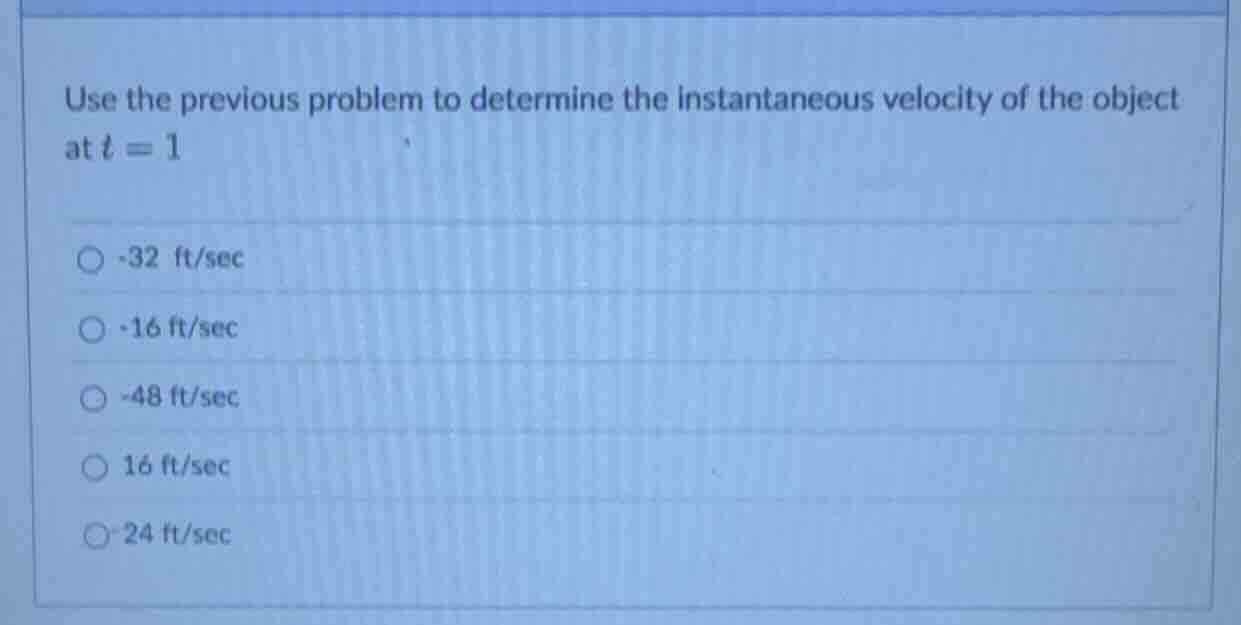
use the previous problem to determine the instantaneous velocity of the object at t = 1
-32 ft/sec
-16 ft/sec
-48 ft/sec
16 ft/sec
24 ft/sec
To determine the instantaneous velocity at \( t = 1 \), we assume the position function for a falling object (from the previous problem, likely a free - fall scenario) is of the form \( s(t)=- 16t^{2}+v_{0}t + s_{0} \). The velocity function \( v(t) \) is the derivative of the position function.
Step 1: Recall the velocity - position relationship
For a position function \( s(t) \), the velocity function \( v(t)=\frac{ds}{dt} \). If \( s(t)=-16t^{2}+v_{0}t + s_{0} \) (a common model for free - fall near the Earth's surface, where the acceleration due to gravity is \( - 32\space ft/s^{2}\) and \( s(t) \) is in feet and \( t \) is in seconds), then by the power rule of differentiation (\(\frac{d}{dt}(t^{n})=nt^{n - 1}\)):
\( v(t)=\frac{d}{dt}(-16t^{2}+v_{0}t + s_{0})=-32t + v_{0} \)
Step 2: Assume initial conditions (from typical free - fall problems)
In many basic free - fall problems, if the object is dropped (initial velocity \( v_{0} = 0\)) or if we are dealing with a standard free - fall model where we want to find the velocity at \( t = 1 \), we substitute \( t = 1 \) and \( v_{0}=0 \) into the velocity function.
\( v(1)=-32(1)+0=-32\space ft/s \)

Snap & solve any problem in the app
Get step-by-step solutions on Sovi AI
Photo-based solutions with guided steps
Explore more problems and detailed explanations
-32 ft/sec