QUESTION IMAGE
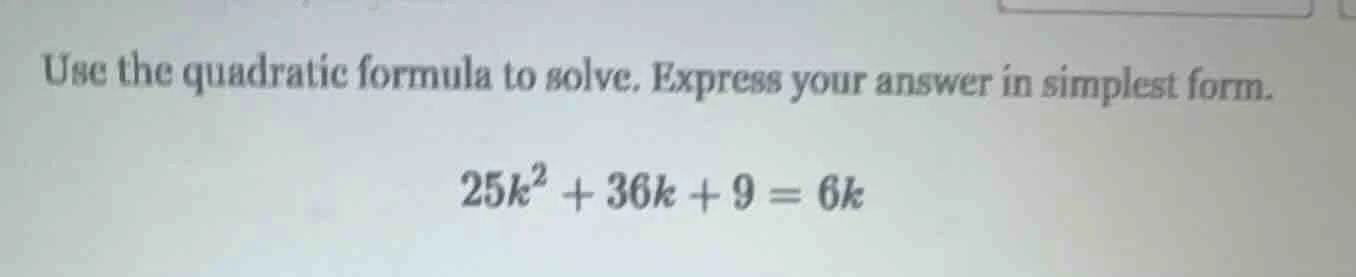
Question
use the quadratic formula to solve. express your answer in simplest form.
25k² + 36k + 9 = 6k
Step1: Rearrange the equation to standard quadratic form \(ax^2 + bx + c = 0\)
Subtract \(6k\) from both sides of the equation \(25k^2 + 36k + 9 = 6k\) to get:
\(25k^2 + 30k + 9 = 0\)
Here, \(a = 25\), \(b = 30\), \(c = 9\)
Step2: Recall the quadratic formula \(k=\frac{-b\pm\sqrt{b^2 - 4ac}}{2a}\)
Substitute the values of \(a\), \(b\), and \(c\) into the quadratic formula. First, calculate the discriminant \(D=b^2 - 4ac\)
\(D=(30)^2-4\times25\times9\)
\(D = 900 - 900\)
\(D=0\)
Step3: Solve for \(k\) using the quadratic formula
Since \(D = 0\), the formula becomes:
\(k=\frac{-30\pm\sqrt{0}}{2\times25}\)
\(k=\frac{-30\pm0}{50}\)
So, \(k=\frac{-30}{50}\) (simplify the fraction)
\(k =-\frac{3}{5}\) (both solutions are the same because the discriminant is zero, so we have a repeated root)

Snap & solve any problem in the app
Get step-by-step solutions on Sovi AI
Photo-based solutions with guided steps
Explore more problems and detailed explanations
\(k = -\frac{3}{5}\)