QUESTION IMAGE
Question
b. it does not use resting heart rate, so it is easier to estimate.
c. it accounts for discrepancies in resting heart rate.
d. this formula does not use an individuals resting heart rate, which likely makes the formula more accurate.
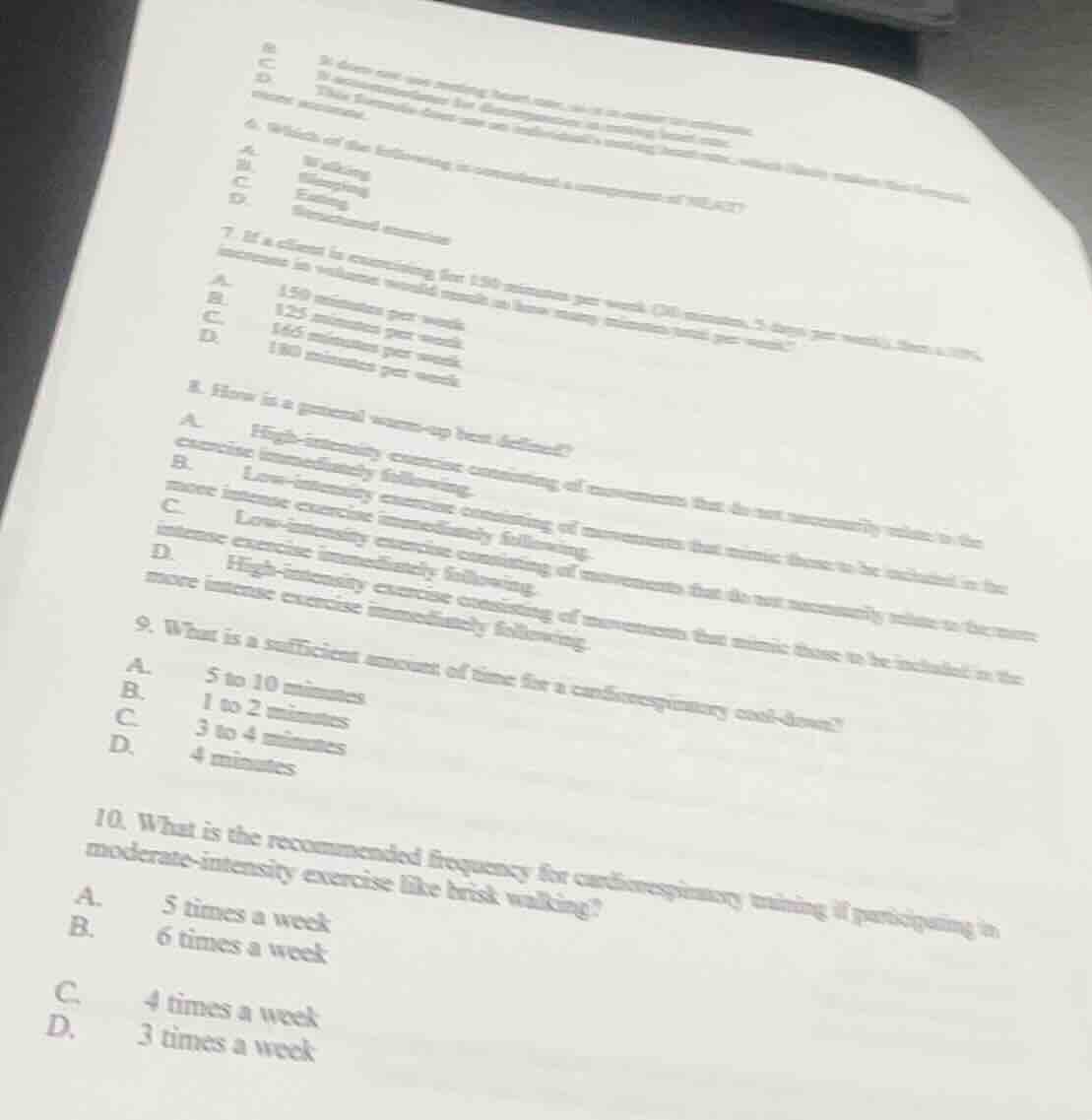
- which of the following is considered a component of neat?
a. walking
b. sleeping
c. eating
d. structured exercise
- if a client is exercising for 150 minutes per week (30 minutes, 5 days per week), then a 10% increase in volume would result in how many minutes total per week?
a. 150 minutes per week
b. 125 minutes per week
c. 165 minutes per week
d. 180 minutes per week
- how is a general warm-up best defined?
a. high-intensity exercise consisting of movements that do not necessarily relate to the exercise immediately following.
b. low-intensity exercise consisting of movements that mimic those to be included in the more intense exercise immediately following.
c. low-intensity exercise consisting of movements that do not necessarily relate to the more intense exercise immediately following.
d. high-intensity exercise consisting of movements that mimic those to be included in the more intense exercise immediately following.
- what is a sufficient amount of time for a cardiorespiratory cool-down?
a. 5 to 10 minutes
b. 1 to 2 minutes
c. 3 to 4 minutes
d. 4 minutes
- what is the recommended frequency for cardiorespiratory training if participating in moderate-intensity exercise like brisk walking?
a. 5 times a week
b. 6 times a week
c. 4 times a week
d. 3 times a week
- NEAT (Non-Exercise Activity Thermogenesis) refers to energy burned from non-exercise daily movements. Walking is a core non-exercise daily activity, while sleeping, eating, and structured exercise fall outside this definition.
- To find the new weekly minutes, calculate 10% of the original 150 minutes, then add it to the original total.
- A general warm-up uses low-intensity, movement-mimicking exercises to prepare the body for the upcoming main workout, done right before the more intense activity.
- Standard guidelines recommend 5 to 10 minutes of low-intensity movement for a proper cardiorespiratory cool-down to gradually lower heart rate and prevent complications.
- Leading health organizations (like the WHO) recommend moderate-intensity cardiorespiratory exercise such as brisk walking 5 times per week for optimal health benefits.

Snap & solve any problem in the app
Get step-by-step solutions on Sovi AI
Photo-based solutions with guided steps
Explore more problems and detailed explanations
- A. Walking
- D. 165 minutes per week
- B. Low-intensity exercise consisting of movements that mimic those to be included in the more intense exercise immediately following.
- A. 5 to 10 minutes
- A. 5 times a week