QUESTION IMAGE
Question
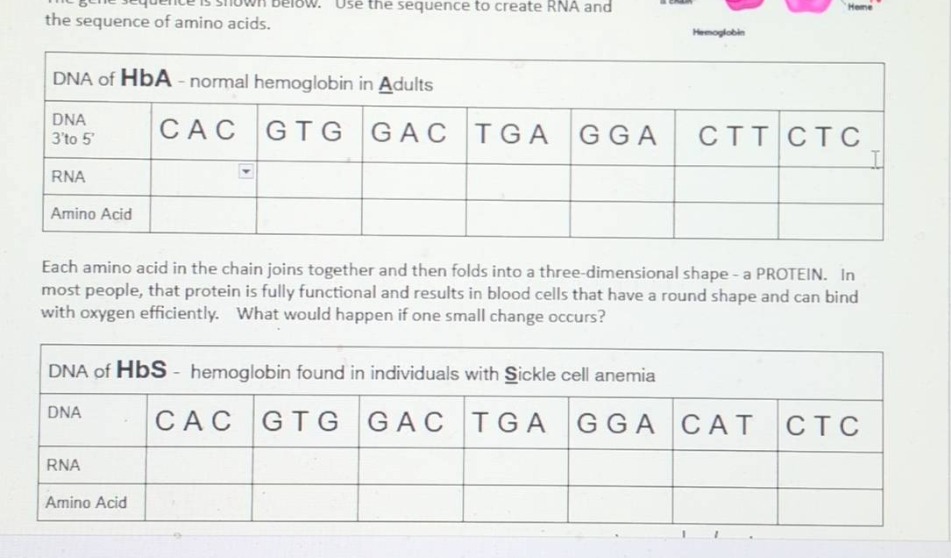
use the sequence to create rna and the sequence of amino acids. dna of hba - normal hemoglobin in adults dna 3to 5 cac gtg gac tga gga ctt ctc rna amino acid each amino acid in the chain joins together and then folds into a three - dimensional shape - a protein. in most people, that protein is fully functional and results in blood cells that have a round shape and can bind with oxygen efficiently. what would happen if one small change occurs? dna of hbs - hemoglobin found in individuals with sickle cell anemia dna cac gtg gac tga gga cat ctc rna amino acid
To solve for the RNA and amino acid sequences, we use the process of transcription (DNA to RNA) and translation (RNA to amino acids) with the genetic code.
For HbA (Normal Hemoglobin):
Step 1: Transcribe DNA to RNA (DNA \( 3' \to 5' \), so RNA is complementary \( 5' \to 3' \); A→U, T→A, C→G, G→C)
- DNA: \( \text{CAC} \) → RNA: \( \text{GUG} \)
- DNA: \( \text{GTG} \) → RNA: \( \text{CAC} \)
- DNA: \( \text{GAC} \) → RNA: \( \text{CUG} \)
- DNA: \( \text{TGA} \) → RNA: \( \text{ACU} \) (Wait, correction: DNA is \( 3' \to 5' \), so the template strand is \( 3' \to 5' \), so RNA synthesis is \( 5' \to 3' \), complementary. So \( \text{TGA} \) (3'→5') → RNA is \( \text{ACU} \)? No, wait, DNA base T pairs with RNA A, G with C, C with G, A with U. So \( \text{TGA} \) (DNA, 3'→5'): T→A, G→C, A→U → RNA is \( \text{ACU} \)? Wait, no, the DNA sequence given is \( 3' \to 5' \), so the coding strand (if we consider) would be \( 5' \to 3' \) as the reverse. Wait, maybe the DNA here is the template strand (3'→5'), so RNA is synthesized as 5'→3', complementary. So:
- \( \text{CAC} \) (DNA 3'→5'): C→G, A→U, C→G → RNA \( \text{GUG} \)
- \( \text{GTG} \) (DNA 3'→5'): G→C, T→A, G→C → RNA \( \text{CAC} \)
- \( \text{GAC} \) (DNA 3'→5'): G→C, A→U, C→G → RNA \( \text{CUG} \)
- \( \text{TGA} \) (DNA 3'→5'): T→A, G→C, A→U → RNA \( \text{ACU} \)? Wait, no, \( \text{TGA} \) (DNA) is T, G, A. So T→A, G→C, A→U → RNA is \( \text{ACU} \)? Wait, but \( \text{TGA} \) is a stop codon in DNA (if it were 5'→3'), but here DNA is 3'→5', so the RNA would be \( \text{ACU} \), which is a codon for Threonine. Wait, maybe the DNA sequence is the coding strand (5'→3') but written as 3'→5'? No, the problem says "DNA 3' to 5'". Let's proceed with base pairing:
Correcting: DNA (3'→5'): each base pairs with RNA (5'→3') as T↔A, G↔C, C↔G, A↔U.
So:
- \( \text{CAC} \) (DNA 3'→5'): C→G, A→U, C→G → RNA: \( \boldsymbol{\text{GUG}} \)
- \( \text{GTG} \) (DNA 3'→5'): G→C, T→A, G→C → RNA: \( \boldsymbol{\text{CAC}} \)
- \( \text{GAC} \) (DNA 3'→5'): G→C, A→U, C→G → RNA: \( \boldsymbol{\text{CUG}} \)
- \( \text{TGA} \) (DNA 3'→5'): T→A, G→C, A→U → RNA: \( \boldsymbol{\text{ACU}} \)
- \( \text{GGA} \) (DNA 3'→5'): G→C, G→C, A→U → RNA: \( \boldsymbol{\text{CCU}} \)
- \( \text{CTT} \) (DNA 3'→5'): C→G, T→A, T→A → RNA: \( \boldsymbol{\text{GAA}} \)
- \( \text{CTC} \) (DNA 3'→5'): C→G, T→A, C→G → RNA: \( \boldsymbol{\text{GAG}} \)
Step 2: Translate RNA to Amino Acids (using codon table)
- \( \text{GUG} \) → Valine (Val)
- \( \text{CAC} \) → Histidine (His)
- \( \text{CUG} \) → Leucine (Leu)
- \( \text{ACU} \) → Threonine (Thr)
- \( \text{CCU} \) → Proline (Pro)
- \( \text{GAA} \) → Glutamic Acid (Glu)
- \( \text{GAG} \) → Glutamic Acid (Glu)
For HbS (Sickle Cell Hemoglobin):
Step 1: Transcribe DNA to RNA (DNA \( 3' \to 5' \))
- DNA: \( \text{CAC} \) → RNA: \( \text{GUG} \)
- DNA: \( \text{GTG} \) → RNA: \( \text{CAC} \)
- DNA: \( \text{GAC} \) → RNA: \( \text{CUG} \)
- DNA: \( \text{TGA} \) → RNA: \( \text{ACU} \)
- DNA: \( \text{GGA} \) → RNA: \( \text{CCU} \)
- DNA: \( \text{CAT} \) (instead of \( \text{CTT} \) in HbA) → RNA: \( \text{GUA} \) (C→G, A→U, T→A)
- DNA: \( \text{CTC} \) → RNA: \( \text{GAG} \)
Step 2: Translate RNA to Amino Acids
- \( \text{GUG} \) → Valine (Val)
- \( \text{CAC} \) → Histidine (His)
- \( \text{CUG} \) → Leucine (Leu)
- \( \text{ACU} \) → Threonine (Thr)
- \( \text{CCU} \) → Proline (Pro)
- \( \text{GUA} \) → Valine (Val) (instead of Glu in HbA)
- \( \text{GAG} \) → Glutamic Acid (Glu)
Impact of the Mutation:
The DNA change i…

Snap & solve any problem in the app
Get step-by-step solutions on Sovi AI
Photo-based solutions with guided steps
Explore more problems and detailed explanations
(for the mutation impact):
A single base change in the DNA (from \( \text{CTT} \) to \( \text{CAT} \) in the \( 3' \to 5' \) strand) alters the RNA codon from \( \text{GAA} \) (coding for Glutamic Acid) to \( \text{GUA} \) (coding for Valine). This changes the amino acid sequence of hemoglobin, causing it to fold into an abnormal (sickle - shaped) structure. Sickle - shaped red blood cells are less efficient at carrying oxygen, can block blood vessels, and lead to the symptoms of sickle cell anemia (pain, organ damage, increased infection risk, etc.).
(For the tables, the filled RNA and amino acid sequences are as above.)