QUESTION IMAGE
Question
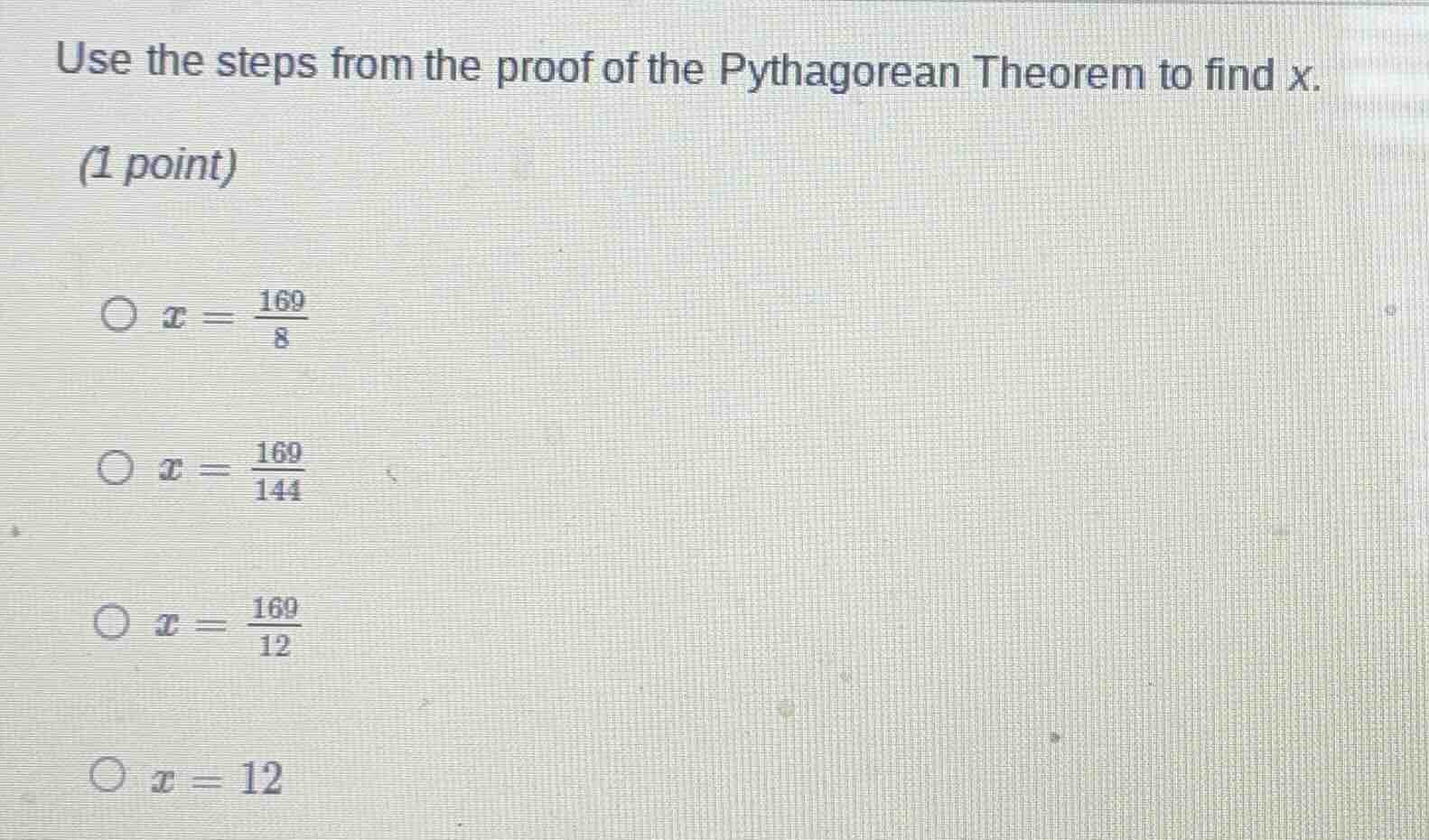
use the steps from the proof of the pythagorean theorem to find x. (1 point) \\(\bigcirc\\ x = \frac{169}{8}\\) \\(\bigcirc\\ x = \frac{169}{144}\\) \\(\bigcirc\\ x = \frac{169}{12}\\) \\(\bigcirc\\ x = 12\\)
To solve for \( x \) using the Pythagorean Theorem, we assume a right triangle context (since the Pythagorean Theorem applies to right triangles). The Pythagorean Theorem states that for a right triangle with legs \( a \), \( b \) and hypotenuse \( c \), \( a^2 + b^2 = c^2 \). However, in the context of geometric mean (which is related to the proof of the Pythagorean Theorem for right triangles with an altitude to the hypotenuse), if we have a right triangle with hypotenuse \( c \), and an altitude \( h \) to the hypotenuse, dividing the hypotenuse into segments \( p \) and \( q \), then \( p \times c = a^2 \), \( q \times c = b^2 \), and \( h^2 = p \times q \). But more likely, if we consider a right triangle where one leg is \( x \), another leg is 12, and hypotenuse is 13 (since \( 12^2 + 5^2 = 13^2 \), but maybe the segments are such that we use the geometric mean). Wait, actually, if we have a right triangle with hypotenuse 13, and one leg 12, then by Pythagorean Theorem:
Step 1: Recall the Pythagorean Theorem
For a right triangle with legs \( a \), \( b \) and hypotenuse \( c \), \( a^2 + b^2 = c^2 \). If we assume one leg is \( x \), another leg is 12, and hypotenuse is 13 (since \( 13^2 = 169 \), \( 12^2 = 144 \)), then:
Step 2: Apply the Pythagorean Theorem
Let \( a = x \), \( b = 12 \), \( c = 13 \). Then \( x^2 + 12^2 = 13^2 \)
Step 3: Solve for \( x^2 \)
\( x^2 = 13^2 - 12^2 \)
\( x^2 = 169 - 144 \)
\( x^2 = 25 \)
Wait, but that gives \( x = 5 \), which is not in the options. Alternatively, maybe we are using the geometric mean theorem (altitude-on-hypotenuse theorem). If we have a right triangle with hypotenuse \( c \), and an altitude \( h \) to the hypotenuse, dividing the hypotenuse into segments \( p \) and \( q \), then \( p \times c = a^2 \), \( q \times c = b^2 \), and \( h^2 = p \times q \). But maybe the problem is about a right triangle where one segment of the hypotenuse is 12, hypotenuse is 13, and we need to find the other segment? No, the options have \( \frac{169}{12} \), \( \frac{169}{144} \), etc. Wait, maybe the problem is about a right triangle where one leg is \( x \), and the other leg is the geometric mean between \( x \) and the hypotenuse? Wait, no. Wait, the options include \( x = \frac{169}{12} \), let's check:
If we consider the geometric mean theorem (also called the altitude-on-hypotenuse theorem), which states that in a right triangle, the length of a leg is the geometric mean of the length of the hypotenuse and the length of the adjacent segment. So if we have a right triangle, with hypotenuse \( c \), and a segment of the hypotenuse adjacent to leg \( a \) is \( p \), then \( a^2 = p \times c \). So if \( a = 13 \)? No, 13 is a common hypotenuse. Wait, maybe the hypotenuse is 13, and one segment is 12, then the other leg \( x \) would satisfy \( x^2 = 13 \times 12 \)? No, that would be \( x^2 = 156 \), which is not. Wait, no, the geometric mean theorem says that the leg is the geometric mean of the hypotenuse and the adjacent segment. So if the hypotenuse is \( c \), and the segment adjacent to leg \( a \) is \( p \), then \( a^2 = p \times c \). So if \( a = 13 \), \( p = 12 \), then \( 13^2 = 12 \times c \), so \( c = \frac{169}{12} \). Wait, maybe the problem is about a right triangle where the leg is 13, the adjacent segment is 12, and we need to find the hypotenuse \( x \). Then by the geometric mean theorem:
Step 1: Recall the geometric mean theorem (leg version)
In a right triangle, the square of a leg is equal to the product of the hypotenuse and the adjacent se…

Snap & solve any problem in the app
Get step-by-step solutions on Sovi AI
Photo-based solutions with guided steps
Explore more problems and detailed explanations
\( x = \frac{169}{12} \) (the third option: \( x = \frac{169}{12} \))