QUESTION IMAGE
Question
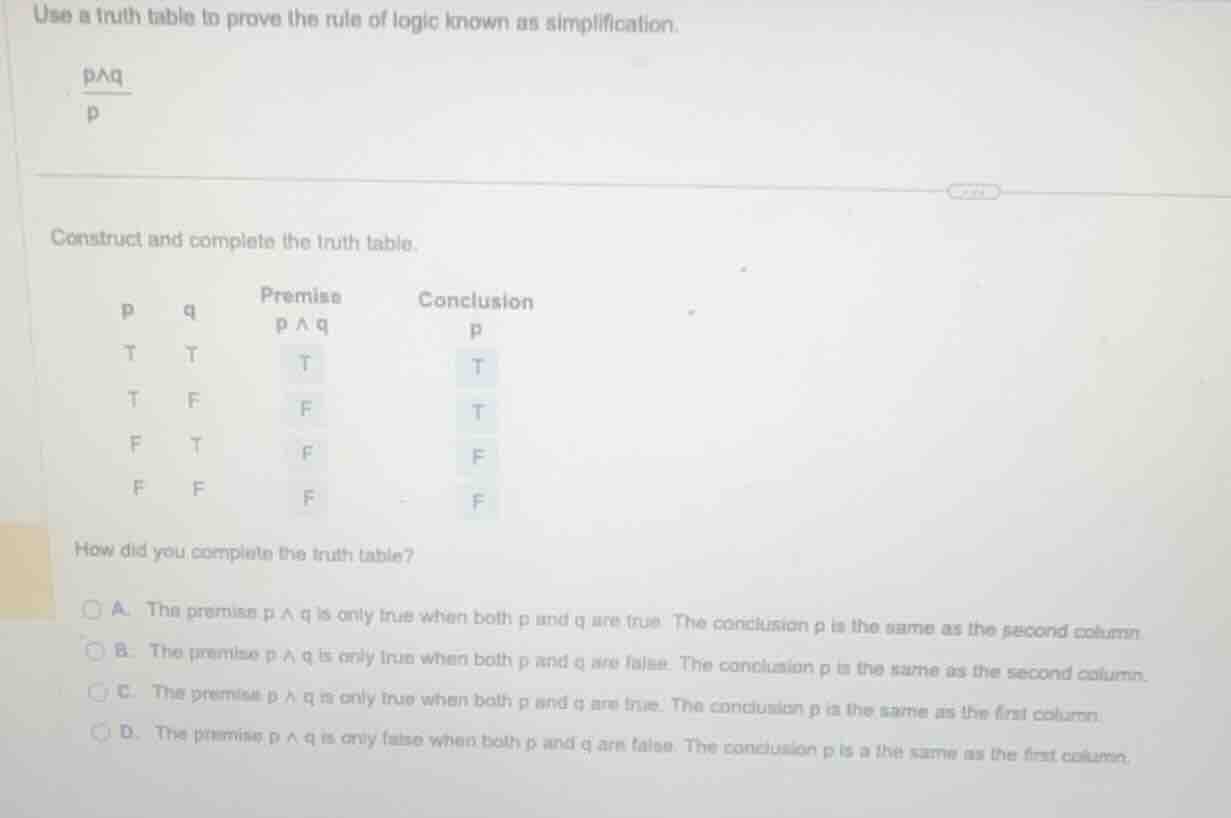
use a truth table to prove the rule of logic known as simplification.
\\(\frac{p wedge q}{p}\\)
construct and complete the truth table.
| p | q | premise \\(p wedge q\\) | conclusion \\(p\\) |
|---|---|---|---|
| t | f | f | t |
| f | t | f | f |
| f | f | f | f |
how did you complete the truth table?
\\(\bigcirc\\) a. the premise \\(p wedge q\\) is only true when both \\(p\\) and \\(q\\) are true. the conclusion \\(p\\) is the same as the second column.
\\(\bigcirc\\) b. the premise \\(p wedge q\\) is only true when both \\(p\\) and \\(q\\) are false. the conclusion \\(p\\) is the same as the second column.
\\(\bigcirc\\) c. the premise \\(p wedge q\\) is only true when both \\(p\\) and \\(q\\) are true. the conclusion \\(p\\) is the same as the first column.
\\(\bigcirc\\) d. the premise \\(p wedge q\\) is only false when both \\(p\\) and \\(q\\) are false. the conclusion \\(p\\) is a the same as the first column.
- For the premise $p \land q$ (logical AND), it is only true if both $p$ and $q$ are true; otherwise, it is false.
- The conclusion column is just the value of $p$, which matches the first column of the table.
- Match this logic to the given options.

Snap & solve any problem in the app
Get step-by-step solutions on Sovi AI
Photo-based solutions with guided steps
Explore more problems and detailed explanations
C. The premise p ∧ q is only true when both p and q are true. The conclusion p is the same as the first column.