QUESTION IMAGE
Question
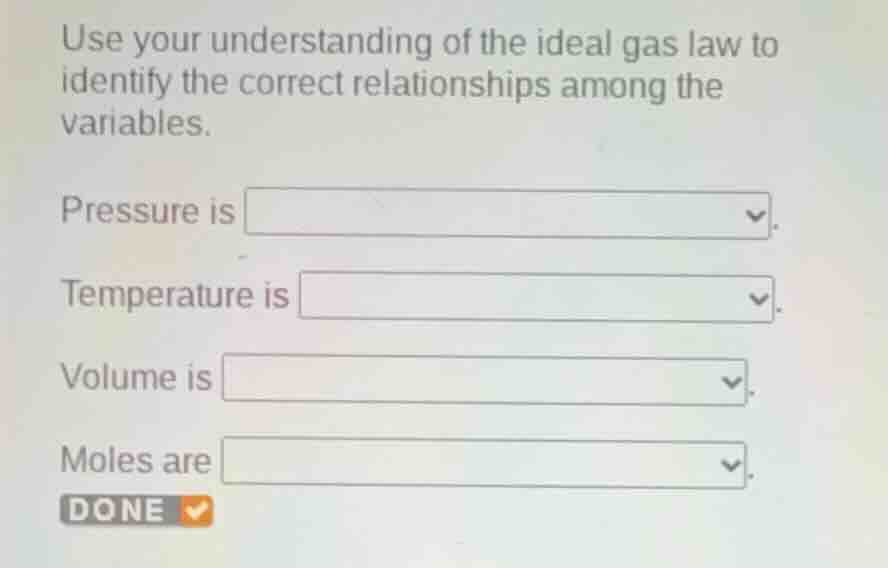
use your understanding of the ideal gas law to identify the correct relationships among the variables. pressure is. temperature is. volume is. moles are. done
The ideal gas law is \( PV = nRT \), where \( P \) is pressure, \( V \) is volume, \( n \) is the number of moles, \( T \) is temperature, and \( R \) is the gas constant.
- For pressure (\( P \)): From \( P=\frac{nRT}{V} \), pressure is directly proportional to temperature (\( T \)) and moles (\( n \)), and inversely proportional to volume (\( V \)) (when other variables are constant).
- For temperature (\( T \)): From \( T = \frac{PV}{nR} \), temperature is directly proportional to pressure (\( P \)) and volume (\( V \)), and inversely proportional to moles (\( n \)) (when other variables are constant).
- For volume (\( V \)): From \( V=\frac{nRT}{P} \), volume is directly proportional to temperature (\( T \)) and moles (\( n \)), and inversely proportional to pressure (\( P \)) (when other variables are constant).
- For moles (\( n \)): From \( n=\frac{PV}{RT} \), moles are directly proportional to pressure (\( P \)) and volume (\( V \)), and inversely proportional to temperature (\( T \)) (when other variables are constant).
Assuming the dropdowns have options like "directly proportional to..." or "inversely proportional to...", the relationships are:
- Pressure: Directly proportional to temperature and moles, inversely proportional to volume (e.g., if options are about proportionality to other variables, like "directly proportional to temperature and moles, inversely proportional to volume").
- Temperature: Directly proportional to pressure and volume, inversely proportional to moles.
- Volume: Directly proportional to temperature and moles, inversely proportional to pressure.
- Moles: Directly proportional to pressure and volume, inversely proportional to temperature.
(Note: The exact options in the dropdowns aren't provided, but based on ideal gas law, these are the relationships. If the dropdowns have options like "directly proportional to n and T, inversely proportional to V" for pressure, etc., those would be the correct selections.)

Snap & solve any problem in the app
Get step-by-step solutions on Sovi AI
Photo-based solutions with guided steps
Explore more problems and detailed explanations
- Pressure: Directly proportional to temperature and moles, inversely proportional to volume (exact wording depends on dropdown options, e.g., if options are "directly proportional to temperature and moles, inversely proportional to volume").
- Temperature: Directly proportional to pressure and volume, inversely proportional to moles (e.g., "directly proportional to pressure and volume, inversely proportional to moles").
- Volume: Directly proportional to temperature and moles, inversely proportional to pressure (e.g., "directly proportional to temperature and moles, inversely proportional to pressure").
- Moles: Directly proportional to pressure and volume, inversely proportional to temperature (e.g., "directly proportional to pressure and volume, inversely proportional to temperature").
(If the dropdowns have specific options like "directly proportional to temperature" or "inversely proportional to volume", the answers would match the ideal gas law - derived proportionalities. For example, if the options for pressure are "directly proportional to temperature" (correct, when n and V are constant), "inversely proportional to volume" (correct, when n and T are constant), etc.)