QUESTION IMAGE
Question
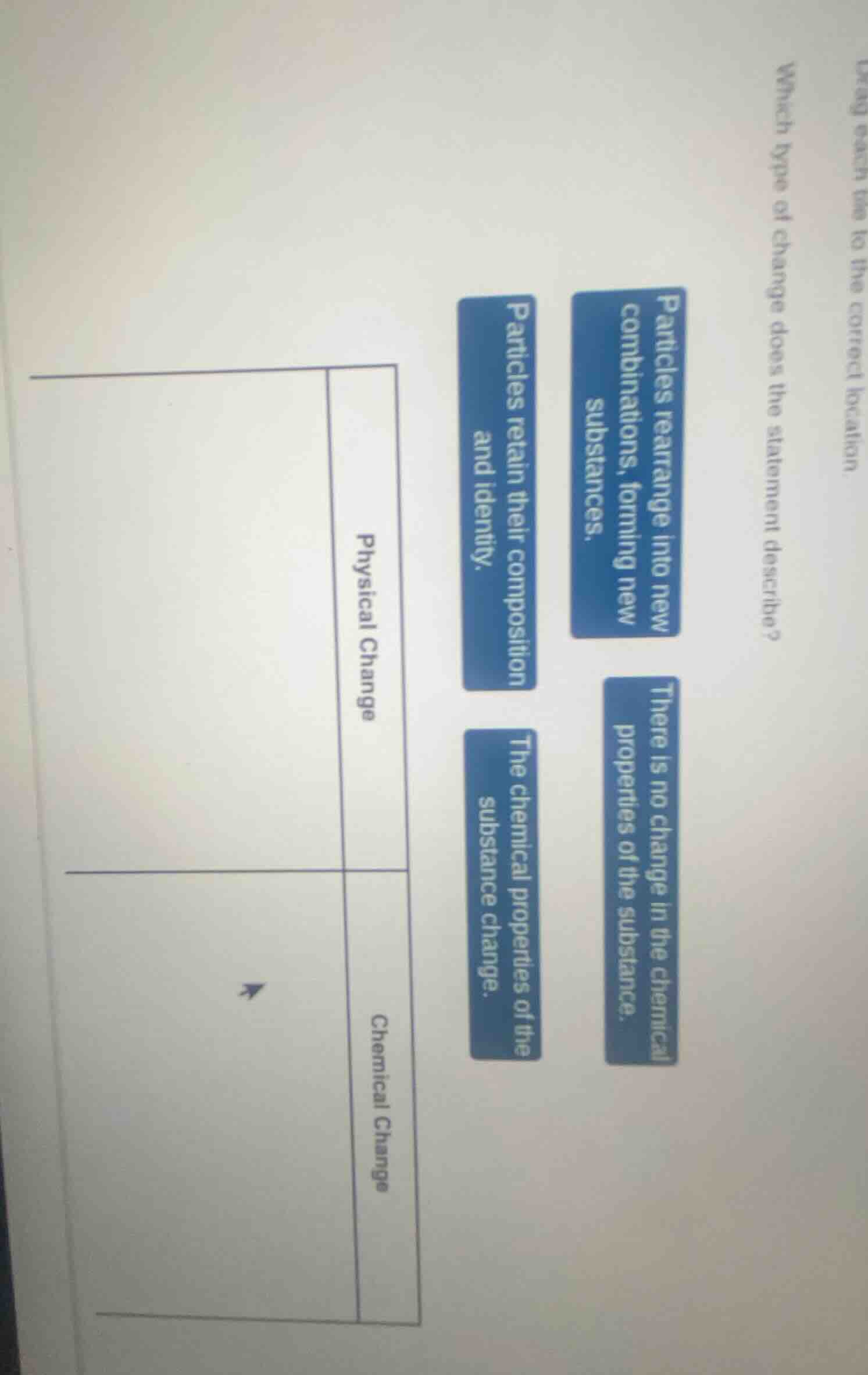
using each tile to the correct location. which type of change does the statement describe?
physical change
chemical change
tiles:
particles rearrange into new combinations, forming new substances.
there is no change in the chemical properties of the substance.
particles retain their composition and identity.
the chemical properties of the substance change.
To solve this, we analyze the characteristics of physical and chemical changes:
Physical Change (Cambios Físicos)
- “Particles retain their composition and identity”: In physical changes, the substance’s chemical identity (composition of particles) stays the same (e.g., melting ice, dissolving salt—water and salt particles remain, just arranged differently).
- “There is no change in the chemical properties of the substance”: Physical changes don’t alter the substance’s chemical nature (e.g., boiling water is still H₂O, no new substance forms).
Chemical Change (Cambios Químicos)
- “Particles rearrange into new combinations, forming new substances”: Chemical changes involve reactions where atoms bond differently, creating new compounds (e.g., burning wood forms CO₂, ash).
- “The chemical properties of the substance change”: New substances have different chemical properties (e.g., iron rusting forms Fe₂O₃, which reacts differently than iron).
Assigning to the Table:
| Tipo de Cambio | Descripciones Asociadas |
|---|---|
| Chemical Change | - Particles rearrange into new combinations, forming new substances<br>- The chemical properties of the substance change |
(If the task was to drag-and-drop, the left column labels “Physical Change” and “Chemical Change” are matched with the blue boxes as above.)
For example, drag:
- “Particles retain their composition and identity” → Physical Change
- “There is no change in the chemical properties of the substance” → Physical Change
- “Particles rearrange into new combinations, forming new substances” → Chemical Change
- “The chemical properties of the substance change” → Chemical Change

Snap & solve any problem in the app
Get step-by-step solutions on Sovi AI
Photo-based solutions with guided steps
Explore more problems and detailed explanations
To solve this, we analyze the characteristics of physical and chemical changes:
Physical Change (Cambios Físicos)
- “Particles retain their composition and identity”: In physical changes, the substance’s chemical identity (composition of particles) stays the same (e.g., melting ice, dissolving salt—water and salt particles remain, just arranged differently).
- “There is no change in the chemical properties of the substance”: Physical changes don’t alter the substance’s chemical nature (e.g., boiling water is still H₂O, no new substance forms).
Chemical Change (Cambios Químicos)
- “Particles rearrange into new combinations, forming new substances”: Chemical changes involve reactions where atoms bond differently, creating new compounds (e.g., burning wood forms CO₂, ash).
- “The chemical properties of the substance change”: New substances have different chemical properties (e.g., iron rusting forms Fe₂O₃, which reacts differently than iron).
Assigning to the Table:
| Tipo de Cambio | Descripciones Asociadas |
|---|---|
| Chemical Change | - Particles rearrange into new combinations, forming new substances<br>- The chemical properties of the substance change |
(If the task was to drag-and-drop, the left column labels “Physical Change” and “Chemical Change” are matched with the blue boxes as above.)
For example, drag:
- “Particles retain their composition and identity” → Physical Change
- “There is no change in the chemical properties of the substance” → Physical Change
- “Particles rearrange into new combinations, forming new substances” → Chemical Change
- “The chemical properties of the substance change” → Chemical Change