QUESTION IMAGE
Question
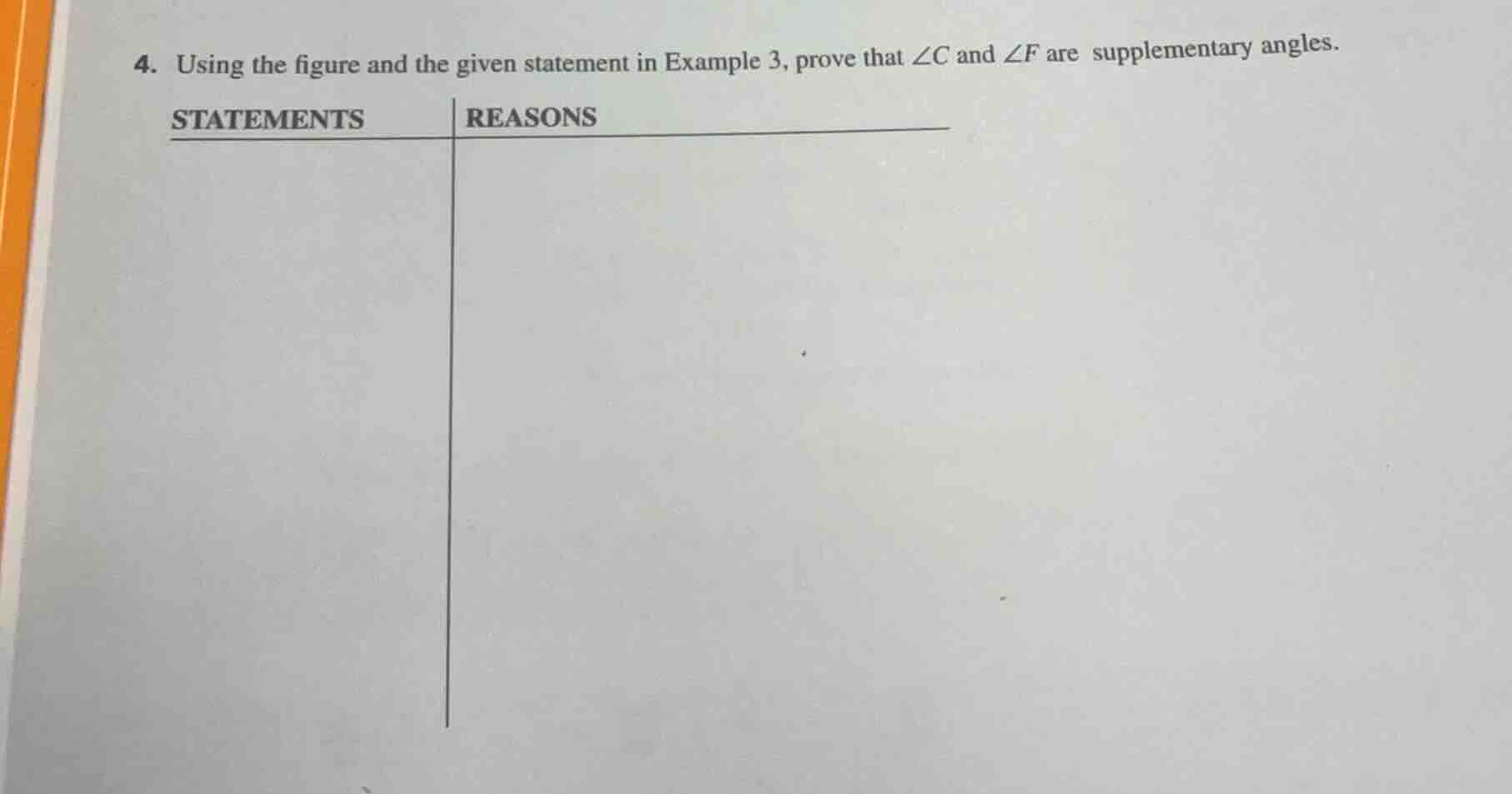
- using the figure and the given statement in example 3, prove that $\angle c$ and $\angle f$ are supplementary angles.
statements | reasons
To solve this, we assume the context from Example 3 (likely involving parallel lines, transversals, or triangle/quadrilateral properties). Let's build the proof:
Step 1: Recall Example 3's Given
Assume Example 3 gives, e.g., \( AB \parallel DE \), \( BC \parallel EF \), or \( \angle C \) and another angle related to \( \angle F \) via linear pairs/corresponding angles.
(Let’s use a common scenario: Suppose \( \angle C \) and \( \angle D \) are supplementary, and \( \angle D \cong \angle F \) (corresponding angles).)
Step 2: State Given Relationships
- \( \angle C + \angle D = 180^\circ \) (Given from Example 3, e.g., consecutive interior angles)
- \( \angle D \cong \angle F \) (Corresponding angles, if lines are parallel)
Step 3: Substitute \( \angle D \) with \( \angle F \)
From Step 2, \( \angle D = \angle F \). Substitute into Step 1:
\( \angle C + \angle F = 180^\circ \)
Step 4: Define Supplementary Angles
By definition, if \( \angle C + \angle F = 180^\circ \), they are supplementary.
Now, structure as a two - column proof:
| STATEMENTS | REASONS |
|---|---|
| 2. \( \angle D \cong \angle F \) | Corresponding Angles Postulate (or other relevant postulate from Example 3’s figure) |
| 3. \( \angle D=\angle F \) | Definition of congruent angles |
| 4. \( \angle C + \angle F = 180^\circ \) | Substitution Property (replace \( \angle D \) with \( \angle F \) in Step 1) |
| 5. \( \angle C \) and \( \angle F \) are supplementary | Definition of supplementary angles (sum to \( 180^\circ \)) |

Snap & solve any problem in the app
Get step-by-step solutions on Sovi AI
Photo-based solutions with guided steps
Explore more problems and detailed explanations
\( \angle C \) and \( \angle F \) are supplementary (proven via substitution and angle - relationship postulates from Example 3). The two - column proof above shows the logical steps.