QUESTION IMAGE
Question
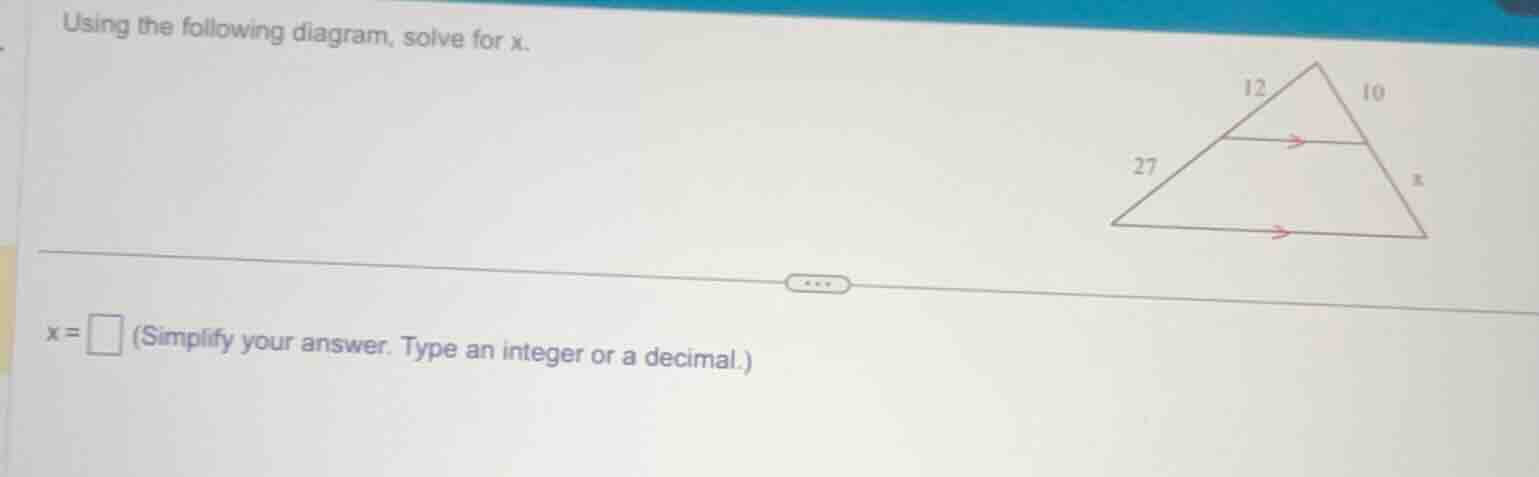
using the following diagram, solve for x.
x = \square (simplify your answer. type an integer or a decimal.)
Step1: Identify Similar Triangles
The diagram shows a triangle with a line parallel to the base, creating two similar triangles. By the Basic Proportionality Theorem (Thales' theorem), the sides are proportional. So, we set up the proportion: $\frac{12}{12 + 27} = \frac{10}{10 + x}$? Wait, no, actually, the segments on the left side are 12 (top) and 27 (bottom part), so the total left side is $12 + 27 = 39$? Wait, no, maybe the smaller triangle has sides 12 and 10, and the larger triangle has sides $12 + 27 = 39$ and $10 + x$? Wait, no, the line is parallel, so the triangles are similar, so the ratio of corresponding sides is equal. So the ratio of the left side of the smaller triangle to the left side of the larger triangle should equal the ratio of the right side of the smaller triangle to the right side of the larger triangle. So the left side of the smaller triangle is 12, the left side of the larger triangle is $12 + 27 = 39$? Wait, no, maybe the smaller triangle has side 12, and the larger triangle (the whole thing) has side $12 + 27 = 39$? Wait, no, looking at the diagram, the top segment of the left side is 12, the bottom segment (from the parallel line to the base) is 27, so the total left side length is $12 + 27 = 39$. The right side of the smaller triangle is 10, and the right side of the larger triangle is $10 + x$? Wait, no, maybe the parallel line divides the sides proportionally. So the ratio of the upper segment to the lower segment on the left side is equal to the ratio of the upper segment to the lower segment on the right side. Wait, no, the correct proportion is that the ratio of the length of the smaller triangle's side to the larger triangle's side is equal for corresponding sides. So if the smaller triangle has left side 12 and right side 10, and the larger triangle has left side $12 + 27 = 39$ and right side $10 + x$? Wait, no, maybe the parallel line creates a smaller similar triangle, so the ratio of the sides of the smaller triangle to the larger triangle is $\frac{12}{12 + 27} = \frac{10}{10 + x}$? Wait, no, that might not be right. Wait, actually, the parallel line divides the two sides proportionally, so the ratio of the upper part to the lower part on the left side is equal to the ratio of the upper part to the lower part on the right side. Wait, the left side: upper part is 12, lower part is 27. The right side: upper part is 10, lower part is x. So the proportion is $\frac{12}{27} = \frac{10}{x}$? Wait, no, that would be if the upper and lower parts are proportional. Wait, no, the correct proportionality for similar triangles (by the Basic Proportionality Theorem) is that if a line is drawn parallel to one side of a triangle, it divides the other two sides proportionally. So the ratio of the segment of the first side (from the vertex to the parallel line) to the segment of the first side (from the parallel line to the base) is equal to the ratio of the segment of the second side (from the vertex to the parallel line) to the segment of the second side (from the parallel line to the base). So in this case, the first side (left) has segment from vertex to parallel line: 12, and from parallel line to base: 27. The second side (right) has segment from vertex to parallel line: 10, and from parallel line to base: x. Wait, no, that would be if the parallel line is between the vertex and the base, so the two segments on the left are 12 (upper) and 27 (lower), and on the right are 10 (upper) and x (lower). Then the proportion is $\frac{12}{27} = \frac{10}{x}$? Wait, no, that's not correct. The correct proport…

Snap & solve any problem in the app
Get step-by-step solutions on Sovi AI
Photo-based solutions with guided steps
Explore more problems and detailed explanations
22.5