QUESTION IMAGE
Question
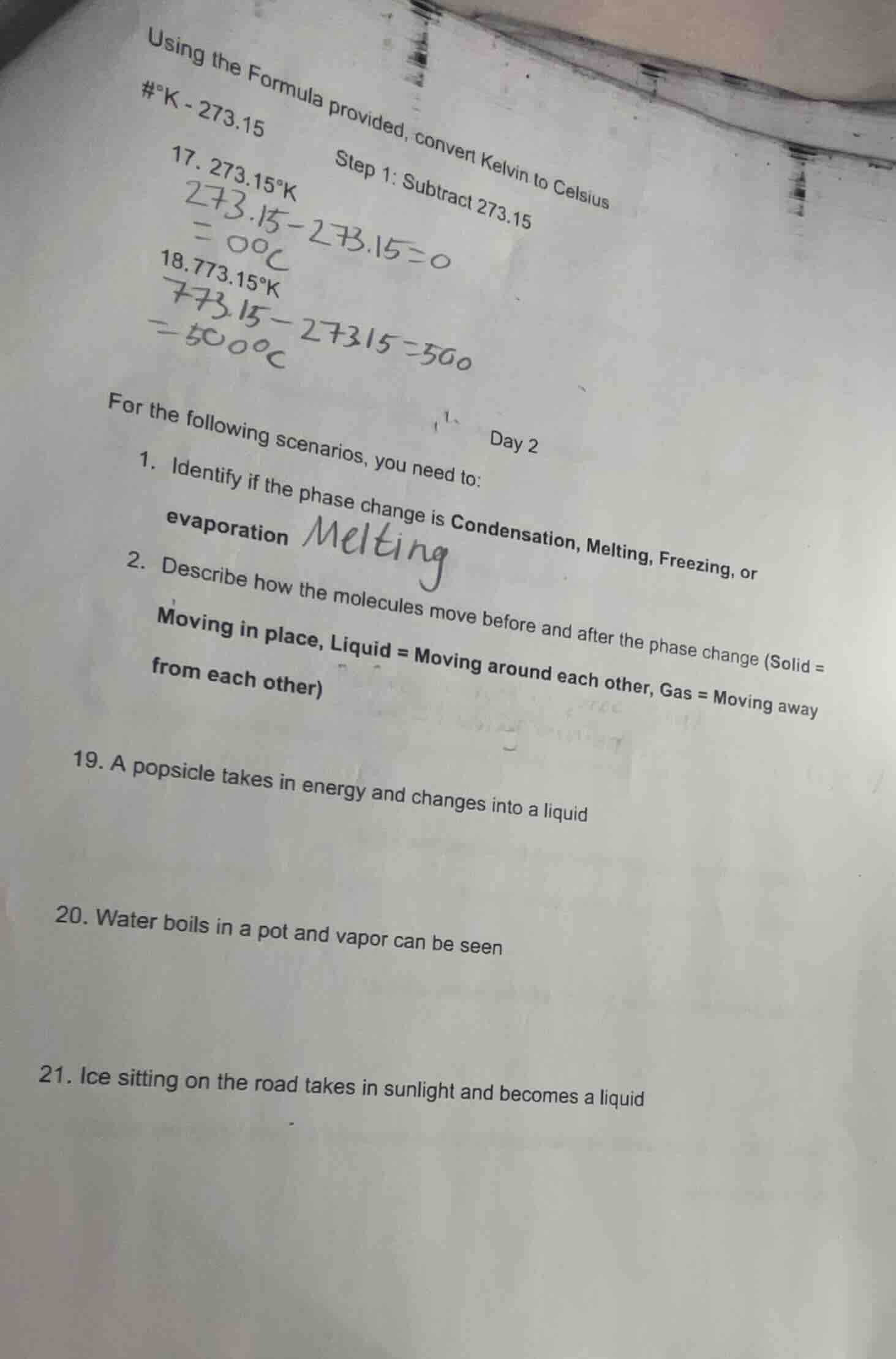
using the formula provided, convert kelvin to celsius #°k - 273.15 step 1: subtract 273.15 17. 273.15°k 18.773.15°k day 2 for the following scenarios, you need to: 1. identify if the phase change is condensation, melting, freezing, or evaporation 2. describe how the molecules move before and after the phase change (solid = moving in place, liquid = moving around each other, gas = moving away from each other) 19. a popsicle takes in energy and changes into a liquid 20. water boils in a pot and vapor can be seen 21. ice sitting on the road takes in sunlight and becomes a liquid
Response
Question 19
Brief Explanations
- Phase Change Identification: A popsicle is a solid (frozen water - ice). When it takes in energy and changes to a liquid, this process is melting. Melting is the phase change from solid to liquid, which requires energy (endothermic process).
- Molecular Movement Description:
- Before (Solid - Popsicle): In the solid state (ice), the water molecules are in a fixed, ordered arrangement. They vibrate in place (since the intermolecular forces are strong enough to hold them in a rigid structure, restricting their movement to just vibrating around their fixed positions).
- After (Liquid): When it melts into a liquid (water), the molecules gain enough energy to overcome some of the intermolecular forces. Now, the molecules can move around each other (they have more freedom of movement compared to the solid state; the intermolecular forces are still present but weaker than in the solid, allowing the molecules to slide past one another).
Brief Explanations
- Phase Change Identification: Water in a pot is a liquid. When it boils and turns into vapor (gas), this process is evaporation (specifically, boiling is a type of rapid evaporation that occurs at the boiling point throughout the liquid). Evaporation is the phase change from liquid to gas, which requires energy (endothermic, as heat is added to the water to make it boil).
- Molecular Movement Description:
- Before (Liquid - Water): In the liquid state, water molecules are moving around each other. They are close together, and the intermolecular forces are moderate (stronger than in gas, weaker than in solid), allowing them to slide past one another but still stay relatively close.
- After (Gas - Water Vapor): When it turns into gas (vapor), the molecules gain a large amount of energy. Now, the molecules move away from each other (the intermolecular forces are very weak, and the molecules have enough kinetic energy to move freely and spread out, filling the available space).
Brief Explanations
- Phase Change Identification: Ice on the road is a solid. When it takes in sunlight (energy) and changes to a liquid (water), this process is melting. Similar to the popsicle example, melting is the transition from solid (ice) to liquid (water) due to the absorption of energy (sunlight provides the heat energy here).
- Molecular Movement Description:
- Before (Solid - Ice): In the solid ice, the water molecules are in a rigid, ordered structure. They vibrate in place (the strong intermolecular forces in the solid hold them in fixed positions, and their movement is limited to vibrating around those positions).
- After (Liquid - Water): When it melts into liquid water, the molecules absorb energy from the sunlight. This energy allows them to overcome some of the intermolecular forces. Now, the molecules can move around each other (they have more mobility; the intermolecular forces are weaker than in the solid, so the molecules can slide past one another, forming the liquid state).

Snap & solve any problem in the app
Get step-by-step solutions on Sovi AI
Photo-based solutions with guided steps
Explore more problems and detailed explanations
- Phase Change: Melting
- Molecular Movement:
- Before: Molecules are moving (vibrating) in place (solid state).
- After: Molecules are moving around each other (liquid state).