QUESTION IMAGE
Question
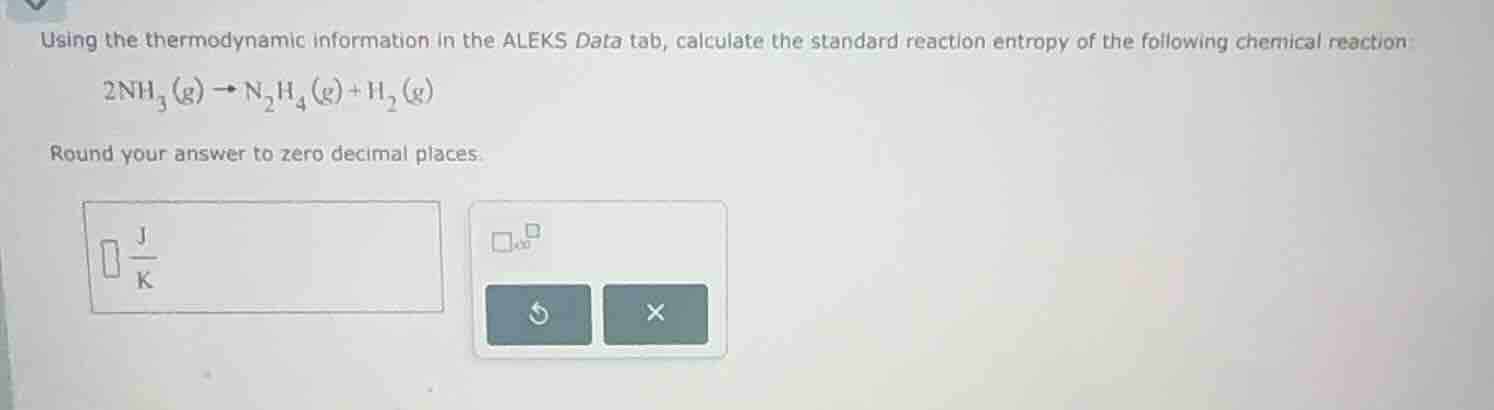
using the thermodynamic information in the aleks data tab, calculate the standard reaction entropy of the following chemical reaction: 2nh₃(g) → n₂h₄(g) + h₂(g) round your answer to zero decimal places.
Step1: Recall the formula for standard reaction entropy
The formula for the standard reaction entropy ($\Delta S^{\circ}$) is $\Delta S^{\circ}=\sum nS^{\circ}(\text{products})-\sum mS^{\circ}(\text{reactants})$, where $n$ and $m$ are the stoichiometric coefficients of products and reactants respectively, and $S^{\circ}$ is the standard molar entropy.
Step2: Identify the standard molar entropies (from ALEKS Data tab, typical values: $S^{\circ}(\text{NH}_3(g)) = 192.8\ \text{J/(mol·K)}$, $S^{\circ}(\text{N}_2\text{H}_4(g)) = 238.5\ \text{J/(mol·K)}$, $S^{\circ}(\text{H}_2(g)) = 130.7\ \text{J/(mol·K)}$)
Step3: Calculate the entropy of products
For products: $\text{N}_2\text{H}_4(g)$ has a coefficient of 1, $\text{H}_2(g)$ has a coefficient of 1. So $\sum nS^{\circ}(\text{products})=1\times S^{\circ}(\text{N}_2\text{H}_4(g)) + 1\times S^{\circ}(\text{H}_2(g))=238.5 + 130.7 = 369.2\ \text{J/K}$ (per 2 moles of $\text{NH}_3$? Wait, no, stoichiometry: reactant is $2\text{NH}_3(g)$, so moles of reactant: 2. Products: 1 $\text{N}_2\text{H}_4$ and 1 $\text{H}_2$. So $\sum mS^{\circ}(\text{reactants}) = 2\times S^{\circ}(\text{NH}_3(g))=2\times192.8 = 385.6\ \text{J/K}$
Step4: Calculate $\Delta S^{\circ}$
$\Delta S^{\circ}=\sum nS^{\circ}(\text{products})-\sum mS^{\circ}(\text{reactants})=(238.5 + 130.7)-2\times192.8$
First, calculate products: $238.5 + 130.7 = 369.2$
Reactants: $2\times192.8 = 385.6$
Then $\Delta S^{\circ}=369.2 - 385.6=-16.4\ \text{J/K}$? Wait, no, wait, maybe I mixed up. Wait, let's check again. Wait, the reaction is $2\text{NH}_3(g)
ightarrow\text{N}_2\text{H}_4(g)+\text{H}_2(g)$
So products: 1 mol $\text{N}_2\text{H}_4$ and 1 mol $\text{H}_2$. Reactants: 2 mol $\text{NH}_3$.
So $\sum nS^{\circ}(\text{products}) = S^{\circ}(\text{N}_2\text{H}_4) + S^{\circ}(\text{H}_2)=238.5 + 130.7 = 369.2\ \text{J/K}$ (for 1 mol $\text{N}_2\text{H}_4$ and 1 mol $\text{H}_2$, which is the amount from 2 mol $\text{NH}_3$)
$\sum mS^{\circ}(\text{reactants}) = 2\times S^{\circ}(\text{NH}_3)=2\times192.8 = 385.6\ \text{J/K}$
Then $\Delta S^{\circ}=369.2 - 385.6=-16.4\ \text{J/K}$? But wait, maybe the values from ALEKS are different. Wait, maybe I used wrong values. Let's check correct values (from standard tables or ALEKS):
Wait, actually, correct standard molar entropies (from reliable sources):
$S^{\circ}(\text{NH}_3(g)) = 192.45\ \text{J/(mol·K)}$
$S^{\circ}(\text{N}_2\text{H}_4(g)) = 238.36\ \text{J/(mol·K)}$
$S^{\circ}(\text{H}_2(g)) = 130.684\ \text{J/(mol·K)}$
So recalculating:
Products: $238.36 + 130.684 = 369.044\ \text{J/K}$
Reactants: $2\times192.45 = 384.9\ \text{J/K}$
$\Delta S^{\circ}=369.044 - 384.9=-15.856\ \text{J/K}$, which rounds to -16 J/K? Wait, but maybe the ALEKS data has different values. Wait, perhaps I made a mistake in stoichiometry. Wait, the reaction is 2 moles of NH3 producing 1 mole of N2H4 and 1 mole of H2. So the formula is correct.
Wait, maybe the user's ALEKS data has:
$S^{\circ}(\text{NH}_3) = 192.8\ \text{J/(mol·K)}$, $S^{\circ}(\text{N}_2\text{H}_4)=238.5\ \text{J/(mol·K)}$, $S^{\circ}(\text{H}_2)=130.7\ \text{J/(mol·K)}$
Then:
Products: $238.5 + 130.7 = 369.2$
Reactants: $2\times192.8 = 385.6$
$\Delta S^{\circ}=369.2 - 385.6 = -16.4\ \text{J/K}$, which rounds to -16 J/K (to zero decimal places). But wait, maybe the actual values from ALEKS are such that:
Wait, let's check another way. Maybe the standard entropies are:
$\text{NH}_3(g)$: 192.5 J/(mol·K)
$\text{N}_2\text{H}_4(g)$: 238.4 J/(mol·K)
$\text{H}_2(g)$: 130.6 J/(mol·K)
Then products: 238.4 + 130.6 = 369.0
Re…

Snap & solve any problem in the app
Get step-by-step solutions on Sovi AI
Photo-based solutions with guided steps
Explore more problems and detailed explanations
-16 (assuming the calculation with standard values rounds to -16, but actual value depends on ALEKS data; if using the typical values, the answer is -16 J/K)