QUESTION IMAGE
Question
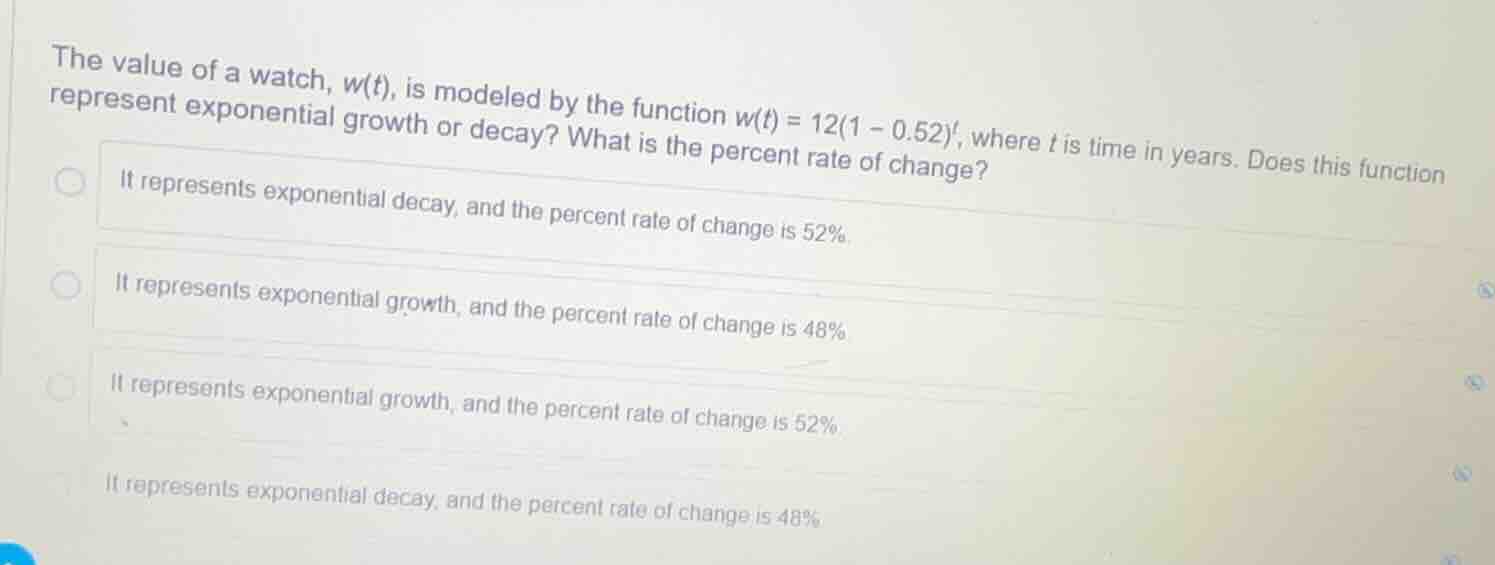
the value of a watch, w(t), is modeled by the function $w(t) = 12(1 - 0.52)^t$, where t is time in years. does this function represent exponential growth or decay? what is the percent rate of change?
- it represents exponential decay, and the percent rate of change is 52%.
- it represents exponential growth, and the percent rate of change is 48%.
- it represents exponential growth, and the percent rate of change is 52%.
- it represents exponential decay, and the percent rate of change is 48%.
Step1: Recall exponential function form
The general form of an exponential function is \( w(t) = a(1 + r)^t \) for growth (where \( r>0 \)) and \( w(t) = a(1 - r)^t \) for decay (where \( r>0 \)), where \( a \) is the initial value and \( r \) is the percent rate of change (in decimal).
Step2: Analyze the given function
The given function is \( w(t) = 12(1 - 0.52)^t \). Comparing with the decay form \( w(t) = a(1 - r)^t \), we see that \( 1 - r = 1 - 0.52 \), so \( r = 0.52 \). To convert \( r \) to a percentage, we multiply by 100: \( 0.52\times100 = 52\% \). Since the base of the exponent is \( 1 - 0.52 = 0.48 \), which is less than 1, the function represents exponential decay.

Snap & solve any problem in the app
Get step-by-step solutions on Sovi AI
Photo-based solutions with guided steps
Explore more problems and detailed explanations
It represents exponential decay, and the percent rate of change is 52% (the first option: "It represents exponential decay, and the percent rate of change is 52%").