QUESTION IMAGE
Question
verb phrases
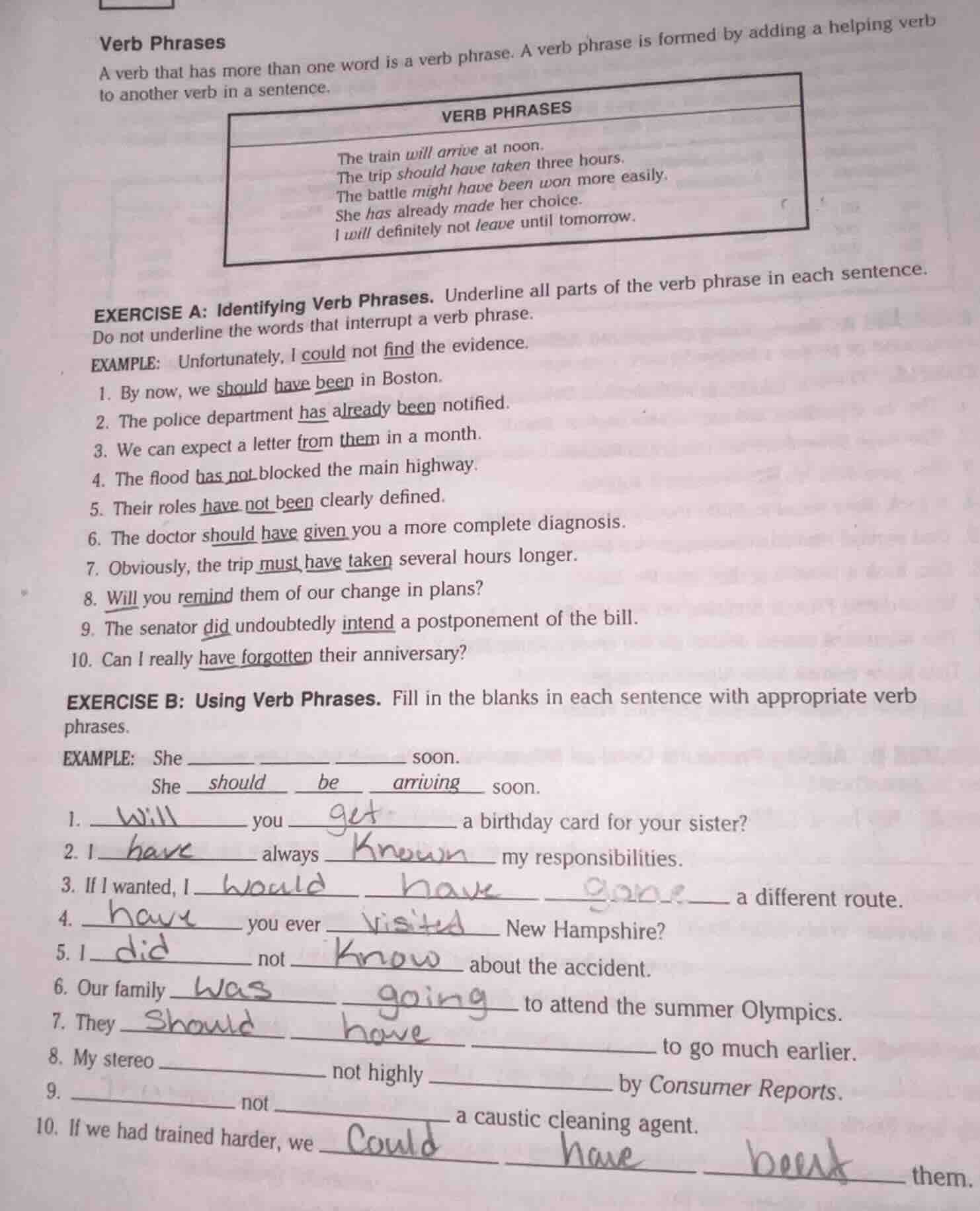
a verb that has more than one word is a verb phrase. a verb phrase is formed by adding a helping verb
to another verb in a sentence.
verb phrases
the train will arrive at noon.
the trip should have taken three hours.
the battle might have been won more easily.
she has already made her choice.
i will definitely not leave until tomorrow.
exercise a: identifying verb phrases. underline all parts of the verb phrase in each sentence.
do not underline the words that interrupt a verb phrase.
example: unfortunately, i could not find the evidence.
- by now, we should have been in boston.
- the police department has already been notified.
- we can expect a letter from them in a month.
- the flood has not blocked the main highway.
- their roles have not been clearly defined.
- the doctor should have given you a more complete diagnosis.
- obviously, the trip must have taken several hours longer.
- will you remind them of our change in plans?
- the senator did undoubtedly intend a postponement of the bill.
- can i really have forgotten their anniversary?
exercise b: using verb phrases. fill in the blanks in each sentence with appropriate verb
phrases.
example: she __ __ soon.
she should be arriving soon.
- will you get a birthday card for your sister?
- i have always known my responsibilities.
- if i wanted, i would have gone a different route.
- have you ever visited new hampshire?
- i did not know about the accident.
- our family was going to attend the summer olympics.
- they should have ____ to go much earlier.
- my stereo __ not highly __ by consumer reports.
- __ not __ a caustic cleaning agent.
- if we had trained harder, we could have beat them.
To solve the problems related to verb phrases (both identifying and using them), we analyze each exercise:
Exercise A: Identifying Verb Phrases
A verb phrase consists of a main verb and one or more helping (auxiliary) verbs. We underline all parts of the verb phrase, ignoring words that interrupt it.
- By now, we should have been in Boston.
Verb phrase: $\underline{\text{should}}$ $\underline{\text{have}}$ $\underline{\text{been}}$
- The police department has already been notified.
Verb phrase: $\underline{\text{has}}$ $\underline{\text{been}}$ (ignore "already")
- We can expect a letter from them in a month.
Verb phrase: $\underline{\text{can}}$ $\underline{\text{expect}}$
- The flood has not blocked the main highway.
Verb phrase: $\underline{\text{has}}$ $\underline{\text{blocked}}$ (ignore "not")
- Their roles have not been clearly defined.
Verb phrase: $\underline{\text{have}}$ $\underline{\text{been}}$ (ignore "not")
- The doctor should have given you a more complete diagnosis.
Verb phrase: $\underline{\text{should}}$ $\underline{\text{have}}$ $\underline{\text{given}}$
- Obviously, the trip must have taken several hours longer.
Verb phrase: $\underline{\text{must}}$ $\underline{\text{have}}$ $\underline{\text{taken}}$
- Will you remind them of our change in plans?
Verb phrase: $\underline{\text{Will}}$ $\underline{\text{remind}}$
- The senator did undoubtedly intend a postponement of the bill.
Verb phrase: $\underline{\text{did}}$ $\underline{\text{intend}}$ (ignore "undoubtedly")
- Can I really have forgotten their anniversary?
Verb phrase: $\underline{\text{Can}}$ $\underline{\text{have}}$ $\underline{\text{forgotten}}$
Exercise B: Using Verb Phrases
We fill in the blanks with appropriate verb phrases (auxiliary + main verb) based on context and grammar.
- ____ you ____ a birthday card for your sister?
Example: $\boldsymbol{\text{Will}}$; $\boldsymbol{\text{get}}$ (modal + main verb)
- I ____ always ____ my responsibilities.
Example: $\boldsymbol{\text{have}}$; $\boldsymbol{\text{known}}$ (present perfect: auxiliary + past participle)
- If I wanted, I ____ __ ____ a different route.
Example: $\boldsymbol{\text{would}}$; $\boldsymbol{\text{have}}$; $\boldsymbol{\text{taken}}$ (past conditional: modal + perfect infinitive)
- ____ you ever ____ New Hampshire?
Example: $\boldsymbol{\text{Have}}$; $\boldsymbol{\text{visited}}$ (present perfect: auxiliary + past participle)
- I ____ not ____ about the accident.
Example: $\boldsymbol{\text{did}}$; $\boldsymbol{\text{know}}$ (simple past: auxiliary + base verb)
- Our family ____ ____ to attend the summer Olympics.
Example: $\boldsymbol{\text{was}}$; $\boldsymbol{\text{going}}$ (past progressive: auxiliary + present participle)
- They ____ __ ____ to go much earlier.
Example: $\boldsymbol{\text{should}}$; $\boldsymbol{\text{have}}$; $\boldsymbol{\text{planned}}$ (modal + perfect infinitive)
- My stereo ____ not highly ____ by Consumer Reports.
Example: $\boldsymbol{\text{is}}$; $\boldsymbol{\text{rated}}$ (passive voice: auxiliary + past participle)
- ____ not ____ a caustic cleaning agent.
Example: $\boldsymbol{\text{Do}}$; $\boldsymbol{\text{use}}$ (imperative: auxiliary + base verb)
- If we had trained harder, we ____ __ ____ them.
Example: $\boldsymbol{\text{could}}$; $\boldsymbol{\text{have}}$; $\boldsymbol{\text{beaten}}$ (past condition…

Snap & solve any problem in the app
Get step-by-step solutions on Sovi AI
Photo-based solutions with guided steps
Explore more problems and detailed explanations
To solve the problems related to verb phrases (both identifying and using them), we analyze each exercise:
Exercise A: Identifying Verb Phrases
A verb phrase consists of a main verb and one or more helping (auxiliary) verbs. We underline all parts of the verb phrase, ignoring words that interrupt it.
- By now, we should have been in Boston.
Verb phrase: $\underline{\text{should}}$ $\underline{\text{have}}$ $\underline{\text{been}}$
- The police department has already been notified.
Verb phrase: $\underline{\text{has}}$ $\underline{\text{been}}$ (ignore "already")
- We can expect a letter from them in a month.
Verb phrase: $\underline{\text{can}}$ $\underline{\text{expect}}$
- The flood has not blocked the main highway.
Verb phrase: $\underline{\text{has}}$ $\underline{\text{blocked}}$ (ignore "not")
- Their roles have not been clearly defined.
Verb phrase: $\underline{\text{have}}$ $\underline{\text{been}}$ (ignore "not")
- The doctor should have given you a more complete diagnosis.
Verb phrase: $\underline{\text{should}}$ $\underline{\text{have}}$ $\underline{\text{given}}$
- Obviously, the trip must have taken several hours longer.
Verb phrase: $\underline{\text{must}}$ $\underline{\text{have}}$ $\underline{\text{taken}}$
- Will you remind them of our change in plans?
Verb phrase: $\underline{\text{Will}}$ $\underline{\text{remind}}$
- The senator did undoubtedly intend a postponement of the bill.
Verb phrase: $\underline{\text{did}}$ $\underline{\text{intend}}$ (ignore "undoubtedly")
- Can I really have forgotten their anniversary?
Verb phrase: $\underline{\text{Can}}$ $\underline{\text{have}}$ $\underline{\text{forgotten}}$
Exercise B: Using Verb Phrases
We fill in the blanks with appropriate verb phrases (auxiliary + main verb) based on context and grammar.
- ____ you ____ a birthday card for your sister?
Example: $\boldsymbol{\text{Will}}$; $\boldsymbol{\text{get}}$ (modal + main verb)
- I ____ always ____ my responsibilities.
Example: $\boldsymbol{\text{have}}$; $\boldsymbol{\text{known}}$ (present perfect: auxiliary + past participle)
- If I wanted, I ____ __ ____ a different route.
Example: $\boldsymbol{\text{would}}$; $\boldsymbol{\text{have}}$; $\boldsymbol{\text{taken}}$ (past conditional: modal + perfect infinitive)
- ____ you ever ____ New Hampshire?
Example: $\boldsymbol{\text{Have}}$; $\boldsymbol{\text{visited}}$ (present perfect: auxiliary + past participle)
- I ____ not ____ about the accident.
Example: $\boldsymbol{\text{did}}$; $\boldsymbol{\text{know}}$ (simple past: auxiliary + base verb)
- Our family ____ ____ to attend the summer Olympics.
Example: $\boldsymbol{\text{was}}$; $\boldsymbol{\text{going}}$ (past progressive: auxiliary + present participle)
- They ____ __ ____ to go much earlier.
Example: $\boldsymbol{\text{should}}$; $\boldsymbol{\text{have}}$; $\boldsymbol{\text{planned}}$ (modal + perfect infinitive)
- My stereo ____ not highly ____ by Consumer Reports.
Example: $\boldsymbol{\text{is}}$; $\boldsymbol{\text{rated}}$ (passive voice: auxiliary + past participle)
- ____ not ____ a caustic cleaning agent.
Example: $\boldsymbol{\text{Do}}$; $\boldsymbol{\text{use}}$ (imperative: auxiliary + base verb)
- If we had trained harder, we ____ __ ____ them.
Example: $\boldsymbol{\text{could}}$; $\boldsymbol{\text{have}}$; $\boldsymbol{\text{beaten}}$ (past conditional: modal + perfect infinitive)
Final Answers (Key Examples)
- Exercise A: Underlined verb phrases as shown.
- Exercise B: Filled verb phrases as shown (e.g., 1. Will; get, 2. have; known, etc.).
For specific answers, refer to the detailed breakdown above.