QUESTION IMAGE
Question
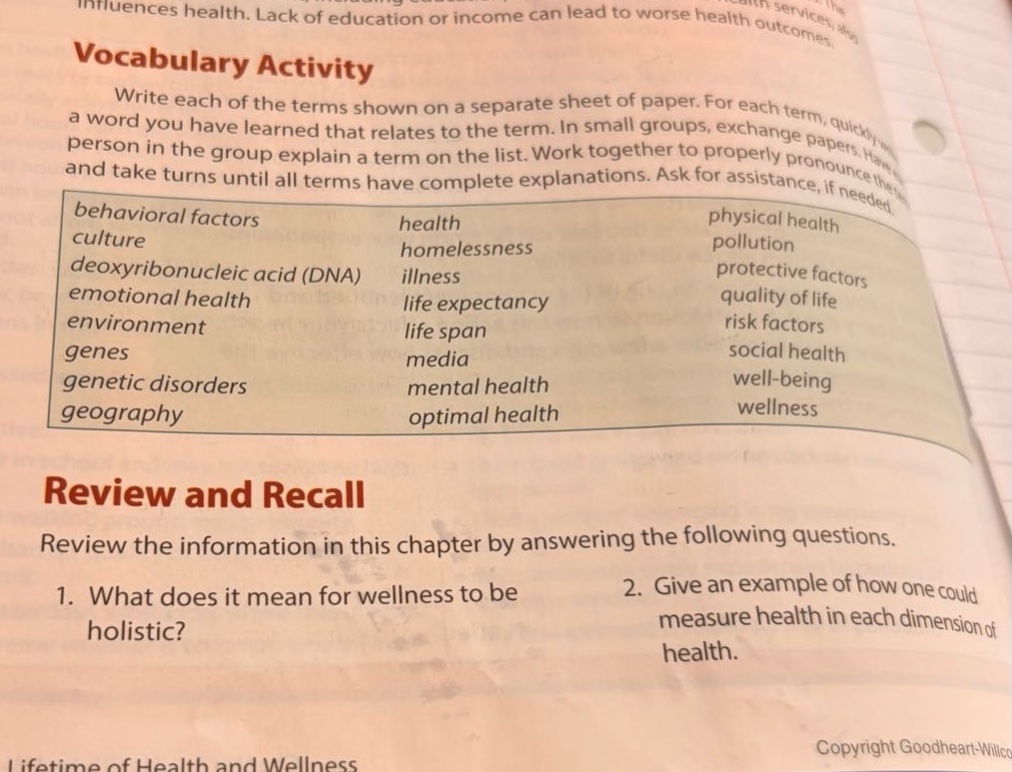
vocabulary activity
write each of the terms shown on a separate sheet of paper. for each term, quickly write a word you have learned that relates to the term. in small groups, exchange papers. have each person in the group explain a term on the list. work together to properly pronounce them and take turns until all terms have complete explanations. ask for assistance, if needed.
behavioral factors
health
physical health
culture
homelessness
pollution
deoxyribonucleic acid (dna)
illness
protective factors
emotional health
life expectancy
quality of life
environment
life span
risk factors
genes
media
social health
genetic disorders
mental health
well - being
geography
optimal health
wellness
review and recall
review the information in this chapter by answering the following questions.
- what does it mean for wellness to be holistic?
- give an example of how one could measure health in each dimension of health.
Question 1: What does it mean for wellness to be holistic?
Wellness being holistic means it considers all dimensions of health (physical, mental, emotional, social, etc.) rather than just one. It acknowledges that these dimensions are interconnected and that a person’s overall well - being depends on the balance and health of each of these aspects. For example, a person’s mental health (like stress levels) can impact their physical health (such as blood pressure), and their social health (like relationships) can impact their emotional health (like feelings of happiness or loneliness). So, holistic wellness looks at the whole person and all the factors that contribute to their health and well - being.
Physical health can be measured by things like body mass index (BMI), which is calculated as $\frac{weight(kg)}{height(m)^2}$. Another example is measuring blood pressure. A normal blood pressure is around 120/80 mmHg. Regular check - ups with a doctor to check for things like cholesterol levels (high cholesterol can be a sign of poor physical health) or the ability to perform physical activities (like how far a person can walk in a certain time or how many push - ups they can do) are also ways to measure physical health.
Mental health can be measured using standardized questionnaires like the Beck Depression Inventory (BDI) or the Generalized Anxiety Disorder - 7 (GAD - 7). These questionnaires ask about symptoms of depression or anxiety, such as feelings of sadness, worry, or changes in sleep patterns. A mental health professional can also conduct interviews to assess a person’s mood, thought patterns, and ability to cope with stress.

Snap & solve any problem in the app
Get step-by-step solutions on Sovi AI
Photo-based solutions with guided steps
Explore more problems and detailed explanations
Wellness being holistic means it considers all interconnected health dimensions (physical, mental, emotional, social, etc.) rather than just one, recognizing that a person’s overall well - being depends on the balance and health of each aspect.