QUESTION IMAGE
Question
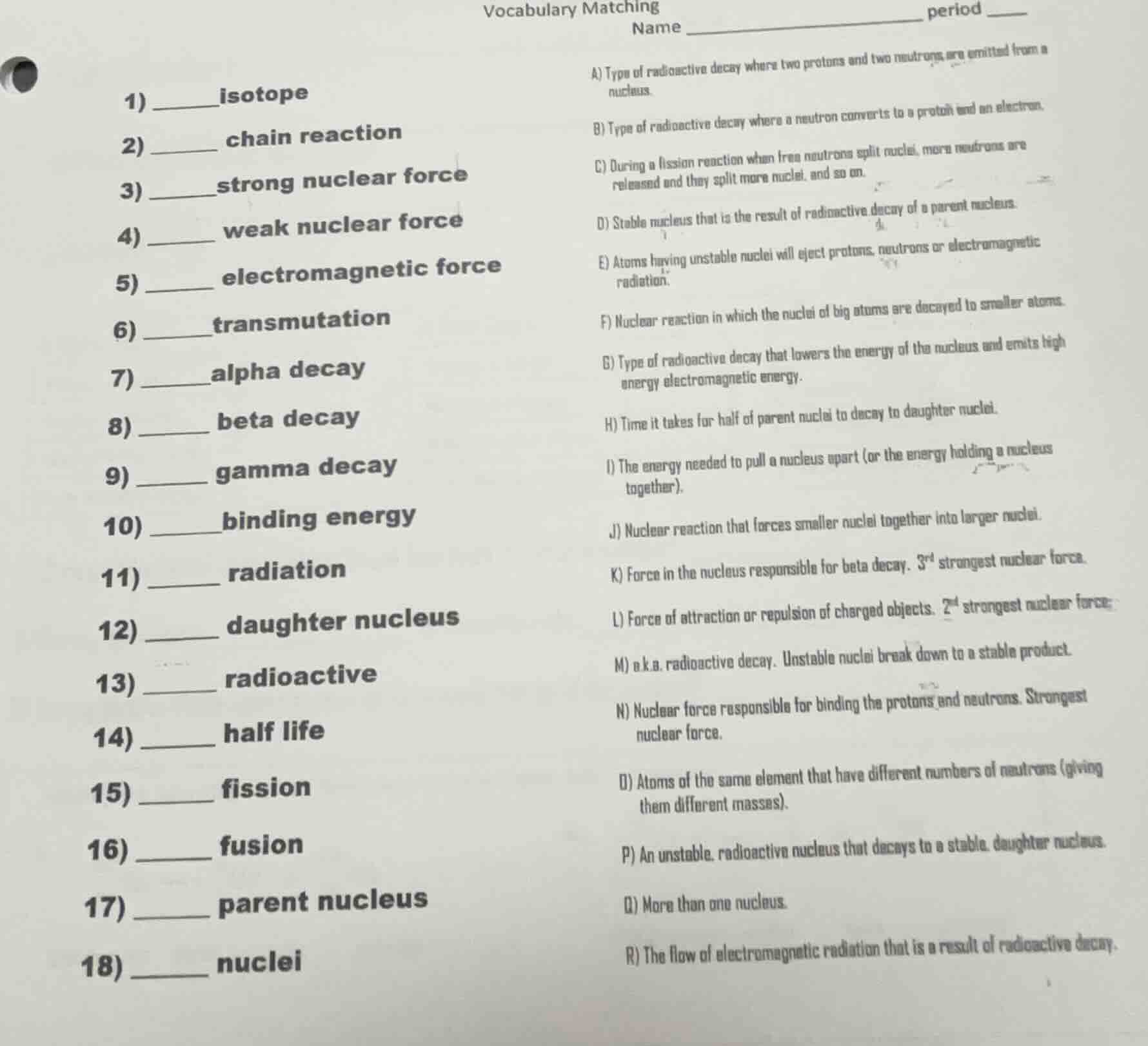
vocabulary matching
name _____________________ period __
- ______isotope
- ______ chain reaction
- ______strong nuclear force
- ______ weak nuclear force
- ______ electromagnetic force
- ______transmutation
- ______alpha decay
- ______ beta decay
- ______ gamma decay
- ______binding energy
- ______ radiation
- ______ daughter nucleus
- ______ radioactive
- ______ half life
- ______ fission
- ______ fusion
- ______ parent nucleus
- ______ nuclei
a) type of radioactive decay where two protons and two neutrons are emitted from a nucleus.
b) type of radioactive decay where a neutron converts to a proton and an electron.
c) during a fission reaction when free neutrons split nuclei, more neutrons are released and they split more nuclei, and so on.
d) stable nucleus that is the result of radioactive decay of a parent nucleus.
e) atoms having unstable nuclei will eject protons, neutrons or electromagnetic radiation.
f) nuclear reaction in which the nuclei of big atoms are decayed to smaller atoms.
g) type of radioactive decay that lowers the energy of the nucleus and emits high energy electromagnetic energy.
h) time it takes for half of parent nuclei to decay to daughter nuclei.
i) the energy needed to pull a nucleus apart (or the energy holding a nucleus together).
j) nuclear reaction that forces smaller nuclei together into larger nuclei.
k) force in the nucleus responsible for beta decay. 3^rd strongest nuclear force.
l) force of attraction or repulsion of charged objects. 2^nd strongest nuclear force.
m) a.k.a. radioactive decay. unstable nuclei break down to a stable product.
n) nuclear force responsible for binding the protons and neutrons. strongest nuclear force.
o) atoms of the same element that have different numbers of neutrons (giving them different masses).
p) an unstable, radioactive nucleus that decays to a stable, daughter nucleus.
q) more than one nucleus.
r) the flow of electromagnetic radiation that is a result of radioactive decay.
- Isotope: Atoms of the same element with different neutrons (D).
- Chain reaction: Fission neutrons split nuclei, more neutrons (C).
- Strong nuclear force: Binds protons/neutrons, strongest (N).
- Weak nuclear force: Causes beta decay, 3rd strongest (K).
- Electromagnetic force: Charged object force, 2nd strongest (L).
- Transmutation: Unstable nuclei decay to stable (M).
- Alpha decay: Emits two protons/neutrons (A).
- Beta decay: Neutron to proton/electron (B).
- Gamma decay: Emits high - energy EM radiation (G).
- Binding energy: Energy to pull nucleus apart (I).
- Radiation: Flow of EM from radioactive decay (R).
- Daughter nucleus: Stable from parent decay (D).
- Radioactive: Atoms with unstable nuclei eject particles (E).
- Half - life: Time for half parent to decay (H).
- Fission: Big nuclei decay to smaller (F).
- Fusion: Smaller nuclei to larger (J).
- Parent nucleus: Unstable, decays to daughter (P).
- Nuclei: More than one nucleus (Q).

Snap & solve any problem in the app
Get step-by-step solutions on Sovi AI
Photo-based solutions with guided steps
Explore more problems and detailed explanations
- D. Atoms of the same element that have different numbers of neutrons (giving them different masses).
- C. During a fission reaction when free neutrons split nuclei, more neutrons are released and they split more nuclei, and so on.
- N. Nuclear force responsible for binding the protons and neutrons. Strongest nuclear force.
- K. Force in the nucleus responsible for beta decay. \(3^{rd}\) strongest nuclear force.
- L. Force of attraction or repulsion of charged objects. \(2^{nd}\) strongest nuclear force.
- M. a.k.a. radioactive decay. Unstable nuclei break down to a stable product.
- A. Type of radioactive decay where two protons and two neutrons are emitted from a nucleus.
- B. Type of radioactive decay where a neutron converts to a proton and an electron.
- G. Type of radioactive decay that lowers the energy of the nucleus and emits high energy electromagnetic energy.
- I. The energy needed to pull a nucleus apart (or the energy holding a nucleus together).
- R. The flow of electromagnetic radiation that is a result of radioactive decay.
- D. Stable nucleus that is the result of radioactive decay of a parent nucleus.
- E. Atoms having unstable nuclei will eject protons, neutrons or electromagnetic radiation.
- H. Time it takes for half of parent nuclei to decay to daughter nuclei.
- F. Nuclear reaction in which the nuclei of big atoms are decayed to smaller atoms.
- J. Nuclear reaction that forces smaller nuclei together into larger nuclei.
- P. An unstable, radioactive nucleus that decays to a stable, daughter nucleus.
- Q. More than one nucleus.