QUESTION IMAGE
Question
vocabulary review
force - push or a pull that acts on an object
net force - the force that results from the combination of all forces that act on an object
speed - the rate at which an object moves. includes distance and time
velocity - the speed of an object in a particular direction
acceleration - the rate at which an object’s velocity changes
mass - the measure of the amount of matter in an object
weight - the force of gravity acting on an object
inertia - the tendency of a still or moving object to resist a change in its motion
motion - a change in a position or place
gravity - the force of attraction between objects that is due to their masses.
motion
- describe the motion of the object based on the graphs below
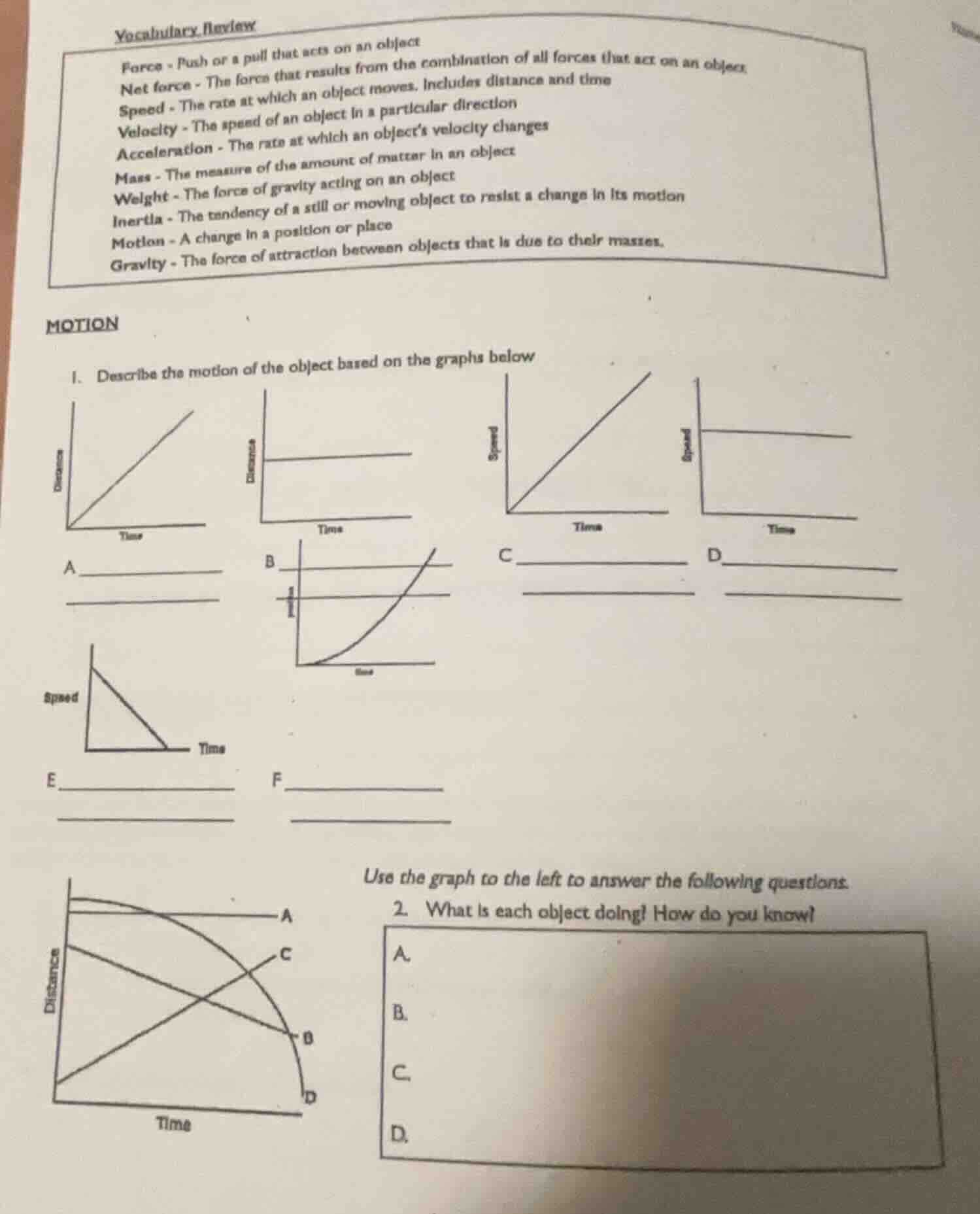
graphs a - f and another graph with objects a - d
- what is each object doing? how do you know?
a, b, c, d sections to answer
Step1: Analyze Graph A (Distance-Time)
Distance increases linearly with time. Speed is constant: $v=\frac{\Delta d}{\Delta t} = \text{constant}$.
Step2: Analyze Graph B (Distance-Time)
Distance is constant over time. Object is stationary: $\Delta d = 0$.
Step3: Analyze Graph C (Velocity-Time)
Velocity increases linearly with time. Object accelerates uniformly: $a=\frac{\Delta v}{\Delta t} = \text{constant}$.
Step4: Analyze Graph D (Velocity-Time)
Velocity is constant over time. Object moves at constant speed: $\Delta v = 0$.
Step5: Analyze Graph E (Speed-Time)
Speed decreases linearly to 0, then stays 0. Object decelerates to stop: $a=-\frac{\Delta v}{\Delta t}$, then $v=0$.
Step6: Analyze Graph F (Speed-Time, curved)
Speed increases with increasing rate. Object accelerates with increasing acceleration: $a=\frac{\Delta v}{\Delta t}$, $\Delta a > 0$.
Step7: Analyze Lower Distance-Time Graphs
Object A:
Distance is constant over time: $\Delta d = 0$.
Object B:
Distance decreases linearly with time: $v=-\frac{\Delta d}{\Delta t} = \text{constant negative speed}$.
Object C:
Distance increases linearly with time: $v=\frac{\Delta d}{\Delta t} = \text{constant positive speed}$.
Object D:
Distance decreases with increasing rate: Speed increases in the negative direction, acceleration is negative and increasing.

Snap & solve any problem in the app
Get step-by-step solutions on Sovi AI
Photo-based solutions with guided steps
Explore more problems and detailed explanations
1.
- A: Object moves at constant speed (uniform motion)
- B: Object is stationary (no motion)
- C: Object undergoes uniform acceleration (speeds up steadily)
- D: Object moves at constant velocity (uniform motion)
- E: Object decelerates uniformly until it stops, then remains stationary
- F: Object accelerates with increasing acceleration (speeds up faster over time)
2.
- A: Object is stationary. Its distance does not change as time passes.
- B: Object moves at a constant speed in the opposite direction. Its distance decreases linearly with time, so speed is constant and negative.
- C: Object moves at a constant speed forward. Its distance increases linearly with time, so speed is constant and positive.
- D: Object speeds up while moving in the opposite direction. The downward curve of distance over time means its negative speed increases in magnitude (acceleration is negative and increasing).