QUESTION IMAGE
Question
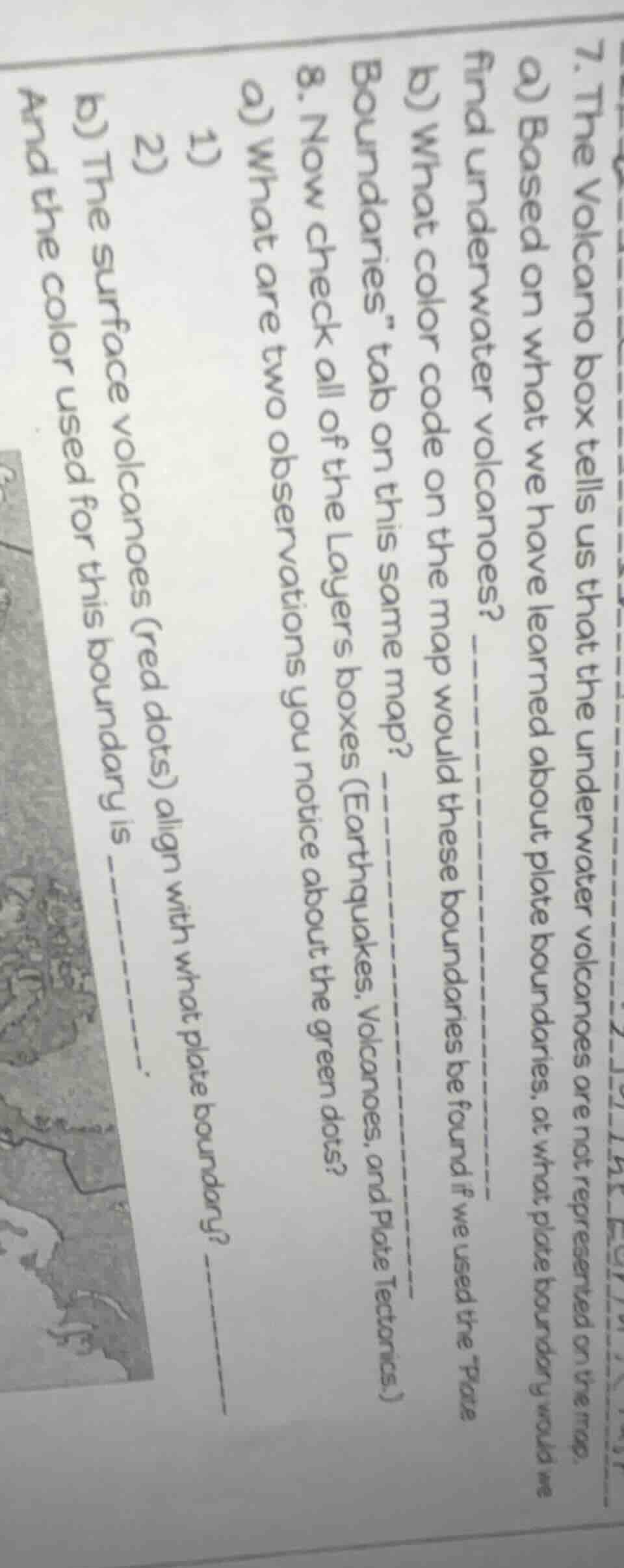
- the volcano box tells us that the underwater volcanoes are not represented on the map.
a) based on what we have learned about plate boundaries, at what plate boundary would we find underwater volcanoes?
b) what color code on the map would these boundaries be found if we used the “plate boundaries” tab on this same map?
- now check all of the layers boxes (earthquakes, volcanoes, and plate tectonics).
a) what are two observations you notice about the green dots?
1)
2)
b) the surface volcanoes (red dots) align with what plate boundary?
and the color used for this boundary is ______.
7a) Underwater volcanoes form at divergent plate boundaries (where tectonic plates move apart, allowing magma to rise) and convergent plate boundaries (where an oceanic plate subducts, melting to produce magma that erupts as volcanoes).
7b) On standard plate boundary maps, divergent boundaries are often represented by red, and convergent boundaries by blue; these match the locations of underwater volcanoes.
8a1) Green dots (representing earthquakes) are concentrated along all types of plate boundaries, as tectonic plate movement causes seismic activity.
8a2) Green dots also occur in some intraplate areas, though far less frequently, due to ancient fault lines or mantle plumes.
8b) Surface volcanoes (red dots) align with convergent plate boundaries (subduction zones) and divergent plate boundaries (mid-ocean ridges); the boundary color for these is typically red (divergent) or blue (convergent) on standard maps.

Snap & solve any problem in the app
Get step-by-step solutions on Sovi AI
Photo-based solutions with guided steps
Explore more problems and detailed explanations
- a) Divergent and convergent plate boundaries
b) Red (for divergent) and blue (for convergent)
- a) 1) Green dots (earthquakes) cluster along plate boundaries
- Rare green dots appear in intraplate regions
b) Convergent and divergent plate boundaries; red/blue