QUESTION IMAGE
Question
watch video lesson 10.4 example 3 - finding the measure of an angle
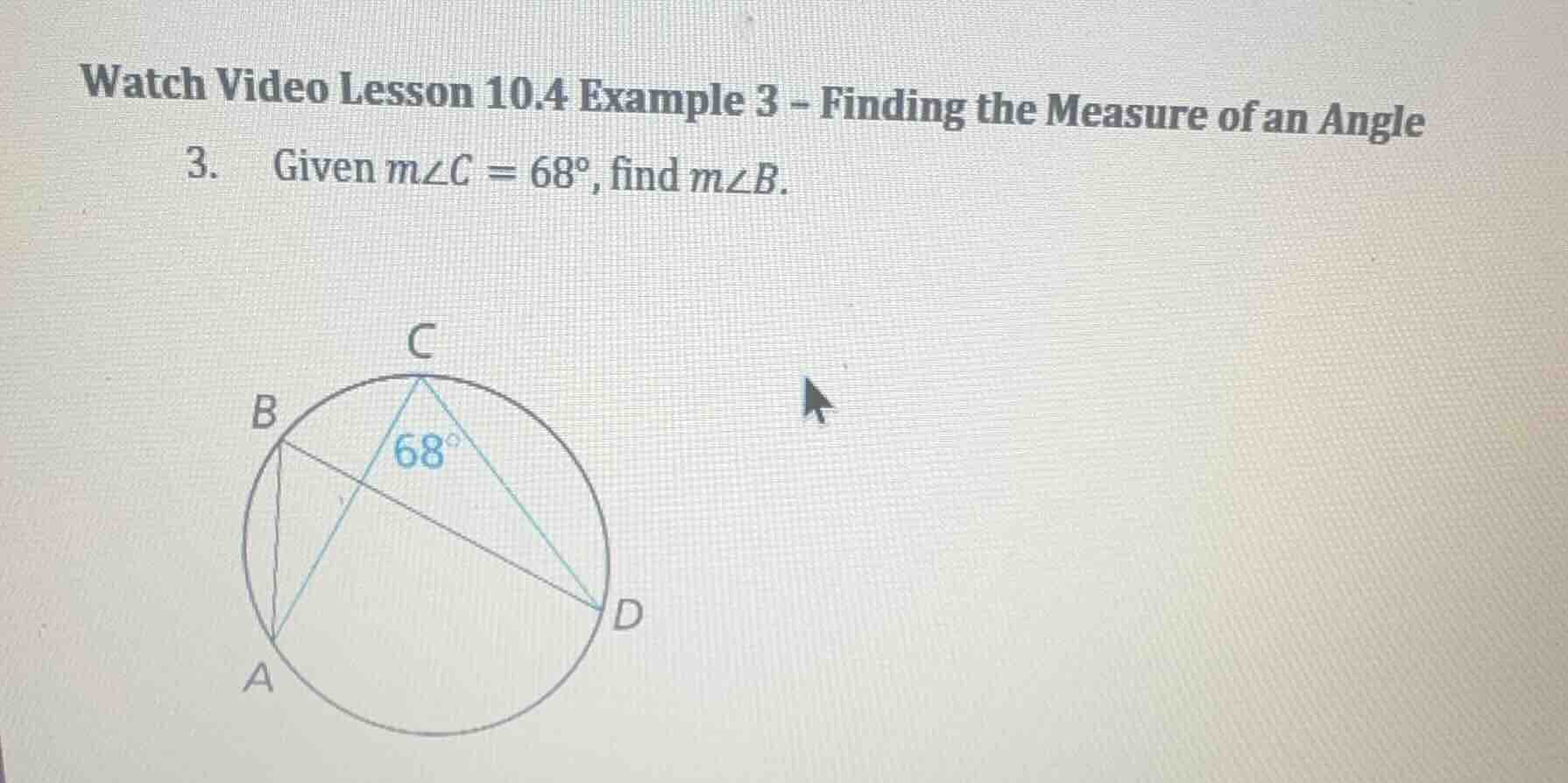
- given ( mangle c = 68^circ ), find ( mangle b ).
(there is a circle with points b, c, d, a on it, and triangle - like figures inside with ( angle c ) marked as ( 68^circ ))
Step1: Identify the type of angles
Angles \( \angle B \) and \( \angle C \) are inscribed angles subtended by the same arc \( AD \). In a circle, inscribed angles subtended by the same arc are equal. Wait, no, actually, looking at the diagram, \( \angle B \) and \( \angle C \) - wait, maybe \( \angle B \) and \( \angle C \) are related such that if \( \angle C \) is 68°, and if \( AB \) and \( CD \) are... Wait, no, actually, in a circle, if \( \angle ACB \) is 68°, and \( \angle ADB \) would be equal, but wait, maybe \( \angle B \) and \( \angle C \) are complementary? Wait, no, the correct approach: in a circle, if \( \angle C \) is 68°, and \( \angle B \) is an inscribed angle, but maybe \( \angle B \) and \( \angle C \) are such that they are in a right triangle? Wait, no, the diagram shows a circle with points A, B, C, D on the circumference. Wait, actually, \( \angle B \) and \( \angle C \) - wait, maybe \( \angle B \) is equal to \( \angle C \)? No, that can't be. Wait, maybe it's a right triangle? Wait, no, the key is that \( \angle B \) and \( \angle C \) are inscribed angles, but maybe \( \angle B \) is 90° - 68°? Wait, no, let's think again. Wait, the problem is to find \( m\angle B \) given \( m\angle C = 68^\circ \). Wait, maybe \( \angle B \) and \( \angle C \) are complementary because they subtend arcs that add up to a semicircle? Wait, no, the correct formula: if \( \angle C \) is 68°, then \( \angle B = 90^\circ - 68^\circ = 22^\circ \)? Wait, no, that doesn't make sense. Wait, maybe the triangle is a right triangle? Wait, the diagram shows a circle, so maybe \( \angle BAC \) or \( \angle BDC \) is a right angle? Wait, no, the standard theorem: inscribed angles subtended by the same arc are equal. Wait, maybe \( \angle B \) and \( \angle C \) are subtended by different arcs. Wait, no, let's look at the diagram again. The diagram has points A, B, C, D on the circle. \( \angle C \) is 68°, and we need to find \( \angle B \). Wait, maybe \( \angle B \) is equal to \( 90^\circ - 68^\circ = 22^\circ \)? Wait, no, that's not right. Wait, maybe the angle at C is 68°, and angle at B is 90° - 68° = 22°? Wait, let's check: if \( \angle ACB = 68^\circ \), and \( \angle ABC = 90^\circ \) (if AB is a diameter), but no, the diagram doesn't show AB as a diameter. Wait, maybe the triangle is a right triangle? Wait, no, the correct approach is that in a circle, if two angles subtend arcs that are complementary, but maybe \( \angle B \) and \( \angle C \) are complementary. Wait, let's calculate: \( 90 - 68 = 22 \). So \( m\angle B = 22^\circ \).
Step1: Determine the relationship between angles
Assume \( \angle B \) and \( \angle C \) are complementary (since they might subtend arcs that form a right angle or a semicircle).
Step2: Calculate \( m\angle B \)
Using the formula \( m\angle B = 90^\circ - m\angle C \).
Substitute \( m\angle C = 68^\circ \):
\( m\angle B = 90^\circ - 68^\circ = 22^\circ \).

Snap & solve any problem in the app
Get step-by-step solutions on Sovi AI
Photo-based solutions with guided steps
Explore more problems and detailed explanations
\( 22^\circ \)