QUESTION IMAGE
Question
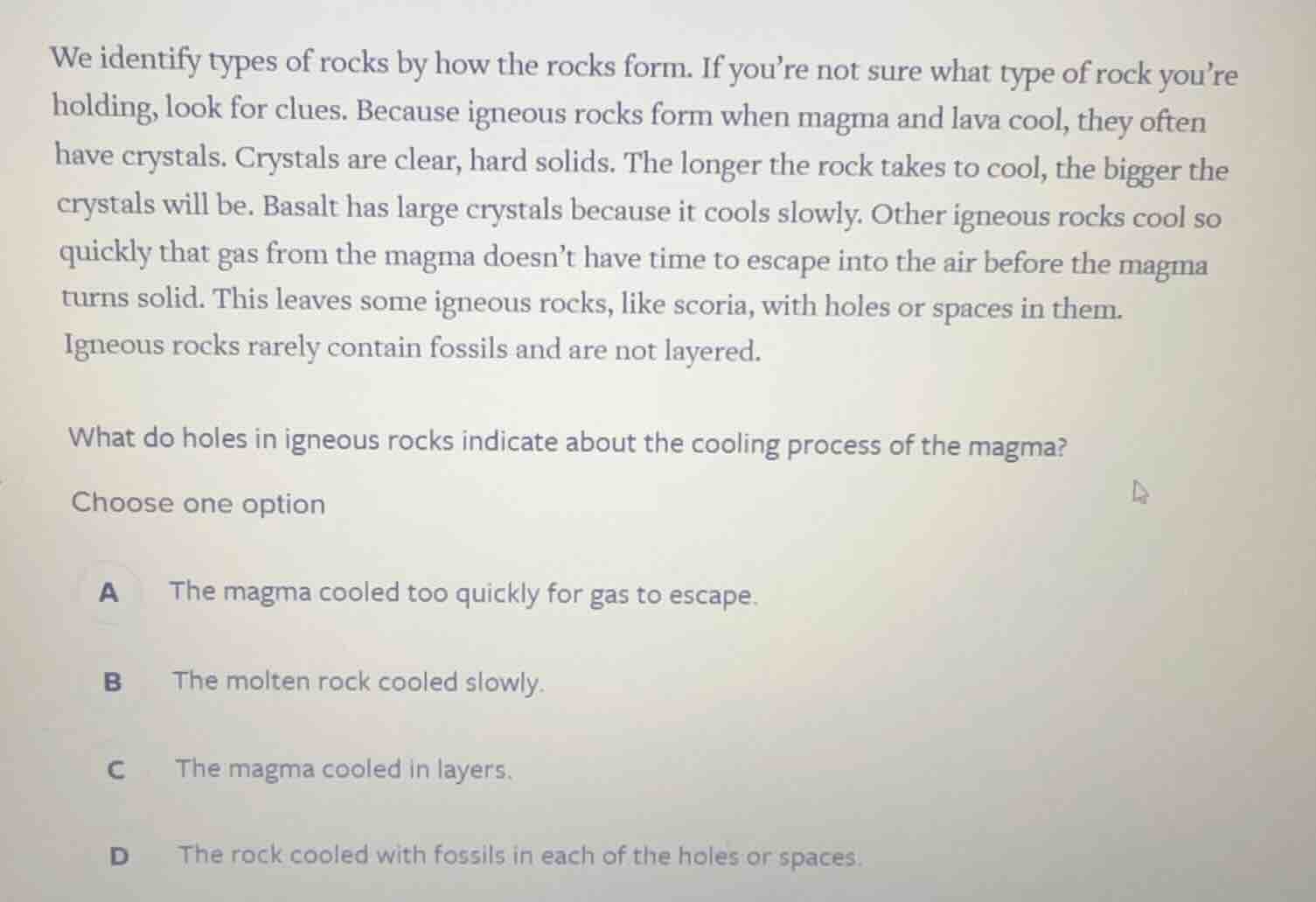
we identify types of rocks by how the rocks form. if youre not sure what type of rock youre holding, look for clues. because igneous rocks form when magma and lava cool, they often have crystals. crystals are clear, hard solids. the longer the rock takes to cool, the bigger the crystals will be. basalt has large crystals because it cools slowly. other igneous rocks cool so quickly that gas from the magma doesnt have time to escape into the air before the magma turns solid. this leaves some igneous rocks, like scoria, with holes or spaces in them. igneous rocks rarely contain fossils and are not layered. what do holes in igneous rocks indicate about the cooling process of the magma? choose one option a the magma cooled too quickly for gas to escape. b the molten rock cooled slowly. c the magma cooled in layers. d the rock cooled with fossils in each of the holes or spaces.
To solve this, we analyze each option:
- Option A: The text says "Other igneous rocks cool so quickly that gas from the magma doesn’t have time to escape into the air before the magma turns solid. This leaves some igneous rocks, like scoria, with holes or spaces in them." So this matches.
- Option B: The text states that slow cooling leads to large crystals (e.g., basalt), not holes. So B is incorrect.
- Option C: The text says igneous rocks are not layered. So C is incorrect.
- Option D: The text says igneous rocks rarely contain fossils. So D is incorrect.

Snap & solve any problem in the app
Get step-by-step solutions on Sovi AI
Photo-based solutions with guided steps
Explore more problems and detailed explanations
A. The magma cooled too quickly for gas to escape.