QUESTION IMAGE
Question
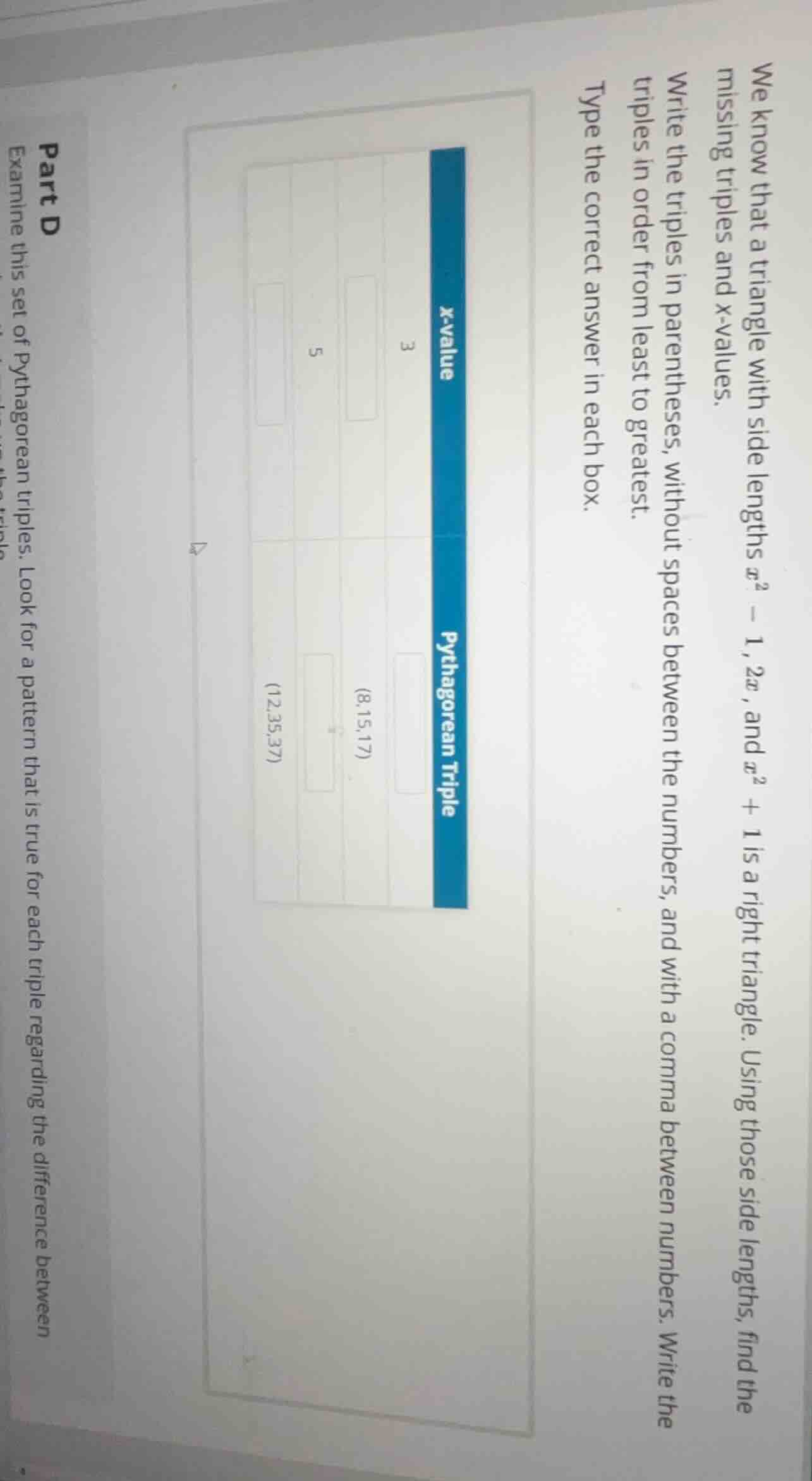
we know that a triangle with side lengths $x^2 - 1$, $2x$, and $x^2 + 1$ is a right triangle. using those side lengths, find the missing triples and x - values.
write the triples in parentheses, without spaces between the numbers, and with a comma between numbers. write the triples in order from least to greatest.
type the correct answer in each box.
(there is a chart with columns x - value and pythagorean triple, and rows with x - values 3, 5 and pythagorean triples (8,15,17), (12,35,37) and some empty boxes to fill. also, on the left, there is part d and examine this set of pythagorean triples. look for a pattern that is true for each triple regarding the difference between... )
Step1: For x = 3
First, we calculate the side lengths using the formulas \(x^{2}-1\), \(2x\), and \(x^{2}+1\).
For \(x = 3\):
- \(x^{2}-1=3^{2}-1 = 9 - 1=8\)
- \(2x = 2\times3 = 6\)
- \(x^{2}+1=3^{2}+1 = 9 + 1 = 10\)
Now, we order these from least to greatest: \(6,8,10\), so the triple is \((6,8,10)\).
Step2: For x = 5
For \(x = 5\):
- \(x^{2}-1=5^{2}-1 = 25 - 1 = 24\)
- \(2x = 2\times5 = 10\)
- \(x^{2}+1=5^{2}+1 = 25 + 1 = 26\)
Ordering these from least to greatest: \(10,24,26\), so the triple is \((10,24,26)\).
Step3: For the triple (8,15,17)
We need to find \(x\) such that the side lengths are \(x^{2}-1\), \(2x\), and \(x^{2}+1\). Let's assume \(2x = 8\) (we can check other possibilities too, but let's start with this). If \(2x = 8\), then \(x = 4\). Let's verify:
- \(x^{2}-1=4^{2}-1 = 16 - 1 = 15\)
- \(x^{2}+1=4^{2}+1 = 16 + 1 = 17\)
Which matches the triple \((8,15,17)\), so \(x = 4\).
Step4: For the triple (12,35,37)
Let's find \(x\) such that the side lengths are \(x^{2}-1\), \(2x\), and \(x^{2}+1\). Assume \(2x = 12\), then \(x = 6\). Verify:
- \(x^{2}-1=6^{2}-1 = 36 - 1 = 35\)
- \(x^{2}+1=6^{2}+1 = 36 + 1 = 37\)
Which matches the triple \((12,35,37)\), so \(x = 6\).

Snap & solve any problem in the app
Get step-by-step solutions on Sovi AI
Photo-based solutions with guided steps
Explore more problems and detailed explanations
For \(x = 3\): \((6,8,10)\)
For \(x = 5\): \((10,24,26)\)
For triple \((8,15,17)\): \(x = 4\)
For triple \((12,35,37)\): \(x = 6\)