QUESTION IMAGE
Question
week 20
period: 4th
the end of class today, thursday, january 22, 2026.
work should be done in your in the space provided. remember to include units in your answer.
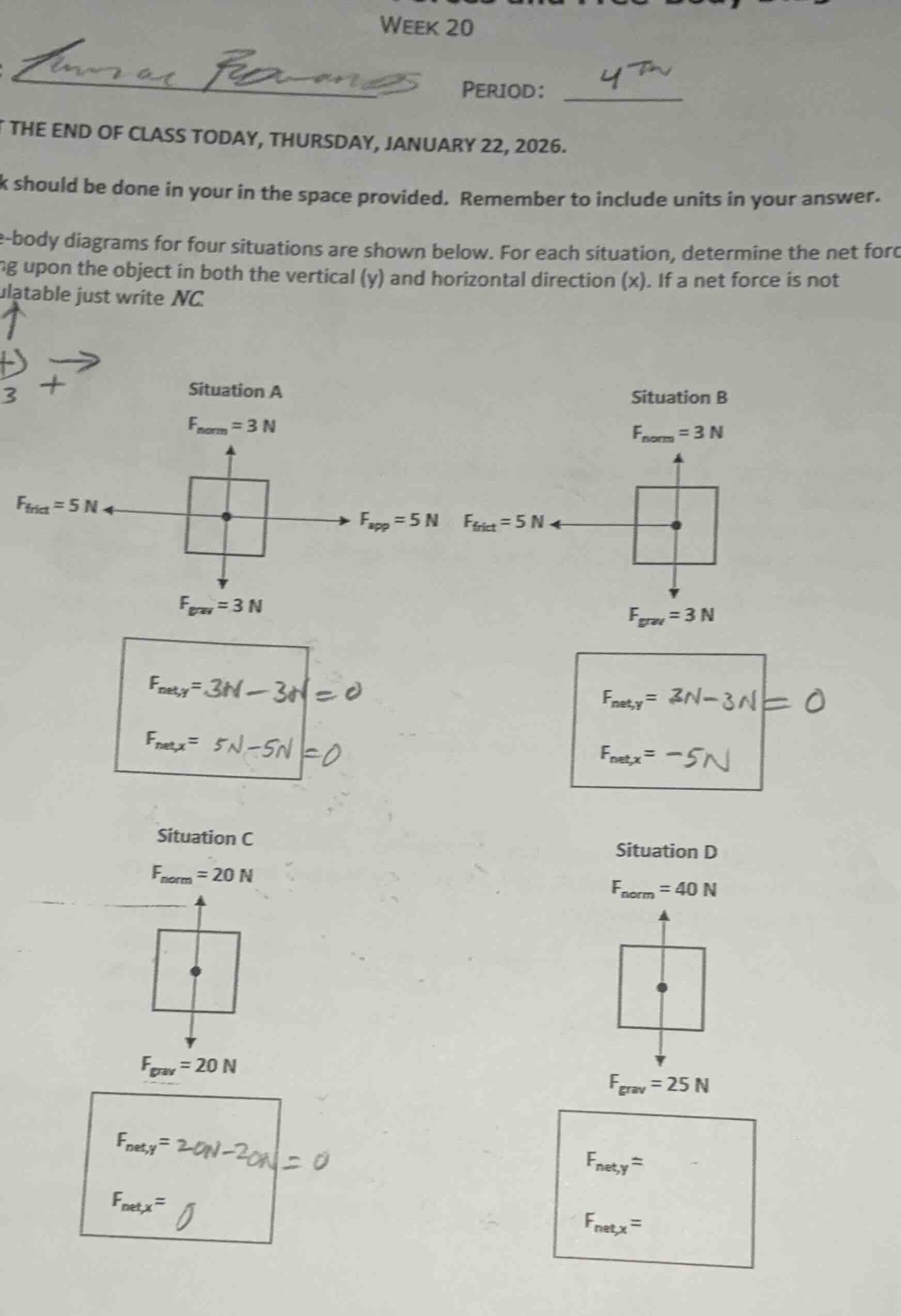
-body diagrams for four situations are shown below. for each situation, determine the net force acting upon the object in both the vertical (y) and horizontal direction (x). if a net force is not calculatable just write nc
situation a
$f_{norm}=3 n$ (upward), $f_{frict}=5 n$ (leftward), $f_{app}=5 n$ (rightward), $f_{grav}=3 n$ (downward)
situation b
$f_{norm}=3 n$ (upward), $f_{frict}=5 n$ (leftward), $f_{grav}=3 n$ (downward)
situation c
$f_{norm}=20 n$ (upward), $f_{grav}=20 n$ (downward)
situation d
$f_{norm}=40 n$ (upward), $f_{grav}=25 n$ (downward)
Situation A
Step1: Vertical Net Force
The vertical forces are \( F_{\text{norm}} = 3\,\text{N} \) (upward) and \( F_{\text{grav}} = 3\,\text{N} \) (downward). Net force in y - direction: \( F_{\text{net},y}=F_{\text{norm}} - F_{\text{grav}}=3 - 3 = 0\,\text{N} \)
Step2: Horizontal Net Force
The horizontal forces are \( F_{\text{frict}} = 5\,\text{N} \) (leftward) and \( F_{\text{app}} = 5\,\text{N} \) (rightward). Net force in x - direction: \( F_{\text{net},x}=F_{\text{app}}-F_{\text{frict}} = 5 - 5=0\,\text{N} \)
Situation B
Step1: Vertical Net Force
Vertical forces: \( F_{\text{norm}} = 3\,\text{N} \) (upward), \( F_{\text{grav}} = 3\,\text{N} \) (downward). \( F_{\text{net},y}=3 - 3 = 0\,\text{N} \)
Step2: Horizontal Net Force
Horizontal force: only \( F_{\text{frict}} = 5\,\text{N} \) (leftward). So \( F_{\text{net},x}=- 5\,\text{N} \) (negative for left direction)
Situation C
Step1: Vertical Net Force
Vertical forces: \( F_{\text{norm}} = 20\,\text{N} \) (upward), \( F_{\text{grav}} = 20\,\text{N} \) (downward). \( F_{\text{net},y}=20 - 20 = 0\,\text{N} \)
Step2: Horizontal Net Force
No horizontal forces. So \( F_{\text{net},x}=0\,\text{N} \)
Situation D

Snap & solve any problem in the app
Get step-by-step solutions on Sovi AI
Photo-based solutions with guided steps
Explore more problems and detailed explanations
- Situation A: \( F_{\text{net},y}=\boldsymbol{0\,\text{N}} \), \( F_{\text{net},x}=\boldsymbol{0\,\text{N}} \)
- Situation B: \( F_{\text{net},y}=\boldsymbol{0\,\text{N}} \), \( F_{\text{net},x}=\boldsymbol{- 5\,\text{N}} \)
- Situation C: \( F_{\text{net},y}=\boldsymbol{0\,\text{N}} \), \( F_{\text{net},x}=\boldsymbol{0\,\text{N}} \)
- Situation D: \( F_{\text{net},y}=\boldsymbol{15\,\text{N}} \), \( F_{\text{net},x}=\boldsymbol{0\,\text{N}} \)